February 4, 2026





Table of Contents
In the high-stakes arena of global trade, the years 2025 and 2026 have redefined the boundaries of industrial resilience. For the Indian packaging sector – specifically the high-performance barrier film industry – these years were a crucible of challenge and transformation. As the United States implemented aggressive reciprocal tariffs in late 2025, Indian packaging film manufacturers faced a steep uphill battle. Yet amid this volatility, Vishakha Polyfab, an Ahmedabad-based global leader in flexible packaging, emerged not just as a survivor but as a dominant force in the international market.
By leveraging cutting-edge 9-layer co-extrusion technology, strategic market diversification, and the landmark January 2026 EU-India Free Trade Agreement (FTA), Vishakha Polyfab has turned a period of global protectionism into an era of unprecedented expansion. This is the story of how an Indian pioneer navigated the “Tariff Wall” to become the preferred partner for high-barrier packaging solutions across Europe, the Middle East, and beyond.
In August 2025, the trade landscape for Indian exporters shifted dramatically. Citing trade imbalances and geopolitical considerations, the United States imposed a staggering 50% reciprocal tariff on a wide array of Indian-origin goods. The plastic products and packaging film sectors were hit particularly hard. For many Indian firms, the sudden surge in landed costs threatened to make their exports economically unviable overnight.
The 50% duty applied to virtually every category of flexible packaging:
However, for Vishakha Polyfab, the impact was mitigated by a “Technological Moat.” While commodity-grade film manufacturers struggled, the demand for Vishakha’s high-performance 7 and 9-layer co-extruded films remained resilient. U.S. buyers in the medical and specialized food sectors found that the cost of a packaging failure (due to inferior barrier properties from alternative suppliers) was far higher than the 50% tariff premium.
Vishakha Polyfab, headquartered in Ahmedabad, has always been a “Technology-First” company. As the first in India to introduce 9-layer blown film technology, the company’s infrastructure is built on world-class engineering from Brampton Engineering (Canada) and Germany. This focus on high-end co-extrusion proved to be the ultimate defense against the 2025 tariff hike.
Even at a 50% tariff, Vishakha’s products like VISHBARR (barrier films) and VISHVACU (vacuum packaging) maintained a presence in the American market for three core reasons:
The 2025 crisis served as a catalyst for what Vishakha Polyfab does best: strategic expansion. Recognizing the volatility of the North American market, the company aggressively pivoted its focus toward the European Union, the UK, and the Middle East.
Europe has long been a market defined by strict sustainability and hygiene standards. Vishakha’s VISHBARR NG (Next Generation) 9-layer films, which are designed to substitute conventional non-recyclable laminates, found a perfect fit in the European “Green Deal” economy.
The signing of the EU-India Free Trade Agreement in January 2026 was the definitive victory for Vishakha Polyfab. The agreement eliminated or drastically reduced tariffs on 99% of Indian exports, including high-barrier flexible packaging.
Our Other Product
Vishakha Polyfab’s portfolio is a testament to the versatility required in modern manufacturing. Each product category is engineered to solve a specific industrial challenge.
Utilizing PA (Polyamide) and EVOH (Ethylene Vinyl Alcohol), VISHBARR films are the gold standard for oxygen and moisture protection.
For the seafood and frozen food industries, puncture resistance is paramount.
As retail habits shift toward “Ready-to-Eat” and “Grab-and-Go” meals, thermoforming technology has become critical.
Transporting liquids – be it edible oils or industrial chemicals – requires a film that can survive the rigors of transit without failure.
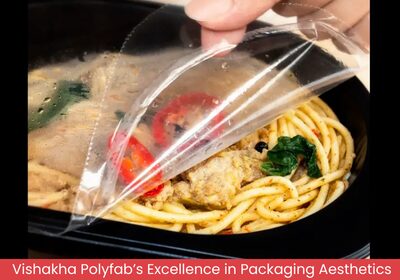
In the competitive retail markets of the USA, Canada, and Europe, the package is the brand’s primary spokesperson. Vishakha Polyfab has invested in top-tier European printing technology to ensure their clients never have to compromise.
The 2026 global economy is a “Circular Economy.” Vishakha Polyfab’s REGAIN initiative is at the heart of their sustainability strategy.
| Market Region | Major Challenge (2025) | Strategy & Outcome (2026) |
|---|---|---|
| USA & Canada | 50% Tariff Hike | Pivot to high-margin medical & specialized food films; sticky demand due to quality. |
| European Union | High regulatory standards | Zero-Duty access via Jan 2026 FTA; Dominance in sustainable & high-barrier sectors. |
| Middle East & Africa | Logistics & Heat resistance | Expansion of liquid packaging & high-barrier VFFS films; aroma retention for spices. |
| SE Asia (ASEAN) | Competition from China | Leveraging 9-layer tech for superior shelf-life; high-quality printing for retail growth. |
The journey of Vishakha Polyfab from a pioneer in Ahmedabad to a resilient global titan is a masterclass in industrial evolution. While the 2025 USA tariff hike was intended to restrict trade, it served only to prove that quality and technology are borderless.
By diversifying into new international markets and staying ahead of the “AI Edge” in manufacturing, Vishakha Polyfab has ensured that the “silent guardian” of the world’s products remains as strong as ever. Whether it is a vacuum pouch in a London supermarket, a medical liner in a New York hospital, or a high-barrier film in a Dubai spice shop – Vishakha Polyfab is the name behind the seal.
As we move forward into 2026, the message is clear: For brands seeking reliability, sustainability, and technical excellence, the road leads to Ahmedabad. Vishakha Polyfab isn’t just surviving the global trade shifts; it is defining them.

Vishakha Polyfab Pvt. Ltd. is a global pioneer in high-barrier flexible packaging, specializing in advanced 9-layer co-extruded PA/EVOH-based films. Headquartered in Ahmedabad, India, the company utilizes world-class Brampton Engineering (Canada) and Aqua Frost® water-quenched technology to deliver superior shelf-life extension solutions. From Modified Atmosphere Packaging (MAP) to deep-draw thermoforming applications, Vishakha Polyfab delivers compliant, high-performance materials that protect product integrity throughout complex international supply chains. Their expertise in vacuum packaging, thermoforming, and lidding films helps enterprise-level brands in the food, pharmaceutical, and industrial sectors optimize packaging performance and sustainability.


 Call Now!
 Email Us