March 22, 2026





Table of Contents
How Vishakha Polyfab’s breakthrough nylon-EVOH co-extruded film is giving U.S. brand owners, converters, and retailers a genuine path to flexible packaging circularity – without giving up shelf life, barrier performance, or commercial viability.
Every year, millions of tons of flexible packaging – pouches, wrappers, flow packs, and barrier films – end up in American landfills. They cannot be recycled. They were never designed to be. And for decades, the food and consumer goods industry accepted this as an unavoidable trade-off: you either protect the product or you protect the planet. You could not do both.
That assumption is now being challenged – and dismantled – by a material innovation from Vishakha Polyfab, one of India’s most respected flexible packaging manufacturers. It is called REGAIN, and it may represent the most meaningful shift in barrier film technology in a generation.
REGAIN is a recyclable nylon-EVOH barrier film – the first of its kind developed in India – that delivers the same high-performance oxygen and moisture barrier properties that food brands and manufacturers rely on, while being fully recyclable within the polyethylene recycling stream. For the U.S. market, where sustainability mandates are tightening, ESG expectations are rising, and consumers are demanding real – not just promised – progress on plastic waste, REGAIN arrives at exactly the right moment.
The United States generates more plastic waste per capita than any other nation on Earth. According to the EPA, Americans produce over 80 million tons of municipal solid waste annually, with flexible plastic packaging making up one of the fastest-growing and hardest-to-recycle categories.
The core problem with conventional barrier films – the multilayer packaging used in snack food bags, frozen food pouches, condiment sachets, and hundreds of other everyday products – is that they are made from fundamentally incompatible materials laminated together. Nylon, EVOH, polyethylene, polyester, and aluminum foil are bonded to achieve the barrier properties the food industry needs, but this bonding makes the resulting structure impossible to separate and recycle. The layers fight each other in a recycling stream, producing contaminated, low-value output that no recycler wants.
The result: billions of flexible pouches and wrappers go directly from the grocery store checkout to the landfill – or worse, into waterways and oceans. The environmental and reputational cost is enormous, and it is accelerating.
The U.S. Packaging Challenge at a Glance:
To understand why REGAIN matters, it helps to understand why conventional barrier films cannot be recycled. Traditional flexible barrier packaging is a laminate – multiple layers of different polymer materials bonded together. Each layer serves a purpose: one provides strength, one provides oxygen barrier, one provides moisture protection, one provides heat-seal ability. The problem is that these polymers – nylon, polyester, EVOH, aluminum – are chemically and physically incompatible with each other in a recycling process.
When these laminates enter a recycling stream, the layers cannot be separated economically. The result is a contaminated melt that has poor mechanical properties and limited market value. Most recycling facilities simply reject them. They are, by design, a single-use dead end.
Vishakha Polyfab’s REGAIN technology takes a fundamentally different approach. Rather than laminating incompatible materials together, REGAIN uses a co-extrusion process – a method where multiple polymer layers are extruded simultaneously as a single, integrated structure. The key innovation is in how the nylon and EVOH layers are incorporated: they are designed to be compatible within a polyethylene matrix, meaning the entire film can be processed in a standard polyethylene recycling stream without separation.
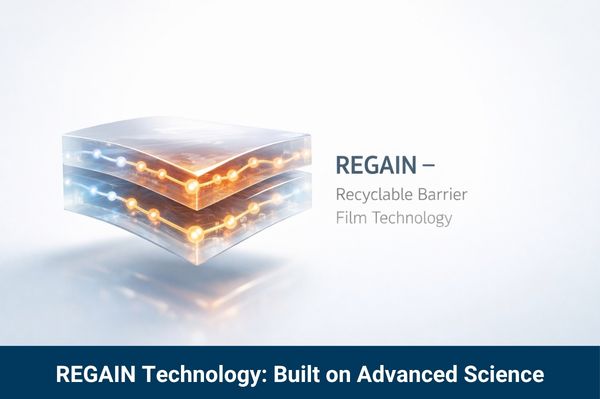
Standard barrier films: Multiple incompatible materials laminated together. Cannot be separated for recycling. End up in landfill.
REGAIN barrier films: Nylon and EVOH layers co-extruded within a polyethylene-compatible matrix. The whole film is recyclable as a single material in the PE stream.
The result: You get the same shelf-life-extending barrier performance – the same protection against oxygen, moisture, gas, and aroma – with a packaging material that can actually be collected, processed, and given a new life after use.
This is not a compromise on performance. REGAIN films provide excellent oxygen transmission rates – the critical measure of a barrier film’s ability to protect food freshness and extend shelf life. They are suitable for liquid, solid, and semi-liquid pack formats, including the exact pouch styles and flow-wrap applications that today’s U.S. food manufacturers rely on most heavily.
REGAIN is not a niche solution for a single industry segment. Its recyclable barrier technology creates value across the entire flexible packaging value chain – from the raw material processor all the way to the end consumer. Here is how each stakeholder benefits:
American food brands are under more pressure than ever to demonstrate genuine sustainability progress. Consumer trust is at stake, retail partnership requirements are evolving, and regulatory frameworks – from California’s SB 54 to proposed federal EPR legislation – are raising the baseline expectations for packaging recyclability.
REGAIN gives brand owners a straightforward, credible path to use packaging that is genuinely, verifiably recyclable – not recyclable-in-theory-but-not-in-practice. Because REGAIN films are compatible with the existing polyethylene recycling infrastructure (including the store drop-off programs operated by major grocery chains), brands can make packaging recyclability claims that hold up to scrutiny.
For companies with public sustainability commitments – net-zero goals, circular economy pledges, plastic waste reduction targets – REGAIN provides a tangible, measurable way to make progress on flexible packaging, which is often the hardest category to address.
Converters – the companies that turn raw film into finished packaging formats – stand to benefit from REGAIN in ways that go beyond the sustainability story. Because REGAIN uses a co-extrusion process rather than a multi-layer lamination, it can simplify production workflows and reduce the number of material suppliers a converter needs to manage.
Additionally, the recyclability of REGAIN films means that scrap generated during converting operations – trim waste, start-up material, off-spec film – has actual value in the recycling stream rather than being a pure disposal cost. In a converting operation processing significant volumes of film, this shift from scrap disposal cost to scrap recovery value can represent a meaningful improvement to operational economics.
Retailers are increasingly accountable for the end-of-life profile of the products they sell. Grocery store drop-off programs for flexible plastic films – operated by major chains across the U.S. – are growing in scope and consumer awareness. REGAIN-packaged products are compatible with these existing drop-off programs, meaning retailers can promote them as part of their store-level sustainability initiatives without investing in new collection infrastructure.
The compatibility with existing programs is a critical practical advantage. REGAIN does not require a new recycling infrastructure to be built – it plugs into what is already available and makes that infrastructure more effective by increasing the volume of high-quality, clean recyclable film moving through it.
American consumers increasingly want to make responsible choices – but they are frustrated by packaging claims that do not translate into real-world recyclability. A pouch that says ‘please recycle’ but has no compatible drop-off point nearby is not actually recyclable in any meaningful sense. REGAIN changes that equation. Because it is compatible with the grocery store drop-off programs that already exist in thousands of locations across the country, consumers have a clear, convenient, and genuinely effective pathway to recycle their flexible packaging.
Our Other Product
The table below compares REGAIN recyclable barrier films against conventional standard barrier films across the dimensions that matter most to U.S. packaging buyers, brand owners, and sustainability managers:
| Feature | REGAIN Recyclable Films | Standard Barrier Films |
|---|---|---|
| End-of-Life | Fully recyclable (polyethylene matrix) | Goes to landfill or incineration |
| Recyclability | Post-consumer recycling ready | Near-zero recycling yield |
| Material | Nylon-EVOH co-extruded recyclable | Multi-material – incompatible polymers |
| Brand Value | Supports ESG & circular economy goals | Growing regulatory & consumer risk |
| Scrap Resale | Scrap has recoverable value | Scrap has no reuse value |
| Drop-off Programs | Compatible with grocery store programs | Excluded from most programs |
| Oxygen Barrier | Excellent – extends shelf life | Good – but not recyclable |
| Manufacturer ROI | Reduces waste handling cost | Increasing compliance cost |
The concept of a circular economy – where materials are kept in use for as long as possible, and waste is designed out of the system rather than managed after the fact – has moved from an aspirational framework to an operational priority for American businesses. And flexible packaging is one of the most visible and most challenging frontiers of this transition.
REGAIN directly addresses the circularity gap in flexible packaging. By enabling post-consumer flexible film to re-enter the material cycle as a usable raw material – rather than exiting the economy as landfill waste – REGAIN creates a feedback loop that benefits every participant in the supply chain.
The scrap and post-consumer film collected from REGAIN packaging can be resold to scrap dealers and recycled into a range of secondary applications. The economics of this recovery are meaningful: rather than paying for disposal of an end-of-life material, producers and converters can recover value from it. At scale, this shift from cost center to value recovery is a significant change in the economic logic of flexible packaging.
Read Our Article
Raw material production → Co-extrusion of REGAIN Nylon-EVOH film
Converting → Pouches, flow wrappers, barrier packs produced (scrap recovered and sold)
Brand filling & retail → Product sold in REGAIN packaging compatible with drop-off programs
Consumer use → Empty pouch dropped at grocery store collection point
Recycling → Film processed in PE recycling stream; material recovered
Secondary manufacturing → Recycled material used in new applications
Result: Plastic stays in the economy. Landfill burden reduced. All stakeholders benefit.
This circularity is not a theoretical future state – it is achievable with existing recycling infrastructure in the United States today. REGAIN is designed to work with the systems that are already in place, not to wait for new ones.
The regulatory environment around plastic packaging in the United States is changing faster than at any point in the past two decades. Several converging policy developments make the timing of REGAIN’s entry into the market particularly relevant for U.S. companies evaluating their packaging sourcing decisions.
California’s SB 54, signed into law in 2022, requires that all single-use plastic packaging sold in California be recyclable or compostable by 2032, with intermediate targets along the way. Given California’s market size and the practical difficulty of maintaining separate packaging lines for one state, SB 54 effectively sets a national compliance bar for many consumer goods companies.
At the federal level, the Break Free From Plastic Pollution Act and related proposed legislation would create extended producer responsibility frameworks that make brand owners financially accountable for the end-of-life costs of their packaging – a powerful economic incentive to shift toward genuinely recyclable materials now, before mandates take effect.
The FTC’s Green Guides, which govern the use of environmental marketing claims including ‘recyclable,’ are under review and expected to be tightened. Companies making recyclability claims on packaging that is not practically recyclable – meaning it lacks accessible collection and processing infrastructure – face growing legal and reputational exposure.
REGAIN provides a defensible, infrastructure-compatible path to recyclability that aligns with where these regulatory frameworks are heading. It is not just the right environmental choice – for U.S. companies planning their packaging strategy for the next five to ten years, it is increasingly the strategically prudent commercial choice as well.
Our Other Product
Vishakha Polyfab is one of India’s leading manufacturers of flexible packaging films, with decades of experience in producing high-performance co-extruded and laminated barrier films for food, pharmaceutical, and consumer goods applications. The company serves major brand owners and converters across domestic and international markets, with a reputation for technical innovation and manufacturing reliability.
The development of REGAIN represents Vishakha Polyfab’s most significant product innovation – a direct response to the global challenge of plastic waste and the industry’s need for sustainable packaging solutions that do not compromise on performance. As the holder of BRC (British Retail Consortium) packaging certification, Vishakha Polyfab operates to international food safety and quality standards that meet the requirements of U.S. retail and brand owner supply chains.
For U.S. companies evaluating REGAIN as a sourcing option, Vishakha Polyfab offers co-extrusion and lamination capabilities across a range of film structures, with the ability to customize barrier properties, seal characteristics, print surface quality, and dimensional specifications to meet specific application requirements.
For too long, the flexible packaging industry has operated under a false choice: high-performance barrier protection OR environmental responsibility. Brand owners, converters, and retailers have had to choose which compromise to make, because the materials available forced a compromise.
REGAIN ends that trade-off. It delivers the nylon-EVOH barrier performance that keeps food safe, extends shelf life, and protects product integrity – in a film that is genuinely recyclable, genuinely circular, and genuinely aligned with where U.S. regulatory requirements, retailer expectations, and consumer values are heading.
For American companies looking to make meaningful progress on flexible packaging sustainability – not greenwashing progress, but real, measurable, infrastructure-compatible progress – Vishakha Polyfab’s REGAIN is worth serious evaluation. The material is proven, the recycling pathway exists, and the business case is compelling on both the cost side and the value side.
The circular economy for flexible packaging is not a distant ambition. With REGAIN, it is available today.
REGAIN is a co-extruded nylon-EVOH barrier film that is fully recyclable in the polyethylene stream.
It delivers equivalent barrier performance to conventional multilayer films – no compromise on product protection.
Compatible with existing U.S. grocery store drop-off recycling programs – no new infrastructure required.
Creates value recovery from post-consumer and production scrap that conventional films send to landfill.
Aligns with California SB 54, FTC Green Guides, and emerging EPR frameworks – future-proofing your packaging compliance.
Developed and manufactured by Vishakha Polyfab, a BRC-certified flexible packaging manufacturer with international supply chain credentials.
Vishakha Polyfab Pvt. Ltd. is a global pioneer in high-barrier flexible packaging, specializing in advanced 9-layer co-extruded PA/EVOH-based films. Headquartered in Ahmedabad, India, the company utilizes world-class Brampton Engineering (Canada) and Aqua Frost® water-quenched technology to deliver superior shelf-life extension solutions. From Modified Atmosphere Packaging (MAP) to deep-draw thermoforming applications, Vishakha Polyfab delivers compliant, high-performance materials that protect product integrity throughout complex international supply chains. Their expertise in vacuum packaging, thermoforming, and lidding films helps enterprise-level brands in the food, pharmaceutical, and industrial sectors optimize packaging performance and sustainability.


 Email Us Today!
 Call Us Now!