April 1, 2026





Table of Contents
In the competitive B2B confectionery market, maintaining a product’s “olfactory signature” is a primary technical challenge. This article outlines how traditional packaging falls short due to aroma scalping, where volatile flavor compounds escape through porous films.
Key Technical Insights:
In the world of premium confectionery, the sensory experience is the primary driver of brand loyalty. Whether it is the delicate scent of cocoa butter in a high-end truffle or the pungent, spicy notes of an artisanal ginger candy, the “aroma profile” is a volatile asset that begins to degrade the moment the manufacturing process is complete. For global confectionery brands, the challenge is not just creating a superior product, but ensuring that the end consumer—whether in New York, Dubai, or London—experiences the exact same olfactory signature intended by the chocolatier. Traditional packaging often fails this test, as volatile organic compounds (VOCs) easily permeate standard plastic films, leading to a phenomenon known as “aroma scalping” or flavor migration.
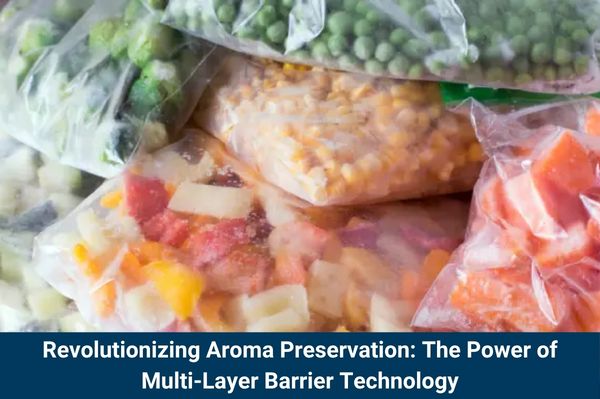
The solution to aroma loss lies in the sophisticated molecular engineering of the packaging material. Modern high-performance vacuum bags have moved away from simple monolayer structures toward up to 9-layer co-extruded films. The most effective of these utilize a combination of Polyamide (PA) and Ethylene Vinyl Alcohol (EVOH).
In this architecture, the PA layers provide the mechanical “backbone,” offering exceptional puncture resistance and structural integrity. However, the EVOH layer is the true hero for aroma preservation. It acts as a high-density gas barrier with a remarkably low transmission rate. Unlike standard polyethylenes, EVOH is specifically designed to block the passage of oxygen and, crucially, the escape of complex aroma molecules. By integrating these materials into a multi-layer format, manufacturers create a “vault” for the product, ensuring that the scent stays trapped inside while external odors and oxygen are kept out.
Beyond the material itself, the method of air displacement plays a vital role in quality retention. For many premium confectioneries, simple vacuum packaging—the complete removal of air—is the gold standard for preventing oxidation and moisture ingress. By removing the oxygen, the oxidative rancidity of fats (common in nut-based chocolates) is halted.
For more delicate items that might be crushed by a high-vacuum draw, Modified Atmosphere Packaging (MAP) or gas flushing is utilized. In this process, the atmospheric air is replaced with an inert gas like Nitrogen. This creates a pressurized “cushion” within the multi-layer bag that protects the physical shape of the confectionery while the high-barrier PA/EVOH layers prevent the inert gas from leaking out. This synergy between gas-flushing and 9-layer barrier film technology ensures that “shelf-freshness” is maintained for 12 to 24 months, even in fluctuating climates.
Our Other Product
For international importers and distributors, the greatest threat to a product’s integrity is the “micro-leak.” Even a high-barrier film is useless if the seal fails or if the bag is punctured during the rigors of global shipping. Premium vacuum bags are engineered with a specific “low-leak” seal layer that activates at precise temperatures, ensuring a hermetic bond that is resistant to the oils and sugars often found in confectionery.
Furthermore, high puncture resistance is non-negotiable for bulk buyers. Confectionery with sharp edges—such as hard candies or chocolates with nut inclusions—can easily pierce standard films. The inclusion of high-tensile PA in a 9-layer co-extrusion provides a rugged exterior that withstands the friction of transit, reducing the “waste-to-shipment” ratio. For industrial use, these films are available in thicknesses ranging from 40 to 200 microns, allowing procurement heads to select a gauge that balances cost-efficiency with the specific protective needs of their product line.
From a commercial perspective, the transition to high-barrier multi-layer vacuum bags is a strategic investment in ROI. While the initial cost per unit may be slightly higher than standard films, the reduction in product returns, the elimination of “off-flavors,” and the ability to access distant export markets far outweigh the cost.
Modern manufacturers offer significant customization to fit various industrial workflows, including thermoform-fill-seal (TFS) lines, flow pack applications, and stand-up pouches with zippers for retail convenience. For specialized products, these bags are also compatible with freezing and sous-vide applications, which is increasingly relevant for “ready-to-finish” confectionery components used in the HORECA (Hotel, Restaurant, and Cafe) sector. Ultimately, adopting 9-layer PA/EVOH technology is a commitment to quality that protects the most valuable asset any premium brand possesses: its reputation for flavor excellence.
Vacuum bags prevent aroma loss by using a high-barrier layer, typically EVOH, within a multi-layer (up to 9 layers) co-extruded structure. These layers have a molecular density that makes it nearly impossible for volatile aroma molecules to permeate the film. By trapping these molecules inside and blocking oxygen from entering, the product's original scent and flavor profile remain unchanged.
The industry standard for high-end confectionery is a PA/EVOH-based co-extruded film. The Polyamide (PA) provides strength and puncture resistance, while the Ethylene Vinyl Alcohol (EVOH) provides the specialized gas and aroma barrier. A 9-layer structure is generally preferred over 3 or 5-layer films because it allows for thinner, more flexible packaging without compromising on barrier performance.
Yes. High-performance multi-layer films are ideal for MAP. Because they have very low gas transmission rates, they are excellent at holding in the inert gases (like Nitrogen) used to replace oxygen. This is particularly useful for delicate confectionery that needs protection from both oxidation and physical crushing.
For most standard applications, a thickness between 60 and 100 microns provides an excellent balance of protection and cost. However, for products with sharp inclusions (like nuts or hard candy) or for very large bulk shipments, thicknesses up to 200 microns may be used to ensure high puncture resistance and seal integrity during long-distance export.
These high-performance films are engineered for versatility. They maintain their mechanical properties and barrier integrity during freezing (for long-term storage) and are often suitable for high-temperature applications like sous-vide or pasteurization. This thermal stability ensures that the aroma and flavor remain protected even when the product moves through diverse climate zones during global transit.
For the modern confectionery manufacturer, packaging must be viewed as a strategic investment rather than a mere operational cost. In an industry where flavor is the brand, the ability to deliver a consistent sensory experience across international borders is what separates market leaders from their competitors.
By adopting PA/EVOH-based multi-layer technology, procurement heads and packaging engineers effectively future-proof their supply chains. This technology not only ensures the integrity of the product’s aroma and texture but also provides the logistical ruggedness required for aggressive global expansion. Ultimately, high-barrier vacuum and MAP solutions offer a superior Return on Investment (ROI) by protecting the most fragile and valuable asset a premium brand possesses: its reputation for quality.

Vishakha Polyfab Pvt. Ltd. is a global pioneer in high-barrier flexible packaging, specializing in advanced 9-layer co-extruded PA/EVOH-based films. Headquartered in Ahmedabad, India, the company utilizes world-class Brampton Engineering (Canada) and Aqua Frost® water-quenched technology to deliver superior shelf-life extension solutions. From Modified Atmosphere Packaging (MAP) to deep-draw thermoforming applications, Vishakha Polyfab delivers compliant, high-performance materials that protect product integrity throughout complex international supply chains. Their expertise in vacuum packaging, thermoforming, and lidding films helps enterprise-level brands in the food, pharmaceutical, and industrial sectors optimize packaging performance and sustainability.




 Call Us Now!