
August 18, 2026
Table of Contents




Table of Contents
Vacuum pouches and bags are flexible packaging formats that remove air before sealing to extend product life and protect contents from oxygen, moisture and contamination. Industries select formats based on multilayer construction, barrier requirements and product characteristics. Materials such as PA, PE and PA PE laminates offer different strength, flexibility and barrier combinations. Options like gas flush pouches, boilable pouches, gusseted bags and zipper pouches serve specific processing needs, while printing and customization support branding. Vishakha Polyfab develops such vacuum packaging solutions for food, pharmaceutical and industrial applications.
Vacuum pouches and bags are flexible packaging formats designed to hold a product after most of the air inside the pack has been removed. Once the air is extracted, the pouch is sealed, which reduces the oxygen available inside the pack and slows down processes like oxidation, microbial growth and moisture transfer.
This packaging method is widely used for products that are sensitive to air exposure, including fresh and processed meat, seafood, dairy items, dried fruits, spices and various industrial components. The absence of trapped air also allows the pouch to conform tightly around the product, which reduces the overall pack volume and supports more compact storage and transportation.
Vacuum pouches are manufactured in several formats to match different filling and sealing requirements, including three and two side seal pouches, tubular bottom seal pouches, gusseted bags, stand up pouches, zipper pouches and easy peel pouches. They are also produced from different materials, such as PA Vacuum Bags, PE Vacuum Bag structures and PA PE Vacuum Bags, along with barrier multilayer pouches and laminated pouches built for specific protection needs.
Vacuum packaging works differently from ordinary sealed bags. A standard pouch may still contain a layer of air that allows oxygen to interact with the product over time. In a vacuum pack, most of this air is drawn out using a vacuum chamber or vacuum sealing machine before the final seal is applied, which is why material selection and seal strength become critical factors in pack performance.
Product protection needs vary significantly across industries, but the underlying reasons for choosing vacuum packaging are similar.
Because these requirements differ by product category, the type of vacuum pouch, the material used and the pack structure all need to be selected with the specific application in mind rather than using a single generic format across every product line.
Different vacuum packaging formats are built for different filling methods, product shapes and processing conditions.
Vacuum pouches are the most common format, typically flat pouches sealed on multiple sides after air removal. They are used across food, pharmaceutical and industrial applications where a simple, reliable barrier pack is required.
Gas flush pouches replace the extracted air with an inert gas such as nitrogen instead of leaving the pack fully evacuated. This is useful for delicate products like certain snacks or bakery items that could be crushed under full vacuum pressure but still need protection from oxygen.
Three and two side seal pouches describe the sealing configuration of the pack. Three side seal pouches are sealed on three edges with the fourth left open for filling, while two side seal pouches are formed from tubing sealed on two ends. The choice depends on the filling line setup and product volume.
Tubular bottom seal pouches are made from continuous tubing with a seal only at the bottom, which is efficient for high volume automated filling lines, particularly in food processing.
Gusseted bags include folded side or bottom panels that expand when filled, allowing the pack to stand or hold a larger volume without stressing the seals. These are common for bulkier products such as grains, dried fruits and industrial granules.
Zipper pouches include a resealable closure, allowing consumers or industrial users to open and reclose the pack multiple times. These are popular for retail snack packaging and reusable industrial packaging.
Stand up pouches have a flat base that allows the pack to remain upright on a shelf, improving retail presentation and shelf visibility while still offering vacuum or barrier protection.
Easy peel pouches use a specially engineered seal that allows the pack to be opened by hand without tools, which is important for pharmaceutical products and ready to eat food packaging where clean, controlled opening matters.
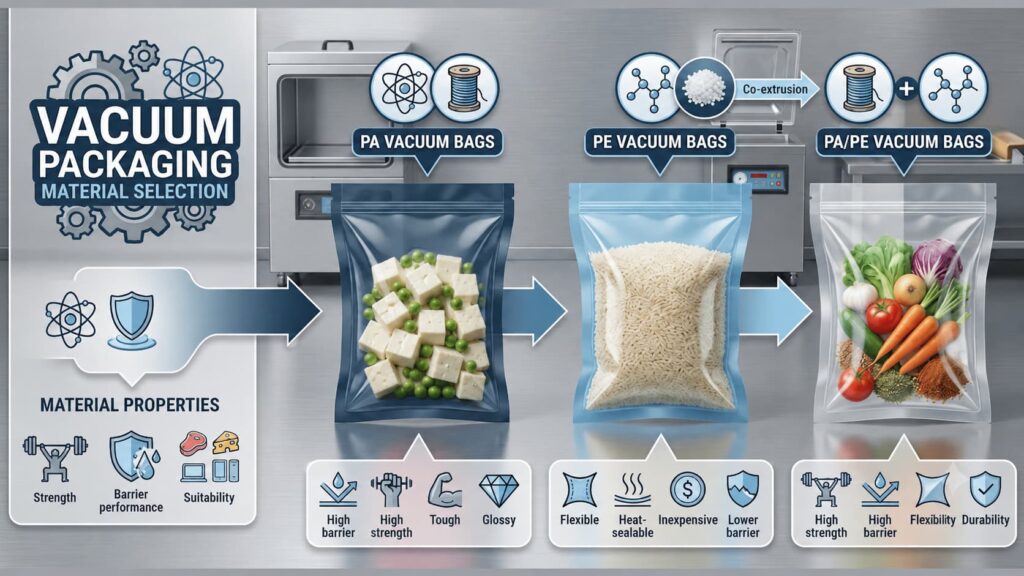
The material used in a vacuum bag directly affects its strength, barrier performance and suitability for a given product.
PA, or polyamide (nylon), layers are known for high mechanical strength, puncture resistance and flexibility even at low temperatures. PA Vacuum Bags are often used where the product has sharp edges, bones or irregular shapes, such as raw meat cuts, since the layer resists tearing during handling and vacuum sealing.
PE, or polyethylene, layers are valued for reliable heat sealing performance and flexibility. PE Vacuum Bag structures are commonly used as the inner sealing layer in a laminate because PE bonds well under heat and forms a strong, consistent seal, which is important for maintaining the vacuum inside the pack.
PA PE Vacuum Bags combine the puncture resistance of nylon with the sealing reliability of polyethylene in a single laminated structure. This combination is widely used in food packaging because it delivers both mechanical protection and dependable seal integrity, making it suitable for products that need to withstand handling, freezing and vacuum sealing without compromising the pack.
| Material | Key Strength | Typical Use |
| PA Vacuum Bags | Puncture and abrasion resistance | Meat, bone in products, sharp edged items |
| PE Vacuum Bag | Reliable heat sealing | Inner sealing layer, general food packaging |
| PA PE Vacuum Bags | Combined strength and seal performance | Meat, seafood, dates, frozen food |
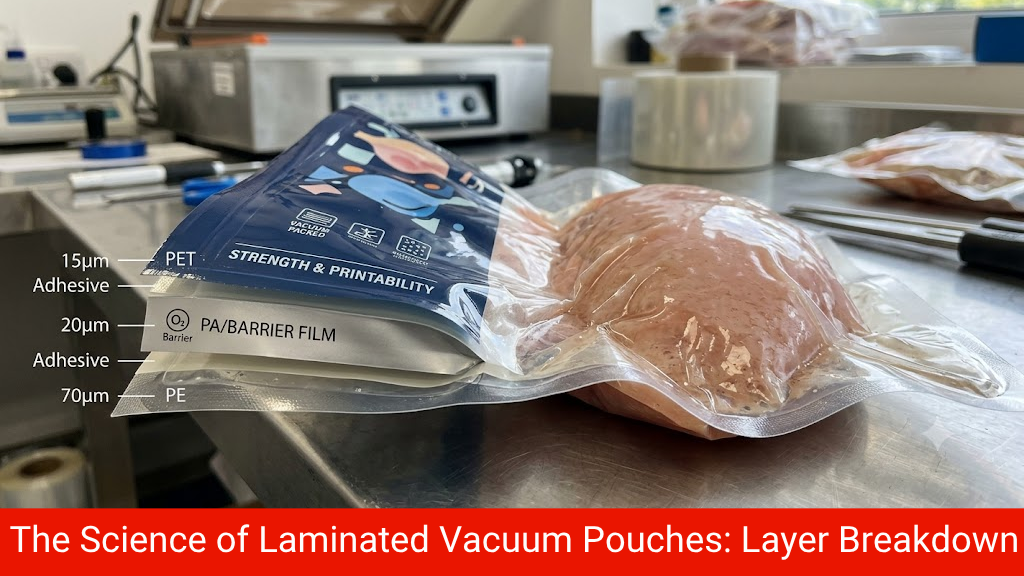
Vacuum pouches rarely rely on a single material layer. Instead, multiple layers are laminated together, with each layer contributing a specific function to the overall pack.
Barrier multilayer pouches are built specifically to achieve a target oxygen transmission rate and moisture barrier level, which is important for products with a longer required shelf life or for export shipments that spend extended time in transit.
Laminated pouches describe the general construction method where two or more films are bonded together using adhesive lamination or extrusion lamination. This process allows manufacturers to combine the benefits of different materials, such as strength from one layer and barrier performance from another, into a single pouch structure without compromising flexibility.
The number of layers, their thickness and their sequence are adjusted based on the product, expected shelf life and processing conditions such as freezing, boiling or pasteurization.
Our Other Product
Certain products require vacuum pouches that can withstand specific processing conditions beyond standard storage and sealing.
Boilable Vacuum Pouches are engineered to withstand direct boiling water temperatures without degrading, splitting or losing seal integrity. These are used for pre cooked meals, marinated meat and ready to cook food products that are prepared by boiling the sealed pack.
Microwavable pouches are designed for ready to eat applications where the consumer heats the sealed pack directly in a microwave. These pouches use materials that remain stable under microwave heating while maintaining pack integrity.
Pasteurization pouches are built to handle moderate heat processing used to reduce microbial content in products such as certain dairy and ready meal items. The pouch material and seal need to tolerate the specific temperature and duration used during the pasteurization cycle without weakening.
Sterilization Pouches are designed for high temperature processing, often used in pharmaceutical and select food applications where a higher degree of microbial reduction is required. These pouches must maintain structural and seal integrity under more demanding heat and pressure conditions compared to standard vacuum packs.
Selecting the correct specialty pouch avoids seal failure or material degradation during processing, which could otherwise compromise product safety.
Beyond material and format, the performance of a vacuum pouch depends on specific protective features built into the pack.
Pouch thickness also plays a direct role in performance. A 3 mil Vacuum Pouch, referring to a thickness of approximately three thousandths of an inch, is commonly selected where a balance is needed between flexibility and adequate puncture resistance for everyday food packaging applications. Thicker gauges may be selected for heavier or sharper products, while thinner gauges suit lighter, less demanding items.
Vacuum pouches can be customized to support branding, product identification and functional requirements without affecting the core protective performance of the pack.
These customization options are generally applied without reducing the barrier or sealing performance of the underlying pouch structure, allowing businesses to combine branding needs with functional packaging requirements.
Vacuum packaging requirements vary by industry, product type and the specific risks the pack needs to guard against. The table below summarizes how vacuum pouches and bags are applied across common food and industrial categories.
| Industry / Product | Primary Risk | Key Requirement | Typical Vacuum Packaging Solution |
| Meat | Bone puncture, oxidation | High puncture resistance, strong barrier | PA PE Vacuum Bags, high puncture resistance pouches |
| Seafood | Moisture loss, odor transfer | Strong moisture and odor barrier, low temperature stability | Barrier multilayer pouches, PA PE Vacuum Bags |
| Dairy | Heat sensitivity during processing | Pasteurization compatible seal and material | Pasteurization pouches |
| Frozen Food | Brittleness at low temperature | Flexibility and seal reliability in freezing conditions | PE Vacuum Bag, PA PE Vacuum Bags |
| Snacks | Crushing under full vacuum | Texture protection without full air removal | Gas flush pouches |
| Spices | Moisture absorption, aroma loss | Strong moisture and aroma barrier | Barrier multilayer pouches, laminated pouches |
| Dates | Moisture loss, handling damage in export | Puncture resistance with export grade barrier | PA PE Vacuum Bags for Dates packaging |
Read Our Article
| Industry / Product | Primary Risk | Key Requirement | Typical Vacuum Packaging Solution |
| Industrial Components (metal parts) | Corrosion from moisture and oxygen | Reliable barrier during storage and shipping | Vacuum pouches, barrier multilayer pouches |
| Electronic Products | Humidity related damage to circuitry | Consistent moisture barrier protection | Moisture barrier vacuum pouches |
| Moisture Sensitive Industrial Products | Material degradation before use | Long term barrier stability | Vacuum sealed barrier pouches |
This structure makes it easier to match a product category to its main packaging risk and the vacuum packaging format best suited to manage it, rather than treating all industries with a single generic approach.
For businesses handling larger product volumes, Big bulk bags and inner liners offer a practical alternative to individual small pack formats.
Bulk packaging is particularly relevant for industrial raw materials, agricultural products and food ingredients that move in large volumes between processing facilities, exporters and distributors.
Choosing the right vacuum pouch or bag involves evaluating several factors together rather than focusing on a single requirement.
Evaluating these factors together helps businesses avoid pack failures, product spoilage or unnecessary material costs from over specifying a pouch beyond what the product actually requires.
Our Other Product
Vacuum packaging decisions involve technical trade offs between material cost, barrier performance, mechanical strength and processing compatibility. An experienced manufacturer helps businesses navigate these trade offs based on practical production knowledge rather than generic specifications.
Vishakha Polyfab works with food, pharmaceutical and industrial businesses to develop vacuum packaging bags and pouches suited to specific product and application requirements. This includes guidance on material selection between PA, PE and PA PE structures, multilayer and laminated construction, specialty pouches for boiling, pasteurization or sterilization, and customization through printing, finishes and closures such as zippers or easy peel seals.
For businesses managing large volume requirements, Vishakha Polyfab also supports bulk packaging needs through big bulk bags and inner liners designed for efficient storage and transportation.
Working with a manufacturer that understands both the technical and practical side of vacuum packaging allows businesses to select solutions that genuinely match their product protection, shelf life and operational requirements, rather than adopting a one size fits all approach to packaging.
Selecting the right vacuum pouch or bag depends on evaluating product characteristics, barrier requirements, material compatibility, processing conditions and customization needs together rather than in isolation. From PA, PE and PA PE materials to multilayer structures, specialty pouches and bulk packaging formats, each option is developed to address specific protection and performance requirements. Vishakha Polyfab works with food, pharmaceutical and industrial businesses to develop vacuum packaging solutions suited to these varied requirements, helping ensure the packaging genuinely matches the product it is meant to protect.
A vacuum pouch has most of the air removed from inside the pack before it is sealed, while a regular pouch may retain trapped air. Removing air reduces oxidation, slows microbial growth and extends shelf life. This makes vacuum pouches better suited for meat, seafood, dairy and other products that are sensitive to oxygen exposure. Vishakha Polyfab develops vacuum pouches designed around these specific barrier and shelf life requirements.
The best material depends on the product. PA offers strength and puncture resistance, PE provides reliable heat sealing, and PA PE combines both benefits in one laminated structure. Products with sharp edges, such as bone in meat, generally perform better with PA PE Vacuum Bags, since they resist tearing while still forming a strong, consistent seal during vacuum sealing.
A 3 mil Vacuum Pouch refers to a film thickness of approximately three thousandths of an inch. This gauge is commonly used for everyday food packaging because it balances flexibility with adequate puncture and handling resistance. Thicker gauges are typically chosen for heavier or sharper products, while thinner gauges suit lighter items that need less mechanical protection.
Yes, but only when made for that purpose. Boilable Vacuum Pouches are engineered to withstand direct boiling water without losing seal integrity, while microwavable pouches are built to remain stable under microwave heating. Standard vacuum pouches are not designed for these conditions, so selecting the correct specialty pouch is important for food safety and pack performance.
Vacuum sealing removes nearly all the air from the pack before sealing, while gas flush packaging replaces the extracted air with an inert gas such as nitrogen. Gas flush pouches are typically used for delicate products like snacks or bakery items that could be crushed under full vacuum pressure but still need protection from oxygen exposure.
Yes, vacuum and barrier pouches are widely used in pharmaceutical packaging where moisture and oxygen sensitivity are concerns. Sterilization Pouches, in particular, are designed to maintain seal and structural integrity under high temperature processing, which is important for products that require a higher degree of microbial reduction before use.
A single material rarely delivers strength, barrier protection and sealing performance together. Multilayer and laminated pouches combine different films, such as an outer layer for strength, a barrier layer for oxygen and moisture resistance, and an inner PE layer for sealing, into one structure. This allows the pack to meet several performance requirements without compromising flexibility.
PA PE Vacuum Bags for Dates packaging are commonly used because they combine puncture resistance with strong barrier and sealing performance. Dates are often exported over long distances, so the pack needs to protect against moisture and oxygen exposure while withstanding handling during transit. This combination helps maintain freshness, texture and appearance throughout distribution.
Yes, vacuum pouches can be customized through options such as multi colour printing, logo printing, embossed and textured finishes, and silver, gold, black or clear pouch variants. These customization options are generally applied without affecting the core barrier or sealing performance, allowing businesses to combine branding and retail presentation with the functional protection the product requires.
Big bulk bags and inner liners are commonly used for large volume packaging needs. Inner liners provide an additional barrier layer inside bulk containers, protecting product from moisture and contamination, while bulk bags reduce the number of individual packs required. This format supports easier storage and more efficient transportation for industrial and food ingredient volumes.

Vishakha Polyfab Pvt. Ltd. is a global pioneer in high-barrier flexible packaging, specializing in advanced 9-layer co-extruded PA/EVOH-based films. Headquartered in Ahmedabad, India, the company utilizes world-class Brampton Engineering (Canada) and Aqua Frost® water-quenched technology to deliver superior shelf-life extension solutions. From Modified Atmosphere Packaging (MAP) to deep-draw thermoforming applications, Vishakha Polyfab delivers compliant, high-performance materials that protect product integrity throughout complex international supply chains. Their expertise in vacuum packaging, thermoforming, and lidding films helps enterprise-level brands in the food, pharmaceutical, and industrial sectors optimize packaging performance and sustainability.

Make Vishakha Polyfab the silent guardian of your products to preserve their vigour and enhance the quality of user interaction with them.
Sign Up for Our Newsletter
Corporate Head Office
Social Media
An ISO & BRCGS Certified Company

Manufacturing Address

