
August 21, 2026
Table of Contents




Table of Contents
Barrier films protect food products by controlling the movement of oxygen, moisture, aroma and light. Materials such as PE films, EVOH layers and multilayer structures are combined to match specific product requirements, from meat and dairy to snacks and processed foods. The right barrier structure improves shelf life, reduces spoilage and supports safe transportation. Manufacturers like Vishakha Polyfab develop customized flexible packaging solutions that balance barrier performance, processing needs and sustainability goals, helping food businesses protect product quality while managing packaging waste and material efficiency.
A barrier film is a flexible packaging material engineered to limit the passage of gases, moisture, aroma compounds and light between the packaged product and the outside environment. Without this protection, most food products lose freshness, texture, flavor or safety far sooner than expected.
Barrier films work by controlling four main factors:
The level of protection required depends heavily on the product. A dry snack needs strong moisture resistance, while a cured meat product needs a high oxygen barrier to prevent discoloration and spoilage. Manufacturers achieve this protection by combining different food packaging materials, including PE films for sealing strength and multilayer structures built around EVOH, where the EVOH full form is Ethylene Vinyl Alcohol, for oxygen barrier performance.
This is where organizations positioned as barrier films international suppliers play a role, since food and pharmaceutical companies increasingly source packaging materials from manufacturers who understand global barrier standards, regulatory expectations and cross border shipping conditions. A film that performs well in humid coastal storage may behave differently in dry inland transport, so barrier performance has to be evaluated against the full supply chain, not just the point of packing.
Selecting a packaging film is not a one size fits all decision. Whether a business sources from a general packaging supply shop or works with a specialized manufacturer, procurement teams typically evaluate food packaging materials against product sensitivity, shelf life targets and cost constraints. Increasingly, this evaluation also factors in sustainability in packaging, since sustainable packaging choices and broader packaging and sustainability goals now influence material selection alongside barrier performance.
Common categories include:
A useful way to compare materials is against the specific risk they are meant to control.
| Product Type | Primary Risk | Common Film Approach |
| Dry snacks | Moisture ingress | PE or metallized laminate |
| Cured meat | Oxidation | EVOH based multilayer film |
| Dairy products | Moisture and light | Multilayer with light barrier |
| Frozen foods | Freezer burn, moisture | Thicker PE laminate structures |
| Ready to eat meals | Oxygen and aroma loss | High barrier multilayer film |
Material selection also affects how a product performs during processing, since films used for retort packaging, hot filling or vacuum sealing must tolerate heat and mechanical stress without losing barrier integrity. Vishakha Polyfab works with food manufacturers to match film construction to these processing conditions rather than defaulting to a generic structure.
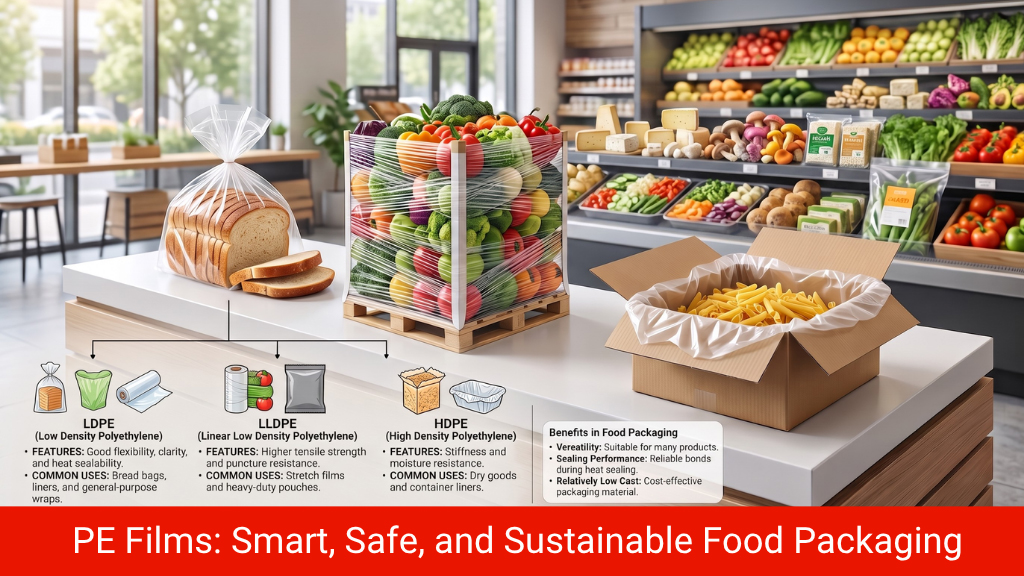
PE films are among the most widely used materials in flexible food packaging because of their versatility, sealing performance and relatively low cost.
Polyethylene is available in several forms, each suited to different applications:
PE films are frequently used as a sealant layer within multilayer structures, even when another material provides the primary oxygen or aroma barrier. This is because PE bonds reliably during heat sealing and helps maintain package integrity during transport and handling.
Compared to other packaging films, PE alone provides limited oxygen barrier properties. For products that need only moisture protection, such as bakery items or fresh produce, PE films can be sufficient on their own. For products requiring stronger oxygen or aroma control, PE is typically combined with barrier materials like EVOH within a laminated structure.
The EVOH full form is Ethylene Vinyl Alcohol, a copolymer resin known for providing one of the highest oxygen barrier performances available in flexible packaging films.
EVOH is not typically used as a standalone film. Instead, it is incorporated as a thin internal layer within a multilayer structure, positioned between protective outer layers. This placement matters because EVOH is sensitive to moisture, and its oxygen barrier properties can weaken if the layer is directly exposed to humidity. Multilayer construction shields the EVOH core while still allowing it to perform its primary function.
EVOH is commonly selected for:
When comparing EVOH to PE and other barrier materials, the distinction is functional rather than competitive. PE contributes sealing strength, moisture resistance and mechanical durability, while EVOH contributes oxygen barrier performance. Most high performing food packaging structures use both materials together, along with tie layers that bond dissimilar polymers into a stable film.
Multilayer barrier films are built from several polymer layers, each contributing a specific property. A typical structure might combine a strength layer, a barrier layer such as EVOH, a tie layer, and a sealant layer such as PE.
These films are generally produced using one of two main processes:
Manufacturing multilayer films requires careful control of processing temperatures, since each polymer layer has different melting characteristics. Poor layer bonding can lead to delamination, reduced barrier performance or seal failures during packaging line operation.
Key considerations during processing include:
Manufacturers who understand both material science and processing behavior are better positioned to deliver films that perform consistently across different packaging environments, from manual pouch filling to high speed automated lines.
Our Other Product
The primary business case for barrier films is shelf life extension and reduced product loss. When oxygen, moisture and aroma movement are properly controlled, food products retain quality for longer periods, reducing waste across the supply chain.
Specific protective functions include:
Applications vary by product category:
In each case, the packaging film is functioning as an active part of product quality management, not simply as a container.
Many businesses begin their sourcing process by searching for a general packaging supply shop, expecting to find standard films for common applications. This approach works reasonably well for basic, low sensitivity products.
However, for food products with specific barrier requirements, working with a specialized flexible packaging manufacturer often delivers better long term results.
Factors worth considering when choosing between a general supplier and a specialized one include:
A general packaging supply shop is often suitable for standard packaging needs, while businesses with more demanding shelf life, export or regulatory requirements tend to benefit from working directly with a manufacturer capable of developing customized film structures, such as Vishakha Polyfab, which supports food and pharmaceutical companies with barrier film development tailored to specific product and processing requirements.
Sustainability in packaging has become a central concern for food manufacturers, retailers and regulators. At the same time, product protection remains essential, since packaging failure leads to food waste, which carries its own environmental cost.
Balancing these two goals involves several approaches:
This is a genuine trade off rather than a simple choice. A film with fewer layers may be easier to recycle but may not provide sufficient barrier protection for oxygen sensitive products. Manufacturers need to evaluate sustainability decisions against actual product risk rather than applying the same approach across all packaging types.
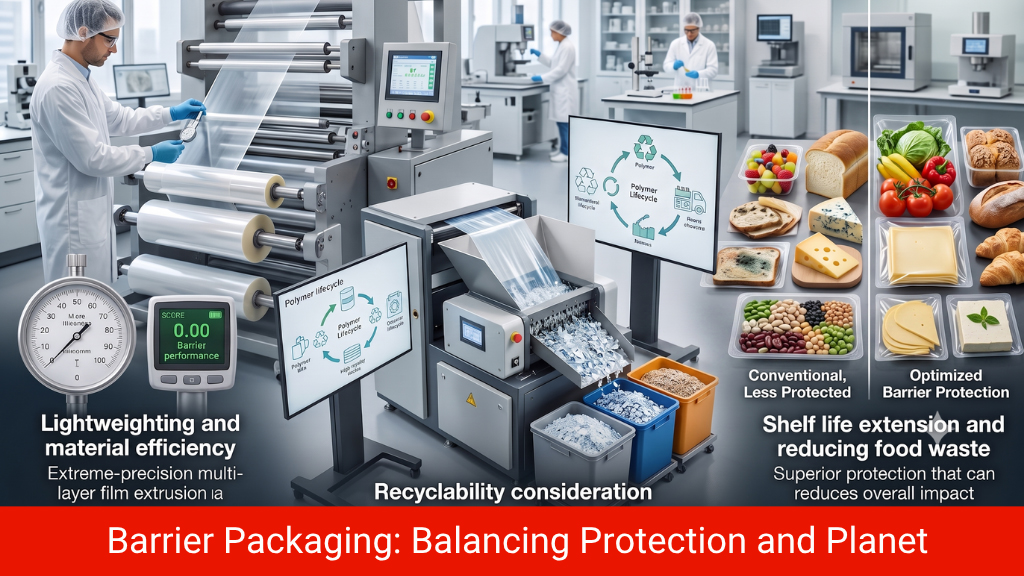
The direction of sustainable packaging development in flexible films is increasingly focused on mono material structures, where a single polymer family, often based on polyethylene, is used to build a film that still delivers adequate barrier performance.
Trends shaping this space include:
Balancing barrier performance with recyclability remains an evolving area, since oxygen sensitive products still often require materials like EVOH that are not yet widely compatible with standard mono material recycling streams. As material science advances, manufacturers are working to close this gap, developing structures that maintain necessary protection while improving end of life outcomes for packaging.
Our Other Product
Packaging and sustainability decisions are most effective when they are based on a full life cycle view rather than a single factor such as recyclability alone.
A responsible approach typically includes:
For food manufacturers and packaging buyers, this means treating sustainability as an ongoing engineering conversation rather than a one time material swap. Vishakha Polyfab works with businesses to evaluate these trade offs, developing flexible packaging solutions that aim to meet product protection needs while supporting practical progress toward sustainability goals.
Barrier films are a functional part of food safety and shelf life management, not just outer packaging. Materials such as PE films, EVOH layers and multilayer structures each contribute specific protective properties against oxygen, moisture, aroma and contamination. Choosing the right structure depends on product sensitivity, processing conditions and sustainability goals rather than a single standard film. Manufacturers such as Vishakha Polyfab help food and pharmaceutical companies develop customized barrier packaging solutions that balance these requirements. As recycling infrastructure and material technology continue to evolve, businesses that understand these fundamentals will be better positioned to select packaging that protects products while supporting responsible material use.
Barrier films are used to protect food products from oxygen, moisture, aroma loss and contamination during storage and transport. They help maintain freshness, texture and safety for products ranging from meat and dairy to snacks and ready to eat meals. The right barrier structure directly extends shelf life. Vishakha Polyfab develops barrier film structures matched to specific product sensitivity and shelf life requirements.
EVOH full form is Ethylene Vinyl Alcohol, a resin known for high oxygen barrier performance. It is used as an internal layer within multilayer films to prevent oxidation in oxygen sensitive products such as cured meat, cheese and sauces. Because EVOH is moisture sensitive, it is typically protected by outer layers rather than used alone.
EVOH primarily provides oxygen barrier protection, while PE films contribute sealing strength, flexibility and moisture resistance. They are not competing materials but complementary ones, often combined within a single multilayer structure so the packaging achieves both mechanical durability and barrier performance suited to the product being packed.
The right PE film depends on the application. LDPE suits general wraps and bread bags due to its flexibility and sealability. LLDPE offers higher puncture resistance for stretch films and pouches. HDPE provides stiffness for dry goods and container liners. Vishakha Polyfab evaluates product handling and sealing needs before recommending a specific PE grade.
Barrier films slow oxidation, limit moisture transfer and reduce microbial growth by controlling what enters or leaves the package. This preserves flavor, texture and safety for longer periods compared to unprotected packaging. For oxygen sensitive products, adding an EVOH layer or metallized barrier significantly extends usable shelf life without relying on additional preservatives.
Recyclability depends on the film structure. Mono material PE based films are generally more compatible with existing recycling streams, while multilayer films containing EVOH or other dissimilar materials are harder to recycle through standard channels. Manufacturers are increasingly developing structures that balance barrier performance with improved recyclability as sustainability requirements grow.
Sustainability in packaging requires balancing environmental goals with product protection needs. Reducing film thickness or layer count can improve recyclability, but oxygen sensitive products may still require barrier materials like EVOH to prevent spoilage. Manufacturers evaluate this trade off case by case rather than applying a single approach across all product types.
Businesses should evaluate technical support, production consistency, customization ability and quality documentation, not just price. A general packaging supply shop may suit basic needs, but products with specific barrier or shelf life requirements benefit from a specialized manufacturer. Vishakha Polyfab works directly with food and pharmaceutical companies to develop packaging matched to actual product requirements.
A multilayer barrier film combines several polymer layers, such as a strength layer, a barrier layer like EVOH and a PE sealant layer, into a single film. These layers are typically produced through coextrusion or blown film processing, allowing each layer to contribute a specific protective or functional property to the finished packaging.
High barrier films are widely used in meat, dairy, snack, frozen food and ready to eat product packaging, where oxidation, moisture loss or aroma leakage can significantly reduce shelf life. Pharmaceutical and industrial applications also rely on high barrier structures for product protection. Vishakha Polyfab supports these industries with customized flexible packaging solutions built around specific barrier requirements.

Vishakha Polyfab Pvt. Ltd. is a global pioneer in high-barrier flexible packaging, specializing in advanced 9-layer co-extruded PA/EVOH-based films. Headquartered in Ahmedabad, India, the company utilizes world-class Brampton Engineering (Canada) and Aqua Frost® water-quenched technology to deliver superior shelf-life extension solutions. From Modified Atmosphere Packaging (MAP) to deep-draw thermoforming applications, Vishakha Polyfab delivers compliant, high-performance materials that protect product integrity throughout complex international supply chains. Their expertise in vacuum packaging, thermoforming, and lidding films helps enterprise-level brands in the food, pharmaceutical, and industrial sectors optimize packaging performance and sustainability.

Make Vishakha Polyfab the silent guardian of your products to preserve their vigour and enhance the quality of user interaction with them.
Sign Up for Our Newsletter
Corporate Head Office
Social Media
An ISO & BRCGS Certified Company

Manufacturing Address

