
October 6, 2026
Table of Contents




Table of Contents
Flexible packaging problems such as seal leaks, delamination, curling and film breakage rarely come from a single cause. They usually result from film structure, lamination quality, sealing conditions, flexible packaging machinery settings or handling practices. Effective troubleshooting starts with the visible failure, isolates one variable at a time and confirms the result with seal, peel and leak tests. Clear technical communication between buyers and packaging manufacturers supports faster and more accurate root cause analysis.
Flexible packaging problems are visible defects in a pouch, film roll or laminate that reduce product protection, machine performance or shelf appearance. The most common are seal leaks, delamination, curling, film breakage and pouch deformation. Production managers, packaging engineers, quality teams, maintenance teams and procurement managers meet these defects regularly, and each of them needs a dependable way to move from what is visible on the pack to a confirmed cause. Vishakha PolyFab, a manufacturer of laminated films, vacuum pouches and customised flexible packaging structures, approaches these failures in the same order: identify the visible defect first, then confirm what caused it.
Packaging failures usually result from interaction between material properties, machine conditions and handling practices. Understanding this relationship helps teams identify the actual cause instead of treating only the visible defect. A leaking pouch on a form fill seal line or multitrack flexible packaging machine, for example, may come from the film structure, the sealing jaws, product residue in the seal area or incorrect machine settings. A change that solves one defect can also create another, so the sections below examine each visible failure directly.
Flexible packaging seal failure appears as weak seals that peel apart under light hand pressure, open seals where the layers never fused, and channel leaks, which are thin unsealed paths that usually form at folds, gussets or wrinkles. Contaminated seals contain powder, oil or product trapped between the layers, while overheated seals look glossy, thinned or brittle. In packs of spices, snacks or sauces, a small channel can let in air and moisture long before a leak is visible, so seal inspection should not rely on appearance alone.
Seal quality starts with the sealant layer. If it does not suit the product or has a narrow sealing window, small process shifts will produce weak or burnt seals. Temperature that is too low prevents fusion, while temperature that is too high thins the sealant and weakens the seal edge. Low pressure or short dwell time leaves incomplete bonding, and uneven pressure across the jaw gives seals that are strong in one area and open in another. Contamination near the seal, hot or humid storage and stacking stress after packing add further risk.
To troubleshoot, inspect seals under good light, run a peel test, and examine jaws and tapes before changing any setting. Then adjust temperature, pressure or dwell time one at a time and record each result. Fast lines using flexible packaging machinery need a sealant with good hot tack, because the seal is stressed while it is still warm. Vishakha PolyFab’s CPP films include a high hot tack grade designed for fast sealing on FFS lines, such as pharmaceutical sachets.
Packaging film delamination is the separation of bonded layers in a laminate, for example a printed outer film lifting from its sealant film. It appears as bubbles, long ridges called tunnelling, lifting at the edges or layers that peel apart by hand. The impact goes beyond appearance. Barrier performance drops, seal strength falls and pouches may leak even when the seal was formed correctly, which makes delamination both a quality issue and a shelf life issue.
Most cases trace back to the bond itself. Incorrect adhesive coat weight, incomplete curing, residual solvent or low surface treatment on the film all reduce bond strength. An adhesive that does not suit the films or inks, or a combination of films with very different stiffness, creates stress at the interface. Rolls stored in heat or humidity while the adhesive is still curing can also fail. Chemical interaction with the product is a frequent cause in edible oil pouches, spice packs and products filled hot or pasteurized, where oils, acids or essential oils attack the adhesive over time.
To troubleshoot, measure bond strength with a peel test on fresh and aged samples, then check where the layers separated: at the adhesive, at the ink layer or inside a film. Test the laminate with the actual product in contact, and compare roll dates and curing time against a retained good batch. Vishakha PolyFab manufactures laminates using both solvent based and solventless lamination technology from Europe, and its VISHLAMI films are built around bond strength and ink adhesion.
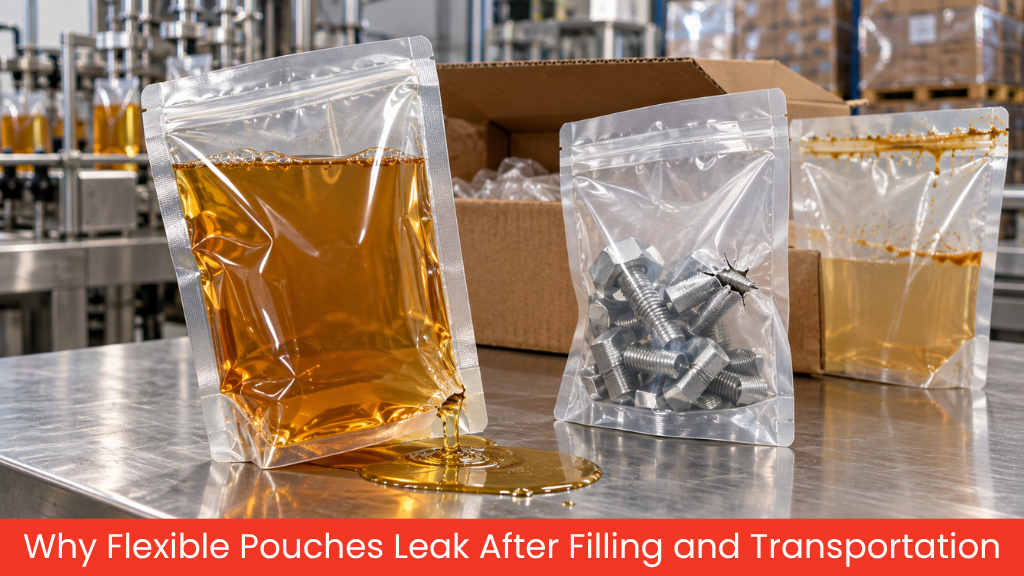
Pouch leakage causes are easier to find once the leak location is mapped. Common leakage points are side and bottom seals, corners and gusset folds, seal areas contaminated during filling, pinholes at flex crack zones and punctures caused by the product. Leakage often becomes visible only after transport, because a liquid pouch that passes inline checks may still burst at a seal after a drop in the distribution chain.
Film thickness that is too low for the fill weight or product shape is a leading cause, along with pouch designs whose seal width or gusset style does not suit the load. Sharp product edges, such as bones in frozen meat, hard cheese rinds or industrial hardware, puncture thin structures. On the filling line, product splashing into the seal, overfilling and excessive drop height increase leak risk, and transportation adds vibration, drops and stacking pressure. Leaks in the same position every time usually indicate a seal or tooling issue, random leaks suggest contamination or film variation, and leaks found only after transport point to thickness, pouch design or packing method.
Confirm findings with a defined leak test, such as vacuum leak, dye penetration or burst testing, and record drop test and transit results so that different structures can be compared fairly. Vishakha PolyFab’s VISHVACU vacuum pouches use PA/EVOH films with high puncture resistance and low leak rate for chilled, frozen and processed foods.
Film curling problems appear as wavy film, edge curl, a laminate bending toward one side or pouches that bow after sealing. On the machine, curled film causes web tracking errors, registration problems and misfeeds. On the shelf, it spoils pack appearance and makes stacking uneven.
Curl develops when stresses in a film are not balanced. Uneven tension during unwinding, printing or lamination locks stress into the laminate, and two webs joined under different tensions at the nip tend to bend toward one side. Structures with asymmetric layers can shrink differently or absorb moisture unevenly, as nylon does. Storage in humid or hot areas, rolls stored on their side and damaged cores add to the problem, while drying oven heat and heavy ink coverage on one side during printing can also contribute.
Corrective actions include balancing web tensions at unwind, nip and rewind, letting rolls reach the temperature and humidity of the production floor before use, keeping rolls wrapped until needed and reducing jaw heat if pouches curl after sealing. If curl persists, the balance of the film structure should be reviewed. Vishakha PolyFab handles extrusion, printing, lamination and pouching, so the balance of a structure can be examined at each stage of production.
Strength related failures include film tearing that starts at a notch or seal edge, punctures from sharp product corners, breakage during filling when web tension is too high, and damage in transit from stacking, vibration or drops. They usually trace back to thickness that does not match the product weight, a structure with low puncture resistance, sharp product edges or rough handling of rolls and filled packs, such as dragging over edges or overstacking.
High strength films use layers that add puncture and impact resistance, such as nylon (PA), combined with EVOH for barrier performance. Simply increasing thickness is not always the answer, because it can affect sealing, machine performance and cost. A better approach is to match the structure to the application, since product weight, sharpness, storage temperature such as chilled or frozen, and machine type all influence which film will hold up in production and distribution. Vishakha PolyFab’s VISHFORM thermoformable films, for example, are designed for high puncture and impact resistance in deep draw vacuum and MAP formats.
Flexible packaging machinery settings influence film performance only when they remain accurate and consistent, and calibration is where that starts. Displayed jaw temperature, pressure readings and web tension values drift over time, so verify them against independent instruments on a fixed schedule and confirm they are uniform across the full jaw width.
Maintenance decides how long calibrated settings hold. Worn Teflon tapes, ageing heater elements, damaged jaw surfaces and misaligned rollers create wrinkles, uneven seals and tension variation that no setting change can correct. Replacing wear parts on schedule, cleaning product residue from the jaws and checking web alignment and filling accuracy keep the seal area clean.
Automation controls reduce variation between operators and shifts. Where the machine supports it, stored recipes make changeovers repeatable, closed loop tension control keeps the web steady as the roll diameter falls, and temperature control linked to line speed compensates when speed changes. Alarms for temperature deviation or web misalignment let operators stop a run before defective packs build up.
A multitrack flexible packaging machine adds a useful diagnostic clue. It seals several lanes at once, so a defect confined to one or two tracks points to local causes such as uneven jaw pressure, a worn tape or tension differences across the web, rather than to the film roll as a whole. Comparing tracks side by side is often the quickest way to separate a machine fault from a film fault. Vishakha PolyFab makes pouches on pouch making machines that support customised formats and tight tolerances, so pouch dimensions can be matched to the customer’s line.

Flexible film troubleshooting works best as root cause analysis. The aim is to find the origin of the defect, not to adjust settings until it disappears for one shift. Begin by recording the defect type, location, frequency and start date, and identify the roll, batch and line involved. Change only one variable at a time and log each result. Batch traceability makes this practical, because a defect can then be linked to a specific production date. Vishakha PolyFab supports this kind of analysis with real time gauge and seal testing and SAP ERP based traceability.
| Visible problem | First checks |
| Weak or open seal | Jaw temperature, pressure, contamination in the seal area |
| Channel leak | Wrinkles at folds, web alignment, jaw alignment |
| Bubbles or tunnelling | Adhesive curing, coat weight, storage conditions |
| Edge curl or wavy film | Web tension, moisture, structure balance |
| Pinholes or tears | Thickness, puncture resistance, sharp product edges |
Each team has a role. Production records settings and defects, quality runs seal strength, peel and leak tests, and maintenance checks jaws, tapes and tension systems.
Many failures can be prevented at the selection stage. Start with the product type, because oily, acidic, powdered, frozen and hot filled products each stress a film differently. Then define the barrier requirement, since oxygen, water vapour, UV and aroma protection depend on the layers used, with PA and EVOH structures common where shelf life is critical. Machine compatibility comes next: the film must seal within the temperature range of your flexible packaging machinery, run at the required production speed and suit the pouch style, whether form fill seal, vacuum or multitrack sachet.
Transportation conditions and regulatory requirements complete the picture. Long distance and export shipments expose packs to vibration, drops and temperature swings, so puncture resistance and seal strength should be validated under those conditions. For food and pharmaceutical use, confirm the food contact and quality documentation required in the destination market before finalising a structure. The Vishakha PolyFab range shows how these requirements map to film types:
Requirement | Example solution |
Vacuum packing of chilled, frozen and processed foods | VISHVACU, PA/EVOH films |
Deep draw thermoforming, vacuum and MAP formats | VISHFORM thermoformable films |
Tray lidding, peelable or lock seal, anti fog | VISHTOP lidding films |
Oils, liquids, retort or pasteurization | VISHBARR multilayer barrier films |
Printed laminated pouches, solventless or solvent based lamination | VISHLAMI laminated films |
Fast sealing on FFS lines, such as sachets | CPP films, high hot tack grade |
A manufacturer can only diagnose what it can see, so complete information shortens the path from complaint to solution. Sharing these details at the first report avoids repeated trial runs:
Better technical communication means fewer trials, faster root cause analysis and repeatable corrective action. Vishakha PolyFab works from these details to develop customised packaging solutions for customers in more than 30 countries.
Many flexible packaging problems can be reduced before the first pack is filled. Start with a written film specification that records product, barrier, machine and transport requirements, and approve structures against it instead of relying on price or appearance alone. Follow with a trial run on the actual line at production speed with the real product, and test seal strength, bond strength and leak performance on the packs it produces. Vishakha PolyFab supports this stage through field trials and enhancement, along with package design and development. Machine validation means confirming, before production starts, that every jaw position or track gives acceptable seals with the chosen film, and repeating a short validation after installation, major maintenance or any change of film.
Incoming material inspection catches variation early. Check roll labels, width, thickness, core condition and surface appearance on receipt, and run a quick seal or peel test on a sample from each new batch before it reaches the line. Storage practices then protect what was inspected: keep rolls wrapped, off the floor and away from heat and humidity, use older stock first and let rolls reach floor temperature before use. Finally, agree change notifications with the supplier so that a resin, adhesive or process change on their side is known before it appears on your line.
Treating each visible defect as a clue, and confirming the cause through testing before making changes, helps manufacturers reduce packaging losses. With experience in barrier films, vacuum pouches and customised flexible packaging structures, Vishakha PolyFab supports businesses in developing solutions suited to product, machine and transportation requirements.
The most common flexible packaging problems are seal leaks, delamination, curling, film breakage and pouch deformation. Each has a visible sign, such as weak seals, layer bubbles, wavy film or punctures, that points toward the cause, and each requires different corrective actions.
Flexible packaging seal failure usually comes from sealing conditions outside the sealant's working range, contamination in the seal area, wrinkles at folds, worn sealing components or a sealant layer unsuited to the product.
Packaging film delamination results from weak bonding between laminated layers, caused by poor adhesive application, incomplete curing, incompatible films, hot or humid storage or chemical attack from oils and acids in the product.
Flexible packaging machinery affects pouch quality through calibration, maintenance and control settings. Drifting instruments, worn components and misaligned webs can cause leaks, curling or tearing, and on a multitrack machine a single faulty lane points to a local machine issue.
Flexible film troubleshooting starts with recording the defect, its location and the batch involved. Teams then change one variable at a time, run seal, peel and leak tests and compare failed packs with good ones.

Vishakha Polyfab Pvt. Ltd. is a global pioneer in high-barrier flexible packaging, specializing in advanced 9-layer co-extruded PA/EVOH-based films. Headquartered in Ahmedabad, India, the company utilizes world-class Brampton Engineering (Canada) and Aqua Frost® water-quenched technology to deliver superior shelf-life extension solutions. From Modified Atmosphere Packaging (MAP) to deep-draw thermoforming applications, Vishakha Polyfab delivers compliant, high-performance materials that protect product integrity throughout complex international supply chains. Their expertise in vacuum packaging, thermoforming, and lidding films helps enterprise-level brands in the food, pharmaceutical, and industrial sectors optimize packaging performance and sustainability.

Make Vishakha Polyfab the silent guardian of your products to preserve their vigour and enhance the quality of user interaction with them.
Sign Up for Our Newsletter
Corporate Head Office
Social Media
An ISO & BRCGS Certified Company


Manufacturing Address

