
October 6, 2026
Table of Contents




Table of Contents
Vacuum bags lose vacuum after sealing mainly because of seal contamination, incorrect sealing temperature, pressure or time, wrinkles in the seal area, pinholes, sharp product edges, handling damage or unsuitable storage. Seal quality and film puncture resistance decide how long vacuum lasts. Teams can trace the cause through visual checks, hand pull tests and water immersion leak tests, then correct machine settings, product loading or material choice. Prevention depends on matching bag structure to product, machine and handling conditions.
A vacuum pack works by removing air from the bag and sealing the open end so the film stays close to the product. This limits oxygen exposure and protects texture and appearance in products such as cheese, marinated meat, fish portions and ready meals.
When vacuum is lost, the film relaxes and air returns. Shelf life drops, purge and freezer burn increase, and the pack looks unreliable.
Vacuum loss is not always a machine fault. It usually comes from a combination of film structure, seal quality, machine settings, product shape and handling. At Vishakha PolyFab, our VISHVACU vacuum bags and pouches use PA/EVOH based film structures designed for different barrier and puncture resistance requirements, so the guidance below reflects how material and process interact on real packing lines.
The two patterns point to different causes.
Note when the loss starts, as it is the first step of diagnosis.
seal, usually visible under good light.
Common symptoms:
Vishakha PolyFab develops VISHVACU structures with customised gauge, width and print, so the film can be matched to the machine and product before production starts.
Diagnosis: Run a hand pull test on samples each shift. Compare a good seal and a failed seal from the same machine and film lot, and record temperature, pressure and time for both.
Corrective actions: Adjust temperature in small steps, replace worn seal bar tape, clean the seal zone and place the bag mouth flat across the bar.
Prevention: Fix approved settings for each bag structure and product.
Problem identification: Vacuum bag leakage means air enters a bag that was sealed correctly at first. It is often gradual, so it appears in storage rather than on the line.
Common leakage points:
Possible causes:
Diagnosis: Use a water immersion test. Submerge the sealed bag, press gently and watch for a stream of bubbles. Mark the exact point, then check whether it sits in the seal, on a fold or on the film face. The location usually reveals the cause.
Corrective actions: Fix the source the location points to. Seal leaks need parameter or contamination checks. Film face leaks need better product protection or a tougher structure.
Prevention: Test a few bags every hour and record results by batch. Vishakha PolyFab supports this with an on site testing lab and real time gauge and seal testing.
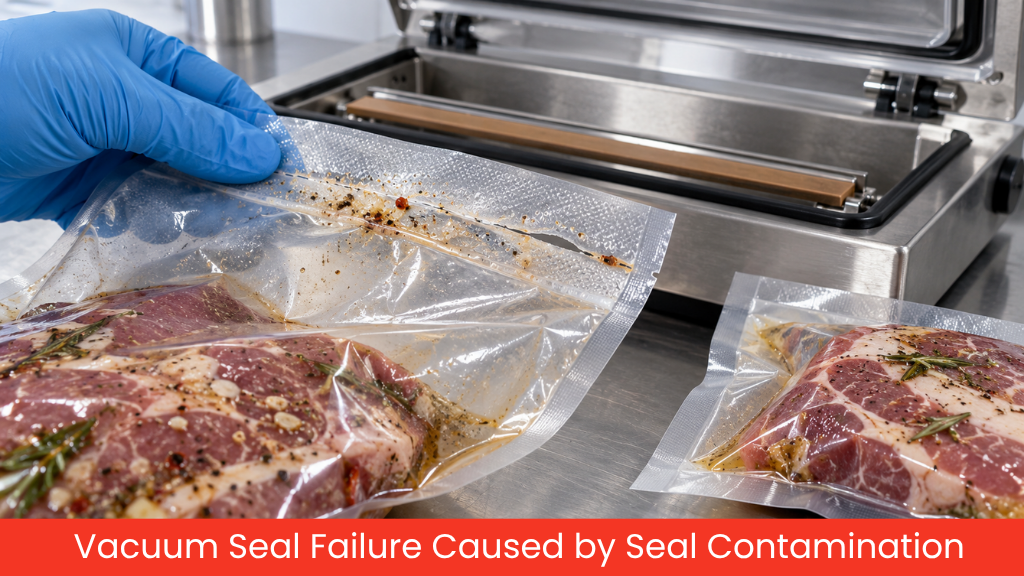
Vacuum seal failure often begins with anything that sits between the two sealing layers. The sealant cannot fuse fully around it, which leaves a weak path for air.
Common contaminants:
Effect on seal strength: Contamination lowers the fused area of the seal and creates channels. Oil and moisture also change how heat moves through the film, so the same settings give a different result.
Correct sealing conditions:
Diagnosis and prevention: Look for particles, grease marks or wet spots under the failed seal. If contaminant marks are present, the cause is housekeeping, not film quality. Wipe bag mouths and use fill funnels or collars for sauces and powders.
Vacuum pouch pinholes are tiny openings in the film, often too small to see at first. Air moves through them slowly, so a tight pack goes slack over hours or days.
Most pinholes start with the product. Bone ends, shell fragments, frozen crystals and hard spices press against the film as the chamber evacuates and the pouch is drawn tight around them. A film with low puncture resistance gives way at that point. Rough handling adds to the damage, especially when packs rub against crate edges.
The quickest way to confirm a pinhole is an immersion test. Submerge the bag, press gently and watch for a fine stream of bubbles, then hold the bag against a bright light. Pinholes tend to cluster near the product feature that caused them, which shows where the film needs protection.
Prevention comes down to four steps:
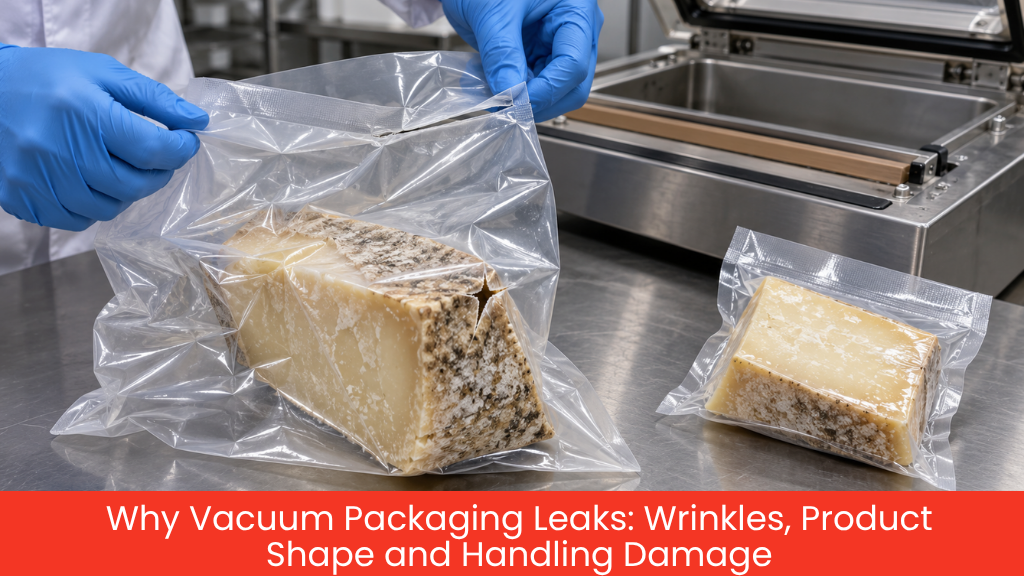
Leaking vacuum packaging is often traced back to a single wrinkle. A crease across the seal leaves a channel where the two layers cannot fuse, and air finds its way through it.
Wrinkles usually come from three places. The first is the bag itself. An oversized bag leaves excess film that folds under the seal bar, and a bag mouth that is twisted before the lid closes does the same. The second is the product, because sharp corners, uneven shapes and overloaded chambers pull or squeeze film into the seal area. The third is movement, where a product shifts during the vacuum cycle and drags the bag mouth with it.
If wrinkles repeat at the same position, the bag size or loading method needs correction, not the machine. Choose a bag width that leaves only a small margin around the product (Vishakha PolyFab supplies VISHVACU in customised widths), smooth the mouth before closing the lid and load products in a fixed position. For soft or irregular products, a slower vacuum draw can reduce film movement where the machine allows it.
Operators should check the seal zone at the start of every batch, so a wrinkle costs one bag, not a full run.
A pack that passes on the line can still lose vacuum later. Storage and transport put stress on both the film and the seal.
Use inner cartons that fit the pack and check a sample after a transport trial.
This table supports quick vacuum bag troubleshooting on the production floor.
Symptom | Possible Cause | Corrective Action |
Vacuum disappears immediately after sealing | Open or incomplete seal, contamination in seal, large hole | Clean seal zone, check temperature, pressure and time, inspect film |
Vacuum reduces after a few hours | Micro leaks, pinholes, marginal seal | Run immersion test, review film gauge, adjust settings |
Seal opens during storage | Low seal strength, unsuitable sealant layer, heat or stress in storage | Verify seal strength, confirm sealant suits the product and machine |
Leakage appears after transportation | Vibration, abrasion, compression, weak carton fit | Improve inner packing, check puncture resistance, run transport trial |
Bag develops pinholes | Sharp product parts, low puncture resistance, rough handling | Use bone guards, increase gauge, choose tougher structure |
Wrinkles appear near seal area | Oversized bag, folded bag mouth, moving product | Match bag size, smooth mouth, fix loading position |
Packaging loses appearance quality | Loose pack from vacuum loss, film scuffing, poor fit | Stabilise vacuum, reduce abrasion, review bag size |
Most vacuum loss can be prevented with steady process discipline.
A supplier can only recommend the right structure with the full picture. Share the following with the Vishakha PolyFab technical team:
A vacuum packaging bags manufacturer can evaluate film structure, thickness and sealing performance based on the product, storage conditions and machine type. Vishakha PolyFab provides customised VISHVACU vacuum film structures in different barrier, temperature and gauge options based on product and machine requirements.
Maintaining vacuum performance requires the right combination of bag structure, sealing conditions, machine settings and handling practices. By identifying whether the issue comes from the seal, film or process, packaging teams can reduce product loss and improve consistency. Vishakha PolyFab supports this with VISHVACU film structures matched to each product and machine.
Vacuum is lost when the seal, the film or the packing process fails. A compromised seal, a pinhole or damage after packing lets air back in. Finding which of the three is involved is the fastest route to a fix.
Submerge the sealed bag in water, press gently and watch for bubbles. The bubble stream shows where the leak is.
Resealing over a damaged or contaminated seal often fails, because the sealant layer may already be thinned or fouled. For food packs, repack the product in a new bag after cleaning, following your food safety procedures.
Mainly sharp product parts such as bone ends or hard crystals, low puncture resistance and rough handling. Bone guards, thicker gauge and tougher structures reduce the risk.
It depends on product weight, how sharp or irregular the product is, shelf life needs and the machine. Heavier and bone in products generally need a higher gauge. Confirm with trials on your machine.

Vishakha Polyfab Pvt. Ltd. is a global pioneer in high-barrier flexible packaging, specializing in advanced 9-layer co-extruded PA/EVOH-based films. Headquartered in Ahmedabad, India, the company utilizes world-class Brampton Engineering (Canada) and Aqua Frost® water-quenched technology to deliver superior shelf-life extension solutions. From Modified Atmosphere Packaging (MAP) to deep-draw thermoforming applications, Vishakha Polyfab delivers compliant, high-performance materials that protect product integrity throughout complex international supply chains. Their expertise in vacuum packaging, thermoforming, and lidding films helps enterprise-level brands in the food, pharmaceutical, and industrial sectors optimize packaging performance and sustainability.

Make Vishakha Polyfab the silent guardian of your products to preserve their vigour and enhance the quality of user interaction with them.
Sign Up for Our Newsletter
Corporate Head Office
Social Media
An ISO & BRCGS Certified Company


Manufacturing Address

