
September 14, 2026
Table of Contents




Table of Contents
Metal parts packaging for long term storage helps limit exposure to moisture, oxygen, dust and handling damage that can affect spare components. Moisture barrier protection, vacuum packaging solutions and suitable barrier structures can reduce contact with humid air. Results still depend on component condition, storage environment and package integrity. Regular package inspection, clear identification and disciplined storage management help ensure that packaged parts stay in usable condition until they are needed.
Spare parts often wait in a warehouse for months or years before they reach a machine or a vehicle. The part does no work during that time, but its surroundings keep acting on it. Humidity, temperature changes, airborne dust and repeated handling all affect the surface.
Effective metal parts packaging combines moisture barrier protection, oxygen control and mechanical protection to keep spare components ready for future use. Vishakha PolyFab, a manufacturer of multilayer barrier films and vacuum pouches, treats this as a system decision rather than the choice of a bag. Its range of flexible packaging solutions reflects that approach.
Without suitable packaging, stored components face several risks:
Short term and long term storage place very different demands on packaging. For a few days or weeks, a corrugated carton with basic wrapping may be enough. Over an extended period, ordinary wraps and general purpose bags can let water vapor and oxygen reach the part gradually.
Metal packaging solutions should be chosen around the component, not the shelf. Metal type, surface finish, weight and expected storage conditions should decide the packaging structure.
Moisture is the most common cause of storage related damage to metal parts. Water vapor can settle on a cold surface as condensation. Even a thin, invisible film of water can start corrosion, especially when salts, fingerprints or residues are present.
Warehouse conditions influence this risk more than many teams expect:
Moisture barrier packaging places a film with low water vapor transmission between the component and the storage area. The technical measure is the Water Vapor Transmission Rate, often written as WVTR. A lower rate means less moisture passes through the film over time.
Sensitive components need particular care. Ground surfaces, bearing races and hydraulic parts can be affected by very small amounts of surface corrosion. For such items, barrier packaging is often combined with desiccants or vapor corrosion inhibitor materials, depending on the specification.
When specifying moisture barrier packaging, Vishakha PolyFab advises reviewing WVTR data against the expected humidity range and storage period, not against pouch thickness alone.
Moisture already inside the pack matters just as much. Parts should be clean and dry before sealing, because packaging cannot protect a surface that is already damp.
Read Our Article
Oxidation needs oxygen. When oxygen reaches a metal surface, especially in the presence of moisture, it drives the reactions that produce rust and discoloration. Limiting the oxygen around the component reduces one of the main conditions for oxidation.
The technical measure here is the Oxygen Transmission Rate, or OTR. Many general purpose plastic films resist moisture reasonably well but allow far more oxygen through. A film chosen only for its moisture performance may therefore be a weak choice for long storage.
Multilayer barrier films address this by combining layers with different jobs:
Polyamide (PA) and ethylene vinyl alcohol (EVOH) are widely used in coextruded barrier structures for this purpose. Vishakha PolyFab multilayer PA/EVOH structures are one option where oxygen resistance is a stated requirement. Oxygen resistance should be specified in the packaging brief, together with the expected storage period.
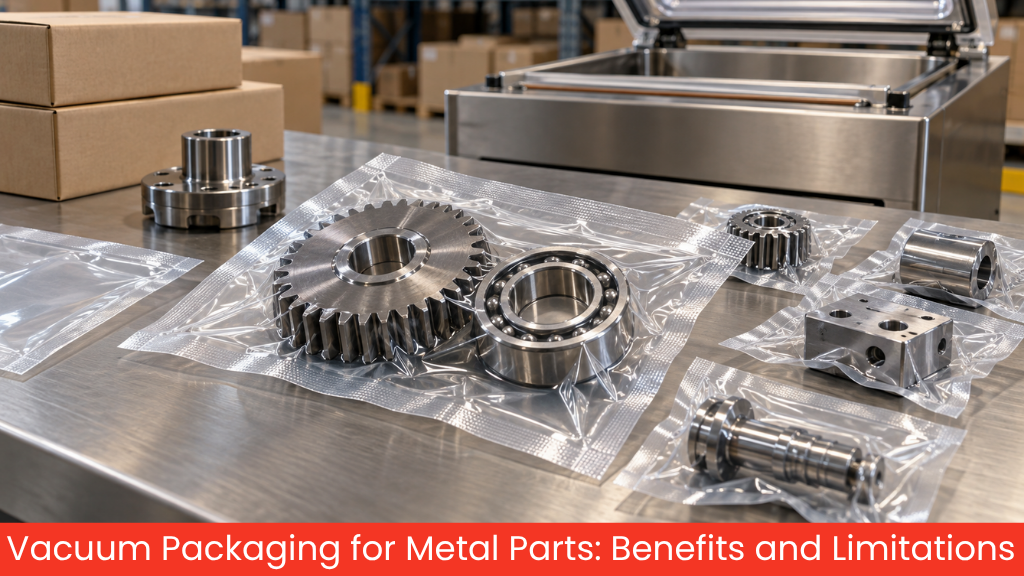
Vacuum packaging removes most of the air from a pouch before sealing. The film then fits closely around the component, and less air remains in contact with the part.
Vacuum packaging for metal parts is useful in these situations:
Advantages
Limitations
Because of these limits, the pouch structure matters as much as the vacuum. Packaging for vacuum use needs a wide sealing window, good puncture resistance and consistent barrier layers. Vishakha PolyFab vacuum pouches are designed with a wide sealing window for automatic vacuum packaging machines.
Our Other Product
Industrial barrier pouches are made from multilayer films and supplied as flat pouches, gusseted bags or larger bags. They can be sealed with or without vacuum, depending on the component and storage plan.
Vishakha PolyFab builds films with 3, 5, 7 or 9 layers. Additional layers let the manufacturer tune thickness, stiffness and puncture resistance for a specific application. For heavy or sharp parts, a thicker structure with a tough polyamide layer is usually the more practical starting point.
Industrial pouches can also be printed with part numbers, handling instructions and batch details, which supports identification later in the storage cycle.
Typical applications:
| Application | Typical Parts | Main Packaging Concern |
| Automotive components | Gears, fasteners, brake and clutch parts | Handling damage, humid stores |
| Machine spare parts | Shafts, couplings, valve components | Weight, sharp edges |
| Precision metal parts | Bearings, dies, nozzles, gauge components | Fine surface protection |
| Replacement assemblies | Pump cartridges, assemblies with mixed metals | Varied shapes and materials |
Many storage failures begin during packing, not on the shelf. A pouch that leaves the packing line with a weak seal or a tiny puncture will not protect the part, however good the film is.
Key process points to control:
Leak testing confirms the result. Common checks include visual seal inspection, water immersion bubble tests and confirming that the pack holds its vacuum after a set period. The method should match the value of the component and the company’s quality procedure.
Consistent results come from documented settings and periodic verification of sealing machines, not from trial and error on every batch. Vishakha PolyFab films are tested for seal integrity, tensile strength and barrier properties, and this data gives packing teams a reference point when setting sealing parameters.
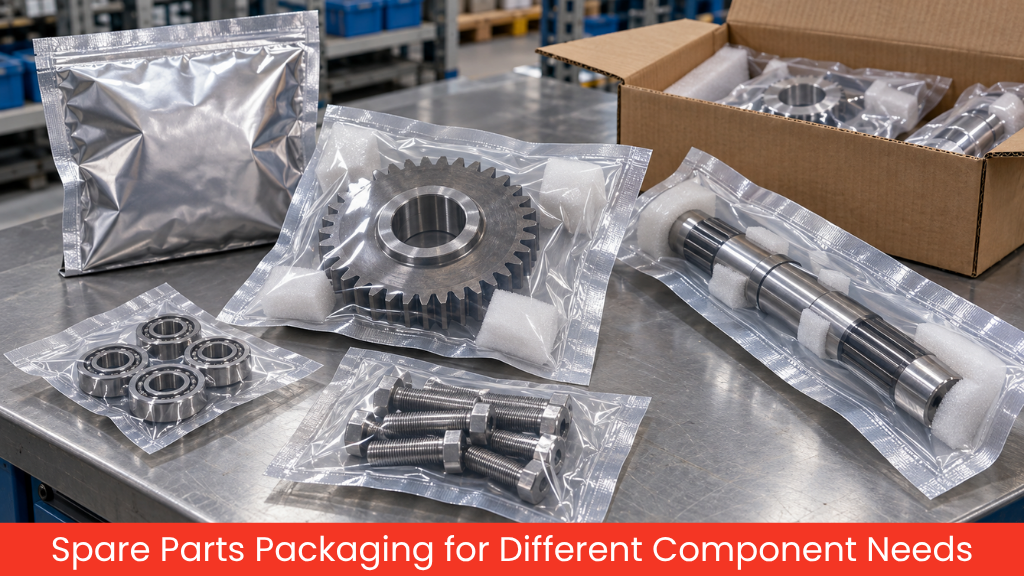
No single pouch suits every part. Spare parts packaging should be selected after reviewing the component and how it will be stored, moved and used.
Factors to evaluate:
Vishakha PolyFab supplies customized pouch sizes and film thicknesses, so packaging can be matched to the component rather than the other way round.
A simple comparison helps procurement and storage teams decide:
Situation | Suggested Approach |
Light parts, short storage, controlled store | Standard moisture barrier pouch |
Long storage, humid warehouse | High barrier pouch, with vacuum where suitable |
Sharp edges or heavy weight | Thicker puncture resistant pouch with edge protection |
Precision surfaces | Barrier pouch, with desiccant or VCI as specified |
Export shipment | High barrier pouch inside a strong outer carton |
Once packs are in the warehouse, integrity depends on how they are stored and moved. A sound seal can still be damaged by rough handling, overloaded shelves or shifting loads in transport.
Points that protect packs after sealing:
Bag durability and puncture resistance are decided at the film selection stage, and Vishakha PolyFab offers high puncture resistance pouches for hardware type items. Handling discipline is what keeps that specification effective over the storage period.
Once a part is sealed, the pack should tell the storage team what is inside without opening it. Opening a pack to check a part breaks the barrier and defeats its purpose.
Good identification includes:
Printed pouches from Vishakha PolyFab or well placed labels help here. Barcodes or QR codes can link each pack to storage records for traceability and stock control.
Clear identification supports warehouse management in practical ways. Teams can locate parts quickly, follow first in first out practice and trace any deterioration back to a batch, packing date or storage zone.
Even good packaging should be checked. Inspection confirms that protection is still working and catches problems before they reach the part.
Key items to review:
Inspection frequency should not follow a fixed rule. It depends on storage conditions, product sensitivity and internal quality procedures. A dry, controlled store may need fewer checks than an open warehouse, and critical parts deserve closer review.
Sampling works well in practice. Select packs from each batch, record the findings and repack or remove any pack that shows damage. Vishakha PolyFab suggests recording findings by batch so packaging performance can be compared over time.
Our Other Product
Working with a metal parts packaging manufacturer helps companies select suitable barrier films, pouch formats and protection levels based on component requirements. Technical support at the selection stage usually prevents costly rework later.
Vishakha PolyFab manufactures PA/EVOH and PA/PE based barrier films and VISHVACU vacuum pouches in 3, 5, 7 and 9 layer structures. Its range includes high puncture resistance pouches designed for hardware type items and vacuum bags used for industrial components that need a hermetic, moisture resistant environment. Films are designed for consistent performance on automatic vacuum packaging machines.
Customization covers pouch size, film thickness and print details, so that packaging can be evaluated against different component types before bulk supply.
Vishakha PolyFab suggests using this checklist when reviewing packaging for long term metal component storage:
Area | Questions to Answer |
Component details | What are the size, shape, weight and quantity per pack? |
Material type | Is the part ferrous, nonferrous or a mixed material assembly? |
Surface protection | Are there oils, coatings or finishes to preserve? Is the surface clean and dry? |
Storage environment | What are the humidity, temperature and storage duration expectations? |
Packaging format | Is a flat pouch, gusseted bag or larger bag best suited? |
Barrier requirements | What moisture and oxygen resistance is needed? |
Vacuum requirement | Will vacuum be used, and are sharp edges protected? |
Identification needs | What print, labels or codes are needed for traceability? |
Supplier technical support | Can the supplier review samples, advise on film structure and customize sizes? |
Reliable protection comes from combining several measures: the right barrier film, a sound seal, clean and dry parts, clear identification and regular inspection. No single step replaces the others.
Vishakha PolyFab works with industrial buyers to match barrier structures and pouch formats to component needs, helping companies reduce corrosion risk, improve storage reliability and maintain spare part readiness throughout long term inventory management.
Moisture and condensation are the main triggers of rust on stored metal components. Moisture barrier packaging limits how much water vapor reaches the part over time. It works best when parts are packed clean and dry, and when the seal stays intact throughout storage.
Vacuum packaging reduces the air, and therefore the oxygen and moist air, around a part, which supports corrosion control. It does not guarantee rust prevention on its own. Part cleanliness, film barrier properties, seal quality and storage conditions all influence the result.
Multilayer barrier pouches with low moisture and oxygen transmission are commonly used, often with vacuum sealing. The right structure depends on the part weight, sharp edges, surface finish, storage duration and transport needs. Desiccants or vapor corrosion inhibitors may be added for sensitive components. Vishakha PolyFab supplies PA/EVOH and PA/PE based pouches for such requirements.
Industrial barrier pouches use multilayer films that slow the passage of moisture and oxygen and keep out dust and splashes. A sealing layer closes the pack, and a tough outer layer resists abrasion. Protection depends on film selection and a leak free seal. Vishakha PolyFab industrial barrier pouches follow this multilayer construction.
Inspect the package condition, seal integrity, visible damage and signs of moisture inside the pack. Also check storage humidity, temperature and cleanliness. Frequency depends on storage conditions, part sensitivity and internal quality procedures, and sampling from each batch is a practical approach.

Vishakha Polyfab Pvt. Ltd. is a global pioneer in high-barrier flexible packaging, specializing in advanced 9-layer co-extruded PA/EVOH-based films. Headquartered in Ahmedabad, India, the company utilizes world-class Brampton Engineering (Canada) and Aqua Frost® water-quenched technology to deliver superior shelf-life extension solutions. From Modified Atmosphere Packaging (MAP) to deep-draw thermoforming applications, Vishakha Polyfab delivers compliant, high-performance materials that protect product integrity throughout complex international supply chains. Their expertise in vacuum packaging, thermoforming, and lidding films helps enterprise-level brands in the food, pharmaceutical, and industrial sectors optimize packaging performance and sustainability.

Make Vishakha Polyfab the silent guardian of your products to preserve their vigour and enhance the quality of user interaction with them.
Sign Up for Our Newsletter
Corporate Head Office
Social Media
An ISO & BRCGS Certified Company


Manufacturing Address

