
September 29, 2026
Table of Contents




Table of Contents
Barrier Films are flexible packaging materials that limit the passage of oxygen, moisture, aroma and light. Medium barrier film suits products with moderate sensitivity and shorter shelf life targets, while high barrier film suits oxygen sensitive or long shelf life products. Selecting flexible barrier films for a food packaging film application depends on product sensitivity, shelf life expectations, storage conditions, distribution environment and cost. Correct packaging material selection matches protection to actual need, avoiding both product loss and unnecessary expense.
A pack of fried snacks that turns stale before its date and a pack of sugar that stays free flowing for months are answering the same question: did the film match the product? Barrier films are flexible packaging films, either coextruded or laminated, designed to slow the movement of oxygen, water vapour, aroma and light between the product and its surroundings. Every polymer transmits some gas and moisture, so barrier performance is a matter of how slowly.
Barrier protection serves four purposes:
Products lose quality through different mechanisms. Edible oil is threatened mainly by oxidation and light, sugar and flour by moisture, and cheese by oxygen and mould. This is why barrier levels are graded, and why the rest of this article focuses on matching the level to the application rather than repeating what each barrier does. Vishakha PolyFab works with PA and EVOH based multilayer films, laminates and CPP films, so how much barrier is enough is a central specification question across its product lines.
A medium barrier film offers meaningful but moderate resistance to gas and moisture transmission. Typical constructions include nylon based coextruded films and polyolefin, polyester or metallized laminates. Depending on design, they can give good moisture control and light protection with moderate oxygen barrier.
A high barrier film usually relies on a dedicated barrier layer. EVOH films are the most common example, often placed between polyamide and polyolefin layers, while aluminium foil and specialised coatings are alternatives. Because EVOH loses some oxygen barrier at high humidity, its position in the structure and its behaviour in humid or retort conditions need attention. Vishakha PolyFab offers nylon based medium barrier films and EVOH based high barrier films, which lets buyers compare both levels within one supplier range.
Aspect | Medium Barrier Film | High Barrier Film |
Typical construction | Nylon based coextrusions, polyolefin, polyester or metallized laminates | Multilayer with EVOH, foil or barrier coatings |
Oxygen protection | Moderate | Very low transmission |
Best suited to | Moderate sensitivity, shorter shelf life | Oxygen or aroma sensitive products, extended shelf life |
Main risk if misapplied | Early quality loss | Unnecessary cost and complexity |
No single numerical threshold separates medium from high barrier, and ranges vary by product category and supplier. Buyers should specify by measured oxygen transmission rate (OTR) and water vapour transmission rate (WVTR) at stated temperature and humidity rather than by category label alone.
Start with the product, not the film. Sensitivity is set by ingredients, fat content, water activity, aroma profile and processing, so two products in the same category can need different structures.
Products with low oxygen sensitivity, short distribution cycles and controlled storage often perform well in a medium barrier film. Sugar, salt and many dry staples are mainly moisture concerns, and short life items moving quickly through a local cold chain have modest oxygen needs. Adding an EVOH layer rarely improves the outcome and raises cost. Vishakha PolyFab laminates are available in standard grades as well as EVOH based high barrier grades.
Practical example: a dry food product sold through regional distribution, with fast stock turnover and a moderate shelf life target, usually needs reliable moisture protection and seal integrity more than an oxygen barrier layer.
Buyers should check:
Oxygen sensitive foods such as cheese, processed meat, seafood, nuts and ground coffee generally call for a high barrier film. So do aroma sensitive products and sauces or ready meals that need extended life. Chilled and frozen foods packed under vacuum or modified atmosphere depend on low gas transmission to hold their shelf life. Vishakha PolyFab’s VISHVACU vacuum pouches use PA/EVOH films for chilled, frozen and processed foods.
Practical example: nuts, coffee or cheese exported over long routes combine oxygen sensitivity with long transit and storage time, which usually justifies a high barrier structure.
Under specifying here shows up as rancidity, discolouration, mould or flavour loss, often after the product has left the factory. Because formulation changes affect sensitivity, testing and validation may be required.
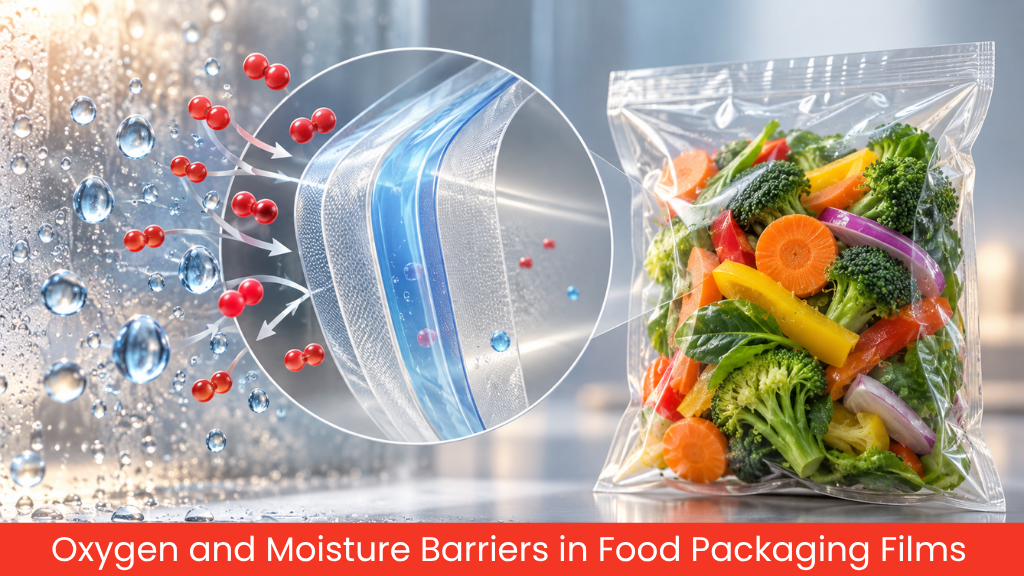
OTR is the volume of oxygen passing through a defined film area per day, commonly expressed in cc per square metre per day (ASTM D3985 is a widely used method). WVTR is the mass of water vapour passing through per square metre per day (ASTM F1249). Lower values mean slower transmission.
Values are only comparable when measured under the same conditions. Permeation generally rises with temperature, and for EVOH structures humidity also matters. Buyers should ask for values at expected storage conditions, not only at standard test conditions. Multilayer barrier films such as Vishakha PolyFab’s VISHBARR range are built around low OTR and WVTR, but the same rule applies to any supplier’s data.
In practice, these numbers translate into three commercial outcomes:
Barrier performance alone does not decide package success. A good food packaging film must also seal reliably, resist puncture and flex cracking, and run on the filling line. A high barrier film with weak seals or pinholes can protect worse than a medium barrier film that stays intact.
Our Other Product
Flexible barrier films reach the market in two main forms. Coextruded multilayer films combine PA, EVOH and polyolefin layers in one process. Laminated films bond separate webs, for example a printed outer film to a barrier or sealant film, so print quality and barrier can be tuned independently. Each application weighs these options differently:
Vishakha PolyFab’s range reflects this variety, spanning vacuum pouches, thermoforming and lidding films, laminates and CPP films in barrier and standard grades.
Sound barrier packaging selection means matching protection to the real requirement. The table shows how the two errors differ.
Factor | Under Specifying Barrier | Over Specifying Barrier |
Product protection | Oxygen or moisture reaches the product faster than it can tolerate, causing oxidation, staling, caking or mould | Protection exceeds what the product can use, with no further quality gain |
Shelf life impact | Usable life falls short of the printed date, especially in warm or humid supply chains | Shelf life may exceed commercial need without adding value |
Cost impact | Low film cost but hidden cost from returns, complaints and waste | Higher material and conversion cost per pack, reducing margin |
Material selection | Structure lacks a needed oxygen, moisture or light layer | Extra layers, thicker gauges or complex laminates without a functional reason |
Application suitability | Fails in demanding formats such as long distance export | Added complexity can affect runnability, sealing and recycling options |
The consequences of under specification are visible: quality complaints, discarded stock and damage to brand trust. Over specification is quieter. It inflates cost, adds material complexity and can complicate recycling, since structures with more layers of different polymers are harder to recover.
Cost should be judged as cost per pack delivered in good condition, not price per kilogram of film. Sometimes a modest step up from a medium barrier film, rather than a jump to the highest structure, is the economical answer. Vishakha PolyFab’s VISHFORM thermoforming films, for example, are available in both barrier and non barrier structures, which reflects that not every pack needs the same level.
The supply chain often decides whether a specification succeeds. Key factors include:
The same product may therefore need different structures for different markets. A biscuit sold within one city and the same biscuit shipped overseas face very different exposure, and trials under realistic conditions help confirm the choice. Vishakha PolyFab exports flexible packaging solutions to more than 30 countries, so climate and route differences are a practical part of specification.
Size changes the physics of protection. Four variables matter: surface area, headspace, product quantity and opening frequency.
Headspace oxygen counts toward the total oxygen load, which is why vacuum packing or gas flushing is often combined with barrier film. Vishakha PolyFab also converts films into pouches in customised formats, so film structure and pack format can be developed together.
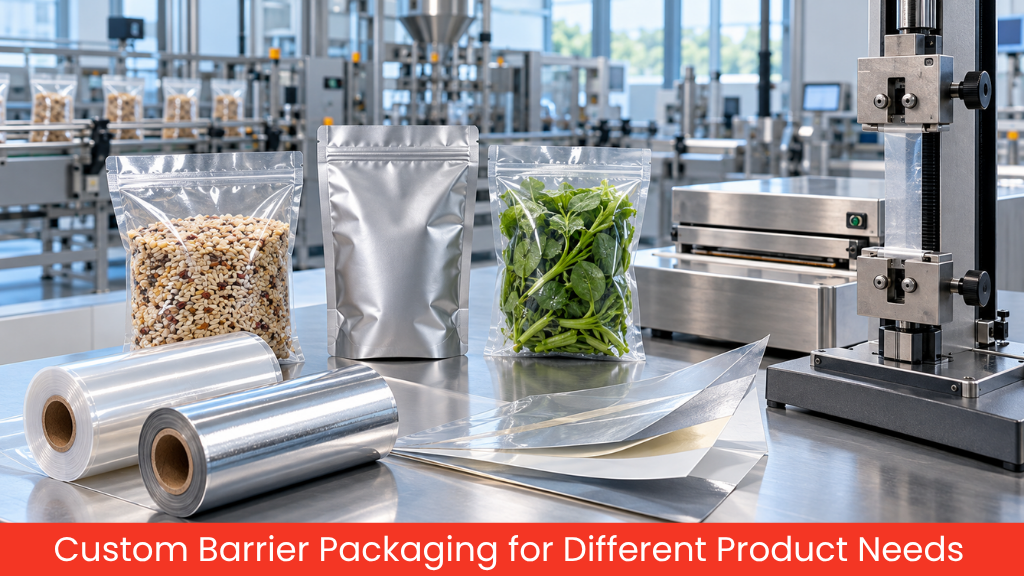
Standard films are useful starting points, but they cannot account for every formulation, filling machine or distribution route. Custom barrier packaging adjusts layer composition, gauge, seal layer, print and surface treatment to a specific product.
Application testing closes the loop. It can include shelf life studies, transit trials, machine trials and seal strength checks. Vishakha PolyFab lists package design and development, customised packaging solutions and field trials among its services.
To help a supplier propose a suitable structure, buyers should share:
Our Other Product
Evaluation should cover more than price. Useful criteria are:
Vishakha PolyFab describes an R&D centre with an on site testing lab and real time gauge and seal testing among its support capabilities. Whichever supplier a team considers, technical support often decides whether a specification performs as intended, so it deserves the same weight as pricing.
Higher barrier is not automatically better packaging, and medium barrier is not enough for every product. The right structure follows from product sensitivity, shelf life expectations, storage conditions, distribution requirements and cost, confirmed through testing and validation.
The right barrier film level protects product quality while avoiding unnecessary material cost, helping manufacturers achieve reliable shelf life and efficient packaging performance. Vishakha PolyFab works with packaging teams to match barrier structures to actual product needs.
Medium barrier film gives moderate resistance to oxygen and moisture and suits products with moderate sensitivity and shorter shelf life targets. High barrier film uses layers such as EVOH, foil or coatings to achieve very low oxygen transmission. It suits oxygen or aroma sensitive products that need extended shelf life.
A high barrier film makes sense when the product degrades quickly on oxygen exposure, when aroma retention is critical, or when shelf life, export distance or warm humid storage place heavy demands on the pack. Testing with the actual product confirms whether the higher level is needed.
No. A high barrier film adds cost and complexity, and it gives no benefit if the product does not need the extra protection. Seal integrity, puncture resistance and correct pack format also affect results. The best choice is the level that meets validated shelf life requirements at a sensible cost.
OTR and WVTR quantify how quickly oxygen and water vapour pass through a film. Comparing them against the product's tolerance, shelf life target and expected temperature and humidity helps narrow the structure. Values should always be compared under the same test conditions.
Teams typically define product sensitivity, shelf life, storage and distribution conditions and pack format. They then shortlist structures by measured OTR and WVTR and validate with shelf life and machine trials before committing. A supplier such as Vishakha PolyFab can support each stage with technical input and trials.

Vishakha Polyfab Pvt. Ltd. is a global pioneer in high-barrier flexible packaging, specializing in advanced 9-layer co-extruded PA/EVOH-based films. Headquartered in Ahmedabad, India, the company utilizes world-class Brampton Engineering (Canada) and Aqua Frost® water-quenched technology to deliver superior shelf-life extension solutions. From Modified Atmosphere Packaging (MAP) to deep-draw thermoforming applications, Vishakha Polyfab delivers compliant, high-performance materials that protect product integrity throughout complex international supply chains. Their expertise in vacuum packaging, thermoforming, and lidding films helps enterprise-level brands in the food, pharmaceutical, and industrial sectors optimize packaging performance and sustainability.

Make Vishakha Polyfab the silent guardian of your products to preserve their vigour and enhance the quality of user interaction with them.
Sign Up for Our Newsletter
Corporate Head Office
Social Media
An ISO & BRCGS Certified Company

Manufacturing Address

