
October 1, 2026
Table of Contents




Table of Contents
A flexible packaging solution should be evaluated with the intended product, packing equipment and distribution conditions before commercial production. This guide explains the checks buyers should plan, the evidence to retain and the decisions needed before approval.
Choosing a flexible packaging solution involves more than approving a material sample or comparing film thickness. Before commercial production, buyers need evidence that the proposed pack suits the product, runs on the intended equipment and performs under expected storage and distribution conditions.
Flexible packaging validation brings these checks into one planned evaluation. It helps quality, production and procurement teams identify unresolved issues before committing to commercial quantities. A datasheet or printed proof describes the material, but cannot show how it behaves with a particular product on a particular line. This is why Vishakha PolyFab lists field trials and enhancement alongside package design and development.
The evaluation starts with packaging compatibility testing to review the product, material and pack components. The packaging trial process then examines performance on the intended line, and seal integrity testing evaluates the closure produced during packing.
Storage and transportation assessments examine different exposure conditions. Shelf-life testing then evaluates whether the packed product maintains its required quality throughout the intended period.
Validation is only as reliable as the requirement it is measured against. Before requesting samples, the buyer’s quality, production and procurement teams should agree a written brief and share it with the packaging supplier. Vishakha PolyFab describes this as the first step of its own approach: working closely with customers to understand their requirements fully.
The brief tells the supplier which properties matter most, whether barrier level, formability, sealability or print. This allows the structure of multilayer flexible films to be chosen for the application rather than adjusted after problems appear. Each item below is information to confirm, not a specification already assumed:
Acceptance criteria belong in this brief. For every later stage, record what result will count as acceptable, how it will be evaluated and who decides.
Settling this before any material runs prevents results from being interpreted around the outcome. The rest of this guide assumes those criteria exist and focuses on what each stage examines.
Packaging compatibility testing asks three separate questions, because a material can satisfy one and fail another.
Oily, aromatic, liquid or sharp products each place different demands on flexible packaging film. Vishakha PolyFab describes its VISHBARR barrier films as resistant to oil and solvents with strong aroma retention. It also offers VISHVACU vacuum pouches in high puncture resistance grades.
A low oxygen transmission rate, meaning little oxygen passes through the film, helps oxygen sensitive products. It is still only one property. High barrier films that suit a product chemically can be the wrong choice if they do not form, seal or run reliably.
The material must run on the intended machine. Vishakha PolyFab states that VISHBARR PLUS films can be customised for different vertical form fill seal machines, while VISHFORM thermoforming films are designed for deep draw packs in vacuum and modified atmosphere formats.
VISHLAMI lamination films can be customised for thickness, seal layer and surface treatment. Gauge, width, seal layer and roll specification should be reviewed against the actual line and process, including any heat treatment the pack will undergo.
Where a formed base or tray is closed with a separate lid, the two webs must seal to each other. VISHTOP tray lidding film is described as matchable to PE, PP, PS, PET, PVC and aluminium substrates, in peelable and permanent seal grades.
For packs using forming and non-forming films, confirm compatibility between the selected bottom and top webs before machine trials. Review the exact material grades and intended seal behaviour together.
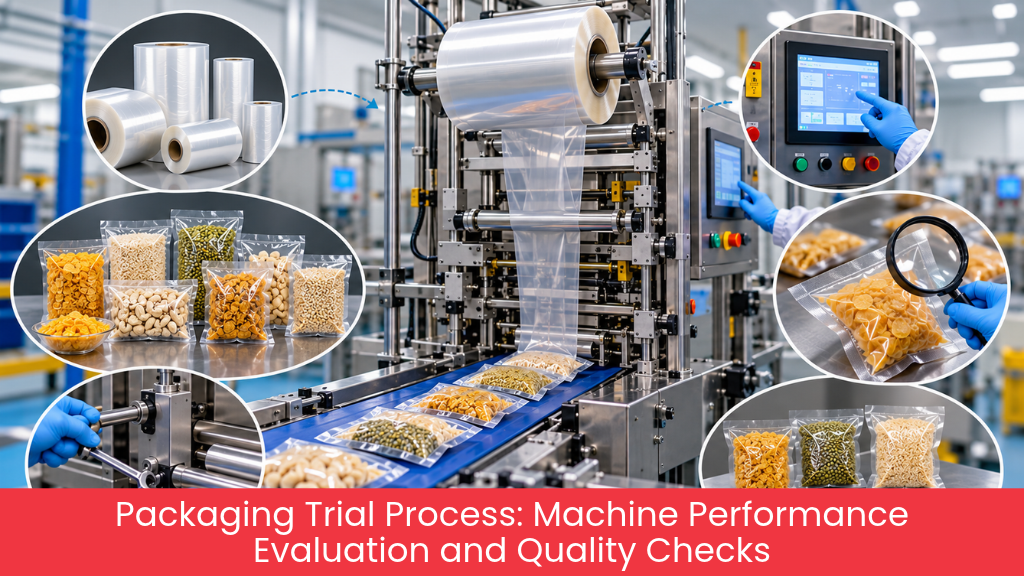
The packaging trial process is where product, material and machine first meet. A trial that produces good packs but records no settings, roll references or adjustments cannot be reproduced reliably in production.
The fields below form a suggested documentation checklist for buyers and suppliers to adapt. They are not a published Vishakha PolyFab procedure.
A clean sample run is encouraging but not conclusive. Trial conditions can differ from daily production in line speed, operator experience, run length and roll changes.
The teams should compare the trial against intended commercial operation and decide whether a further run under production conditions is needed. Where adjustments are required, Vishakha PolyFab notes that options such as gauge, width and seal layer can be tailored for several of its film ranges. Retained samples also supply the seal, storage and shelf-life evaluations that follow.
Seal integrity testing evaluates whether pack closures are complete and resist leakage under defined test conditions. A barrier film offers little protection if the closure fails, so seal performance deserves its own review. The buyer and technical teams should ask:
Visual inspection is a useful first screen, but a seal can look complete and still leak. It cannot replace an agreed evaluation method.
Vishakha PolyFab’s brochure refers to real time seal testing within its manufacturing quality systems, and its website states that VISHVACU vacuum packaging films are tested for seal integrity in its in-house laboratory. These statements describe the company’s own quality checks. They do not by themselves establish what test evidence accompanies a particular supplied batch, so buyers should agree the supporting documentation with the supplier. Closures formed on the buyer’s machine also need evaluating separately.
Storage evaluation looks at how the sealed pack holds up where it will actually sit, whether a cold store, freezer, retail chiller or ambient warehouse. Its focus is packaging condition over time, which keeps it distinct from shelf-life work on the product. Teams should define:
Format and environment shape what is worth monitoring. Vishakha PolyFab offers anti fog lidding options and films described for freezing applications.
A chilled lidded tray would be checked for fogging and presentation, while a frozen vacuum pack would be watched for vacuum retention and low temperature damage. Results from one environment should not be assumed to apply to another.
Distribution introduces handling, stacking, loading and climate changes that storage alone does not reveal. Sharing the planned route early helps, because it can influence material gauge, puncture resistance and outer packing decisions. Useful planning questions include:
For exporters, destination conditions and documentation expectations can differ from the home market. These should be raised during validation planning rather than discovered after the first shipment.
Vishakha PolyFab exports flexible packaging solutions to more than 30 countries, which provides useful context. Each route and pack combination still needs its own evaluation.
Shelf-life testing treats the target shelf life as a requirement to demonstrate, not a property that arrives with the film. Barrier flexible packaging films influence how quickly oxygen and moisture reach the product, which is why Vishakha PolyFab offers films across a range of oxygen transmission rates.
The shelf life actually achieved also depends on the product, its processing and the conditions after packing. The relevant teams should establish:
When evaluating flexible packaging for food products, the manufacturer’s quality and food safety teams should determine which product attributes require assessment throughout the intended shelf life. Packaging performance contributes to preservation, but commercial approval also requires evidence that the contents remain within the product’s defined quality and safety requirements.
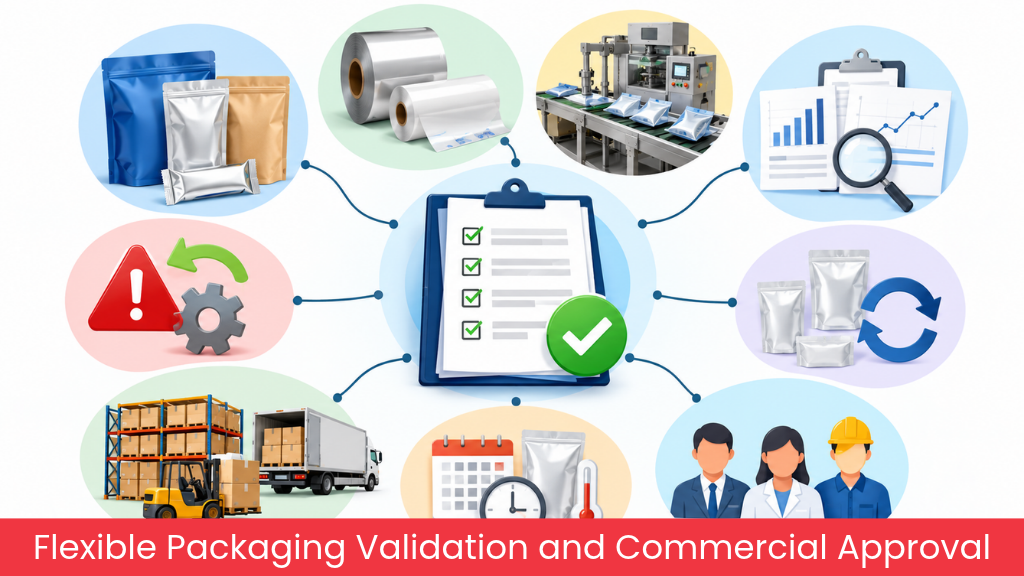
Commercial approval turns the evidence from earlier stages into a decision that can be traced later, for example during a complaint or customer audit. A proposed approval file brings together:
The approval should name the exact combination evaluated: product, packaging material, pack format, packing machine, process and distribution route. It does not automatically extend to a different product, machine, tray supplier or recipe.
When any element changes, the responsible technical teams should decide whether further evaluation is needed and record that decision in the same file. Recording the exact Vishakha PolyFab material reference used in the trial helps ensure that commercial supply matches what was approved.
This is a practical planning checklist, not a published Vishakha PolyFab testing protocol.
Validation Stage | What to Confirm | Evidence or Record to Review |
Requirement definition | Product, format, equipment, environment, route, shelf life and acceptance criteria are agreed | Signed requirement brief |
Compatibility | Material suits the product, the machine and any mating tray or lid | Compatibility review notes |
Trial packing | Pack runs acceptably and trial conditions reflect production | Trial record and retained samples |
Seal integrity | Closures meet the agreed evaluation | Seal evaluation results |
Storage | Pack condition holds in the intended environment | Storage observations at review points |
Transportation | Packs arrive in acceptable condition via the planned route | Post distribution inspection record |
Shelf life | Product meets its target over the agreed period | Product and pack assessment results |
Commercial approval | Evaluated combination is approved with open issues resolved | Approval file and reference samples |
Vishakha PolyFab manufactures flexible packaging materials for food, non-food and institutional applications. Its portfolio includes VISHVACU vacuum bags and pouches, VISHFORM thermoforming films, VISHTOP top lidding films, VISHBARR barrier films and VISHLAMI laminated films.
Vishakha PolyFab offers package design and development, customised packaging solutions, and field trials and enhancement, with its R&D centre and on-site testing laboratory supporting custom development work. The most useful starting point is a complete brief. Sharing product details, packing equipment information and intended storage and distribution conditions allows its technical experts to propose a suitable structure and plan trials around the intended application. Contact Vishakha PolyFab to begin a packaging development discussion.
Quality, production, procurement and product development teams each own different evidence, and the packaging supplier's technical team should join from the requirement stage. Naming one coordinator on the buyer's side and one contact at Vishakha PolyFab keeps trial records, samples and decisions in a single file.
Not automatically. A film that suits one product may respond differently to another product's fat content, moisture, shape or processing. Vishakha PolyFab's technical team can review whether the current structure suits the new application or whether a different grade fits better.
Record the defect, settings and adjustments, retain affected samples, and identify whether the cause lies with material, machine, product or format. Sharing these records with Vishakha PolyFab helps decide whether a material change, setting change or repeat trial is the right next step.
Yes. A recyclable structure is a material change, so its forming, sealing and barrier behaviour should be evaluated with the actual product and line. Vishakha PolyFab offers REGAIN recyclable barrier films, and its team can help plan the trials needed to compare them with the current structure.
There is no fixed duration. Trial packing may be completed quickly, while storage and shelf-life assessments run for the period the teams agree, which often depends on the target shelf life. Agreeing the full plan with Vishakha PolyFab at the start makes the overall timeline clearer.

Vishakha Polyfab Pvt. Ltd. is a global pioneer in high-barrier flexible packaging, specializing in advanced 9-layer co-extruded PA/EVOH-based films. Headquartered in Ahmedabad, India, the company utilizes world-class Brampton Engineering (Canada) and Aqua Frost® water-quenched technology to deliver superior shelf-life extension solutions. From Modified Atmosphere Packaging (MAP) to deep-draw thermoforming applications, Vishakha Polyfab delivers compliant, high-performance materials that protect product integrity throughout complex international supply chains. Their expertise in vacuum packaging, thermoforming, and lidding films helps enterprise-level brands in the food, pharmaceutical, and industrial sectors optimize packaging performance and sustainability.

Make Vishakha Polyfab the silent guardian of your products to preserve their vigour and enhance the quality of user interaction with them.
Sign Up for Our Newsletter
Corporate Head Office
Social Media
An ISO & BRCGS Certified Company


Manufacturing Address

