
October 9, 2026
Table of Contents




Table of Contents
Choosing a snack packaging film for a high-speed VFFS line means evaluating roll consistency, film tracking and friction, thickness consistency, the seal window, hot tack and print registration together, not just a single barrier rating. Performance depends on how the film, the machine, the snack and the operating conditions combine, so suitability should be confirmed through a production trial with the actual product rather than assumed from general claims.
Choosing a snack packaging film is not just about picking a barrier rating off a datasheet. The film has to run on the vertical form fill seal (VFFS) line it is meant for. It has to seal consistently around the product being filled. It also has to hold its printed artwork in register, pack after pack.
A rollstock that performs well on one machine, with one snack, at one speed, will not automatically behave the same way on a different line or with a different fill. Film movement, sealing, print alignment and line interruptions all depend on how the film, the machine, the product and the operating conditions work together.
Selecting VFFS film for snacks starts with the product’s physical characteristics. Products with sharp edges, oily surfaces, fine particles or high moisture content each place different stresses on a rollstock. These characteristics should be confirmed before a film is shortlisted.
Snack Category | Product Characteristics to Establish | Packaging Requirement to Discuss |
Chips | Oil content on the surface, fragility, static charge | For chips packaging machine film, assess oil resistance, product breakage risk and seal-area contamination |
Wafers | Layer thickness, brittleness, bulk density | Moisture protection and the complete pack arrangement needed to limit breakage |
Popcorn | Low bulk density, sharp kernel edges, aroma sensitivity | Volume to weight fill behaviour, aroma retention, resistance to piercing |
Namkeen | Mixed particle sizes, oil migration, spice aroma | Oil and aroma barrier, seal integrity around uneven product contact |
Nuts | Oil content, rancidity sensitivity, hard edges | Oxygen barrier for shelf life, puncture resistance |
Biscuits and other bakery snacks | Fragility, moisture sensitivity, stacking in pack | Moisture barrier and any additional support needed for fragile products |
Each category is a starting point for discussion, not a fixed prescription. The film construction suited to a given snack, fill weight and pack format needs to be confirmed with the supplier rather than assumed from a general category. A pack’s resistance to breakage or crushing comes from the film, the pack design and any outer carton or tray together, not from the film alone.
As high barrier snack packaging, Vishakha PolyFab’s VISHBARR range is built on PA/EVOH-based multilayer coextrusion. It offers protection against oxygen, water vapour and aroma loss, which is particularly relevant for oil bearing and aroma sensitive snacks such as namkeen and nuts.
Before tracking or sealing performance can be assessed, the rollstock packaging film itself needs to meet the specification the line was set up around.
Buyers should confirm roll width, core compatibility, winding orientation, roll build and splice requirements with their supplier. Where numerical winding tolerances or splice controls are not stated upfront, treat these as specification and acceptance questions to raise directly with Vishakha PolyFab.
Machinability on a VFFS line comes down to two related but distinct areas.
Tracking is how consistently the web follows its intended path through the forming collar, over rollers, and down the forming tube. Poor tracking can show up as wandering edges, wrinkling at the seal area, or misalignment that worsens as the run continues.
Friction is how the film interacts with machine surfaces, such as the forming collar, sealing jaws and guide rollers. It also covers how film surfaces contact each other in the pack.
During a trial, record tracking behaviour, any drift and any snagging at operating speed.
The lowest possible friction is not always the goal. Some friction is needed for the film to grip rollers and feed correctly. A tracking issue should not automatically be treated as a film defect either, since collar alignment, roller tension and machine setup all play a part.
A quoted film thickness is a nominal figure, not a guarantee of consistency across the width or length of a roll.
VISHBARR NG films are available from 40 to 250 microns. VISHLAMI laminated structures run from 30 to 300 microns. A wide available range describes what can be manufactured, not the tolerance on any single order.
Buyers should ask what thickness specification applies to their proposed packaging roll film. They should also ask what supporting consistency information, such as gauge variation data and acceptance criteria, the supplier can provide for that specific order.
A thicker film does not automatically run better. A thinner film does not automatically reduce total packaging cost once machine performance, seal reliability and product protection are all accounted for.
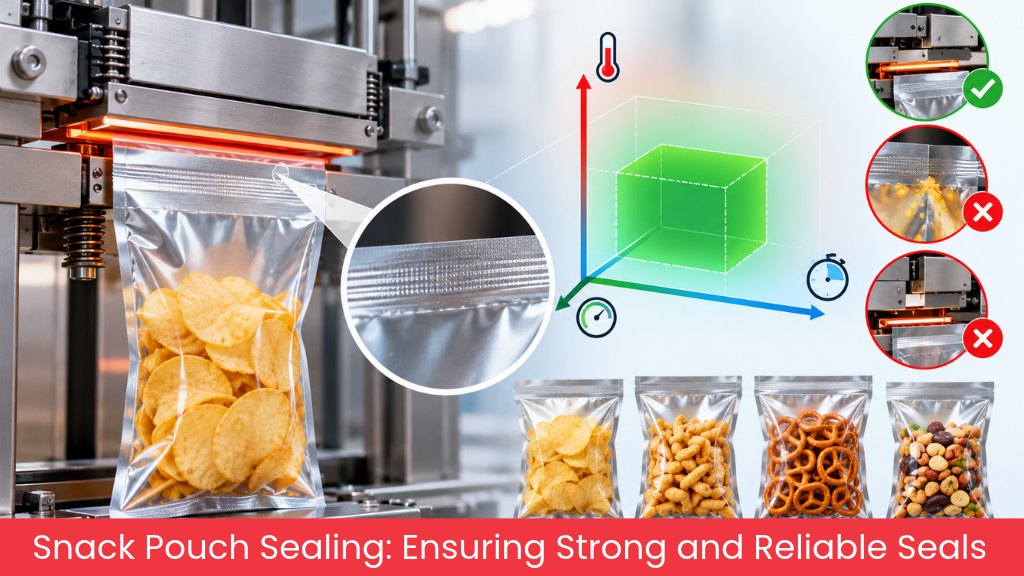
The seal window is the range of sealing conditions, broadly temperature, dwell time and jaw pressure, within which a film produces a reliable seal.
A film that seals well at one combination of these variables may underperform outside that range. The seal window needs to be established for the specific film, machine and product combination rather than assumed from general literature.
VISHBARR films are described as offering strong sealing performance with elevated temperature resistance. Film selection alone does not resolve sealing problems that come from machine calibration, product interference at the seal area, or incorrect jaw settings.
Hot tack is the strength of a seal in the brief interval after the jaws open but before the film has fully cooled. It is distinct from the seal window above and from final, fully cooled seal strength.
On a high-speed VFFS line, the pack is often being formed, dropped or indexed while the seal is still warm. Adequate hot tack keeps that seal intact during that window rather than failing under the weight of the product.
VISHBARR lists hot tack among its performance features; suitability at the intended speed requires evaluation.
Print quality and print registration are often discussed together but are not the same thing.
Print quality concerns the sharpness, colour accuracy and finish of the artwork on the roll. Registration concerns whether the printed repeat stays aligned with where the machine forms and cuts each pack, run after run, at operating speed.
Vishakha PolyFab offers printed laminated films with up to nine-colour printing through rotogravure and CI Flexo processes. Buyers should assess print capability separately from the film’s registration performance on their particular VFFS machine.
Buyers should confirm artwork repeat length, registration mark requirements and compatibility with their own machine’s sensor system directly with the supplier.
A film described as suitable for high-speed VFFS applications does not carry one universal speed rating. Achievable running speed depends on the snack being packed, the fill quantity, the pack format, and the specific machine and operating conditions in use. Confirming this, and everything covered above, calls for a production trial with the actual product.
A useful trial record should capture:
Agree trial responsibilities, acceptance criteria and available technical support with the supplier and machine team before testing.
A film recommendation, whether for rollstock or finished snack packaging bags, is only as useful as the information behind it. When approaching a supplier, it helps to have the following ready:
Sharing this information upfront lets the supplier narrow down a relevant film construction rather than working from assumptions.
Vishakha PolyFab is an Indian manufacturer of flexible barrier packaging films, with a track record in seven- and nine-layer coextruded film production. For snack packaging on VFFS lines, its VISHBARR range offers PA/EVOH-based multilayer barrier films with hot tack and sealing performance suited to vertical form fill seal equipment, while VISHLAMI covers coextruded laminated films for laminated snack pouches and other print or substrate combinations beyond VFFS.
The company’s portfolio also includes VISHVACU vacuum packaging pouches, VISHFORM thermoforming films for deep-draw applications, VISHTOP tray lidding films, and REGAIN recyclable barrier films. Films across the range can be customised in gauge, print and barrier structure, and production runs through ISO and BRCGS certified facilities. Application-specific details should still be confirmed with the supplier.
Approving a snack packaging film for a high-speed VFFS line should be a decision made against the actual production conditions it will face, not against general barrier or printability claims alone. Confirming performance through documented trials gives a far more reliable basis for commercial adoption than any single specification sheet can.
If you are evaluating film options for an upcoming or existing VFFS line, Vishakha PolyFab welcomes a conversation about your snack, machine and film requirements.
Not reliably. Oil content, particle sharpness and moisture sensitivity vary widely between snack categories, so suitability needs confirming for each distinct snack and pack format. Discuss each snack's requirements with Vishakha PolyFab before adopting a common specification.
No. Achievable speed depends on the product, pack format and machine. Buyers should validate the intended speed through a production trial and discuss film requirements with Vishakha PolyFab.
Details such as the snack type, fill quantity, machine make and model, current film construction, required speed and any observed production issue all help. Sharing this with Vishakha PolyFab allows a more relevant film recommendation.
A repeat trial is generally advisable whenever the fill product, pack dimensions or film structure changes meaningfully, since sealing, tracking and speed performance are specific to that combination. Discuss repeat trial requirements and available technical support with Vishakha PolyFab.
Price alone rarely tells the full story. Buyers should also compare documented barrier figures, thickness specification and tolerance, and what each supplier states about trial support. Requesting comparable technical detail from Vishakha PolyFab alongside a competing quotation helps make that comparison on equal terms.

Vishakha Polyfab Pvt. Ltd. is a global pioneer in high-barrier flexible packaging, specializing in advanced 9-layer co-extruded PA/EVOH-based films. Headquartered in Ahmedabad, India, the company utilizes world-class Brampton Engineering (Canada) and Aqua Frost® water-quenched technology to deliver superior shelf-life extension solutions. From Modified Atmosphere Packaging (MAP) to deep-draw thermoforming applications, Vishakha Polyfab delivers compliant, high-performance materials that protect product integrity throughout complex international supply chains. Their expertise in vacuum packaging, thermoforming, and lidding films helps enterprise-level brands in the food, pharmaceutical, and industrial sectors optimize packaging performance and sustainability.

Make Vishakha Polyfab the silent guardian of your products to preserve their vigour and enhance the quality of user interaction with them.
Sign Up for Our Newsletter
Corporate Head Office
Social Media
An ISO & BRCGS Certified Company


Manufacturing Address

