
June 26, 2026
Table of Contents




Table of Contents
Specialty food brands in coffee, tea, spices, and artisanal products depend on vacuum bags to preserve volatile aromatic compounds that define sensory experience and justify premium pricing. Vacuum sealing removes oxygen that oxidizes flavor-bearing volatiles, while multi-layer barrier films prevent aromatic loss through evaporation—critical for products where aroma comprises 80% of perceived quality. Global coffee roasters, tea importers, and specialty food retailers source customized vacuum bags from India’s flexible packaging manufacturers to achieve barrier film performance maintaining product integrity across extended retail shelf life. Vishakha Polyfab’s VISHVACU vacuum bagging films deliver the oxygen transmission control and customization flexibility enabling premium brands to reach international consumers without aroma degradation, moisture loss, or sensory compromise.
Aroma represents the most volatile component of specialty food products, yet it receives minimal attention in packaging discussions dominated by mechanical protection and moisture barrier metrics. For coffee, tea, spices, chocolate, and artisanal food categories, aroma loss represents the primary quality degradation pathway—more damaging than moisture ingress or physical damage. A premium single-origin coffee bean loses characteristic fruity or floral notes within weeks of exposure to ambient oxygen; a high-grade oolong tea’s complex fermentation aromatics become muted and indistinct within months without protection.
Vacuum bags engineered specifically for aroma preservation protect these volatile organic compounds through simultaneous removal of oxygen (which oxidizes aromatics) and barrier film construction preventing aromatic molecule escape through permeation. This protection becomes the invisible component differentiating exceptional products from commodity alternatives in competitive retail environments.
Aromatic volatiles—the organic compounds creating distinctive sensory perception in coffee, tea, spices, and specialty foods—exist as molecules dispersed throughout product matrices. These molecules differ fundamentally from structural nutrients; oxidation and evaporation compromise them while leaving visible product appearance and nutritional composition ostensibly intact. Consumers detecting aroma loss without obvious quality indicators often perceive products as “off,” resulting in returns or negative reviews despite technical adequacy.
Oxygen presence accelerates oxidative degradation through enzymatic and free-radical pathways converting aromatic compounds into flavorless or off-flavor alternatives. Roasted coffee exposed to ambient air experiences rancidity within 2-3 weeks; sealed in vacuum, identical coffee maintains flavor profile for 4-6 months. The single variable—oxygen exclusion—determines whether premium coffee commands retail price premiums or degrades to commodity status.
Aromatic molecules evaporate through polymeric film structures lacking sufficient barrier resistance. Standard polyethylene or single-layer polypropylene allow aromatic escape comparable to unpackaged products; multi-layer PA/EVOH films restrict molecular permeation to minimal levels, preserving sensory complexity.
Oxygen transmission rate (OTR)—measured in cc/m²/day—determines how rapidly oxygen infiltrates sealed packages. Standard films allow 100-500 cc/m²/day; premium multi-layer constructions achieve 1-5 cc/m²/day. For aroma-sensitive products, OTR below 5 cc/m²/day becomes essential. Coffee roasters targeting 4-6 month shelf life specify films with OTR not exceeding 3 cc/m²/day; premium loose-leaf tea exporters request OTR below 2 cc/m²/day to maintain complex fermentation aromatics.
Aromatic permeability represents a separate metric from standard gas permeability. Aromatic molecules larger and more complex than oxygen require thicker barrier layers or chemical interactions preventing molecular escape. Multi-layer nylon (PA) structures incorporating EVOH (ethylene vinyl alcohol) provide dual protection—EVOH blocks aromatic molecule migration while nylon provides mechanical strength. Layering thickness and composition determine aromatic retention efficiency.
Moisture vapor transmission rate (MVTR) complements OTR protection. Specialty foods like loose-leaf tea or spices require moisture exclusion preventing mold growth and texture changes. Premium vacuum bags balance low OTR (oxygen exclusion) with controlled MVTR (moisture protection), requiring engineering expertise to optimize both properties simultaneously.
Specialty coffee roasters producing single-origin or small-batch products justify premium retail pricing only through sensory integrity and flavor complexity. Achieving this requires packaging protecting roasted coffee aromatics throughout multi-week international transport and retail shelf display.
Premium roasters specify vacuum bags with integrated one-way degassing valves—allowing CO2 release from freshly roasted coffee while preventing oxygen infiltration. This specialized function requires precise engineering; only dedicated coffee-grade vacuum bags deliver reliable valve function without compromising seal integrity. Standard food vacuum bags lack valve integration, making them unsuitable for high-volume coffee applications.
Customized printing on transparent vacuum bags showcases coffee quality through visual presentation while protecting product. High-quality rotogravure printing displays roasting date, origin information, and tasting notes that influence consumer perception. This branding integration—merging protection with marketing—available only through customized vacuum bags from specialized manufacturers—enables roasters to command premium pricing justified by perceived quality.
Coffee roasters sourcing customized vacuum bags in bulk (100,000+ units annually) achieve per-unit costs supporting margins while maintaining aroma protection throughout extended supply chains. Importers bringing coffee directly to regional roasting facilities depend on vacuum bag protection maintaining green bean quality until roasting; post-roasted coffee depends on vacuum protection preserving roaster value addition.
Specialty tea markets segment by oxidation level (white, yellow, green, oolong, black) with corresponding aroma profiles justified through meticulous processing and grade selection. A premium oolong tea commanding $50-200 per ounce derives value from complex fermentation aromatics; commodity oolong at $2-5 per ounce contains equivalent nutritional compounds but lacks aroma sophistication due to suboptimal processing or storage degradation.
Custom vacuum bags with transparent construction showcase visual characteristics indicating quality—leaf color, leaf size, oxidation evenness. Premium teas demand visual verification capability unavailable through opaque packaging. Multi-layer barrier films preventing aroma escape must simultaneously maintain exceptional clarity; not all vacuum bag constructions achieve this combination.
Customizable printing accommodates extensive labeling requirements communicating origin (Darjeeling, Oolong region, specific estate), harvest timing (first flush, second flush), oxidation percentage, and steeping instructions. This detailed communication justifies premium pricing by educating consumers about product characteristics. Standard vacuum bags lack printing capability; specialty tea brands require manufacturing partners offering advanced printing integrated with barrier film construction.
Our Other Product
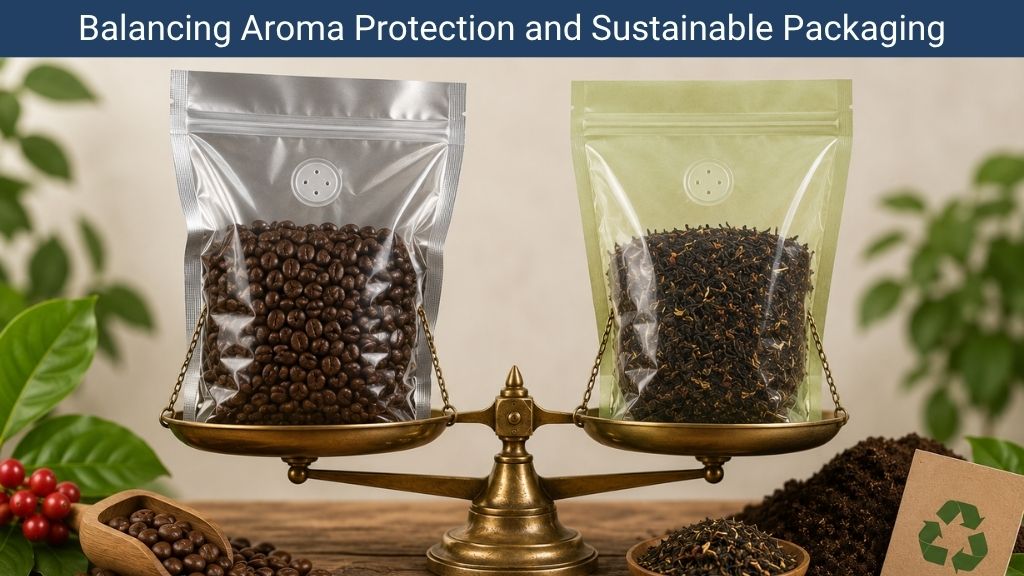
Growing consumer preferences for sustainable packaging create tension with aroma protection requirements. Traditional multi-layer nylon-polyethylene films optimize barrier properties but present recycling challenges. Compostable vacuum bags using plant-based polymers offer environmental benefits but compromise barrier performance—typically achieving OTR of 10-20 cc/m²/day versus 2-5 cc/m²/day for conventional films.
Premium brands address this tension through segmentation. Products destined for markets prioritizing aroma preservation (specialty coffee, high-grade tea, artisanal spices) utilize conventional multi-layer films ensuring maximum sensory preservation. Products targeted at sustainability-focused consumers (increasingly common in Europe and Australia) accept modest aroma compromise in exchange for compostable packaging. This strategy acknowledges that environmental responsibility and sensory optimization represent distinct customer values.
Manufacturers like Vishakha Polyfab increasingly offer compostable vacuum bags meeting ASTM D6868 or similar certification standards while delivering barrier properties adequate for 2-3 month shelf life. This bridges sustainability and protection objectives, enabling premium brands to satisfy environmental positioning without compromising core product quality.
North American specialty coffee market reached $8+ billion annually, with boutique roasters collectively representing $2+ billion. These roasters universally source customized vacuum bags protecting roasted coffee aromatics during retail display. European countries with strong coffee culture (Scandinavia, Germany, Netherlands) similarly demand premium vacuum packaging supporting brand differentiation.
Japanese and Korean premium tea markets represent significant consumers of customized vacuum bags, with international tea importers sourcing specialized packaging supporting direct-to-consumer e-commerce. Middle Eastern spice traders depend on vacuum bags preserving complex spice aromatics (saffron, cardamom, agarwood) that define luxury positioning.
Australian and New Zealand artisanal food producers (specialty chocolate, coffee, dried fruits) increasingly export through e-commerce channels depending on vacuum protection maintaining sensory quality during weeks of transit. EU regulatory frameworks favoring sustainable packaging drive demand for compostable vacuum bags suitable for specialty foods, creating market growth in this segment.
Direct-to-consumer e-commerce for specialty foods requires packaging protecting sensory quality across uncontrolled shipping conditions (temperature fluctuations, humidity variation, extended transit duration). Retail shelf-display occurs in controlled environments; e-commerce shipment traverses warehouses and transport networks without temperature management.
Vacuum bags specifically engineered for aroma protection enable specialty brands to sell directly to global consumers, bypassing traditional retail distribution requiring large wholesale volumes. A small-batch coffee roaster can ship to 50 countries via e-commerce when vacuum bags ensure that customer-received product matches sensory promises made through website descriptions and images.
Custom printing on vacuum bags enables direct consumer connection—including roasting date, brewing instructions, tasting notes, and brand story. This direct marketing occurs through packaging itself, creating unboxing experience reinforcing premium positioning and justifying direct-to-consumer pricing substantially exceeding retail alternatives.
Oxygen transmission rate specification requires matching product type and intended shelf life. Coffee and tea targeting 4-6 month retail display require OTR below 3 cc/m²/day; shorter shelf-life products (dried herbs, spices) tolerate OTR up to 5 cc/m²/day. Specification documentation ensures consistent performance across production batches.
Custom printing specifications must address color accuracy (tea and coffee consumers expect precise shade reproduction), ink food-contact certification, and print durability through storage and transport. Multi-color rotogravure printing enables photographic quality presentation justifying premium positioning.
Valve integration (for coffee degassing) requires specialized engineering; standard food vacuum bags lack this function. Brands requiring degassing valves must specify this requirement and verify manufacturing capability before commitment.
Thickness specification balances cost reduction against durability. Specialty foods requiring extended shelf life or transport across temperature extremes benefit from 70-100 micron films; shorter shelf-life products achieve cost reduction at 40-60 micron thickness without performance compromise.
Transparent construction allows visual inspection of product quality—a critical purchasing factor for specialty coffees (where bean size, color, and roast evenness communicate quality) and teas (where leaf appearance and color graduation indicate oxidation level and quality). Consumers purchasing online cannot smell products; visual inspection through transparent packaging provides surrogate quality verification.
Premium positioning depends on product visibility. Commodity coffee and tea often utilize opaque packaging reducing costs; premium brands universally adopt transparent materials despite modest cost premium. This visible differentiation influences retail shelf performance and e-commerce conversion rates.
Custom printing on transparent film combines product visibility with brand messaging and educational content. Rotogravure printing at high resolution displays tasting notes, origin information, and preparation instructions while maintaining sufficient transparency for product inspection. This integration available only through specialized manufacturing partners distinguishes premium brands from commodity alternatives.
OTR below 3 cc/m²/day maintains roasted coffee sensory characteristics for 4-6 months. Higher OTR (5-10 cc/m²/day) results in noticeable aroma degradation after 2-3 months. Specialty roasters targeting premium positioning specify OTR below 2 cc/m²/day, providing safety margin against temperature fluctuations or extended retail display exceeding initial projections.
No. Standard food vacuum bags designed for general applications typically achieve OTR of 10-20 cc/m²/day—inadequate for complex fermentation aromatics in premium teas. Tea brands attempting cost reduction through commodity vacuum bags experience noticeable aroma loss within 4-6 weeks. Specialty tea requires purpose-designed packaging achieving OTR below 2 cc/m²/day; general-purpose alternatives fail sensory objectives despite appearing functionally equivalent.
Degassing valves allow directional gas flow—CO2 from freshly roasted coffee exits while preventing oxygen infiltration. Valves incorporate one-way mechanisms (typically metal balls or polymer flapper constructions) permitting gas escape at internal pressure levels while resealing against external pressure. Properly engineered valves maintain barrier integrity; poorly engineered valves permit oxygen infiltration equivalent to no valve. Sourcing from quality manufacturers ensures reliable valve function.
Yes, if both utilize identical multi-layer film constructions. Transparency indicates thinner nylon layers than opaque alternatives, but modern transparent nylon-EVOH films achieve comparable OTR through strategic layer composition. Transparent and opaque variants of premium vacuum bags deliver equivalent barrier protection; transparent construction provides consumer perception benefits without performance compromise.
Rotogravure printing at high resolution (300+ dpi) maintains transparency while producing photographic-quality imagery. Ink selection (specifically food-contact certified inks with low volatility) preserves clarity without interfering with product visibility. CI Flexo printing accommodates fewer colors (up to 6) compared to rotogravure (9+ colors) but still produces professional results. Avoid screen printing on transparent films; it compromises clarity while producing inferior image quality.
Include roasting/packing date prominently on vacuum bag printing, enabling consumers to verify freshness at receipt. Transparent construction allowing product inspection provides confidence surpassing opaque alternatives. Specify vacuum seal integrity in product descriptions (e.g., "hermetically sealed under vacuum") and provide imagery of sealed bag in packaging context. Include "examine upon receipt" instructions prompting consumer verification of seal integrity.
Standard lead times are 4-6 weeks from artwork approval and payment. Expedited production (2-3 weeks) accommodates urgent requirements at modest premiums. Specialty requests (unusual dimensions, custom valve integration, specific film specifications) may extend lead times by 1-2 weeks. Brands with seasonal sales cycles should plan procurement 8-12 weeks ahead of peak retail periods.
Yes. BRC-certified manufacturers like Vishakha Polyfab operate under identical food safety standards, quality control procedures, and testing protocols as Western competitors. Certification is globally recognized; importers can source from certified Indian manufacturers with confidence equivalent to Western alternatives. Cost advantages reflect manufacturing efficiency and labor cost differences rather than quality compromises.
Specialty food brands—particularly coffee, tea, spices, and artisanal products deriving value from aromatic complexity—depend fundamentally on vacuum bags protecting volatile flavor compounds throughout supply chains and retail environments. Conventional packaging solutions fail to preserve aromatics adequate for premium positioning; customized vacuum bags engineered specifically for aroma protection enable sensory integrity supporting premium pricing and brand differentiation.
The decision to invest in aroma-protective vacuum bags—particularly customized formats with degassing valves, multi-layer barrier films, and advanced printing—represents strategic commitment to product excellence reinforced through packaging. Premium brands worldwide increasingly recognize this imperative, sourcing specialized vacuum bags from dedicated manufacturers rather than accepting commodity alternatives.
Vishakha Polyfab’s VISHVACU vacuum bagging films deliver the barrier performance, customization flexibility, and printing capabilities enabling specialty food brands to reach global consumers without aroma compromise. Whether protecting roasted coffee during weeks of retail display, preserving fermentation aromatics in premium tea, or maintaining spice volatility throughout e-commerce logistics, vacuum bags engineered for aroma protection ensure that sensory promises implicit in premium pricing are fulfilled at consumer point of consumption.

Vishakha Polyfab Pvt. Ltd. is a global pioneer in high-barrier flexible packaging, specializing in advanced 9-layer co-extruded PA/EVOH-based films. Headquartered in Ahmedabad, India, the company utilizes world-class Brampton Engineering (Canada) and Aqua Frost® water-quenched technology to deliver superior shelf-life extension solutions. From Modified Atmosphere Packaging (MAP) to deep-draw thermoforming applications, Vishakha Polyfab delivers compliant, high-performance materials that protect product integrity throughout complex international supply chains. Their expertise in vacuum packaging, thermoforming, and lidding films helps enterprise-level brands in the food, pharmaceutical, and industrial sectors optimize packaging performance and sustainability.

Make Vishakha Polyfab the silent guardian of your products to preserve their vigour and enhance the quality of user interaction with them.
Sign Up for Our Newsletter
Corporate Head Office
Social Media
An ISO & BRCGS Certified Company


Manufacturing Address

