
June 5, 2026
Table of Contents




Table of Contents
Commercial food producers face a strategic decision when selecting vacuum packaging formats—reusable silicone or plastic vacuum bags versus single-use disposable vacuum bags. While reusable options appeal to sustainability-conscious retailers and reduce per-unit packaging costs after initial investment, disposable vacuum bags manufactured from food-grade nylon and polyethylene offer superior barrier properties, simpler hygiene compliance, and economies of scale essential for bulk food export. This analysis compares cost structures, performance characteristics, regulatory considerations, and market applications to guide commercial food packers, cheese manufacturers, meat exporters, and international retailers in selecting the appropriate vacuum packaging solution. Vishakha Polyfab’s heavy-duty disposable vacuum bags and customizable nylon vacuum bags serve the requirements of bulk buyers prioritizing barrier protection and food safety compliance over reusability considerations.
The vacuum bag for food packaging market presents manufacturers with a fundamental choice: invest in reusable systems with upfront costs offset by repeated use, or adopt disposable formats offering per-unit simplicity and scalability. This decision profoundly affects product quality protection, operational complexity, supply chain cost structures, and environmental positioning—making it critical to evaluate options systematically rather than based on sustainability claims alone.
Commercial food producers shipping vacuum-sealed products internationally cannot compromise on barrier performance or food safety compliance. The decision framework must prioritize product protection, regulatory adherence, and true total-cost-of-ownership rather than single-metric comparisons.
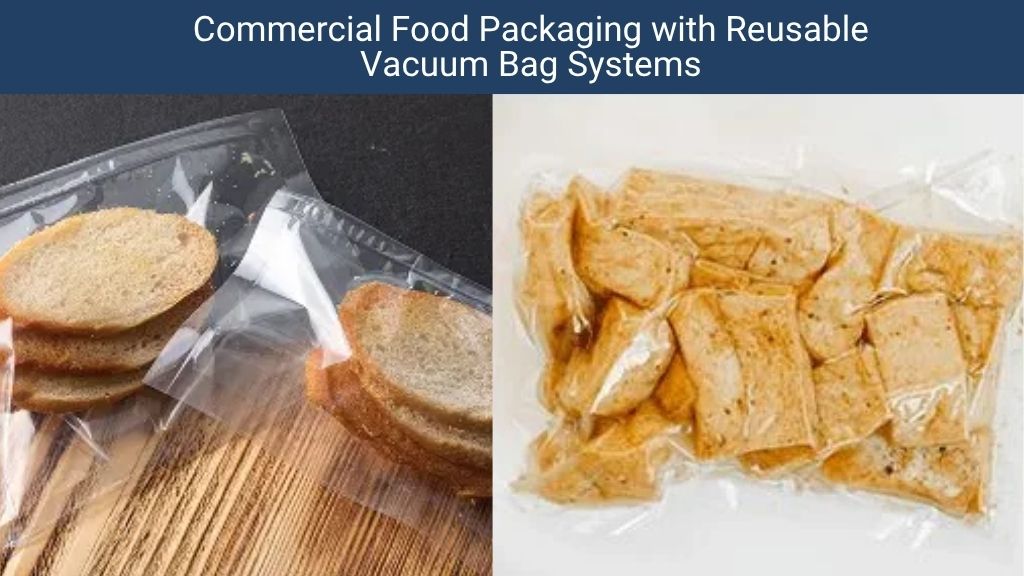
Reusable vacuum bags typically use silicone or durable plastic construction with zippered tops and mechanical vacuum pump-compatible valves. Producers fill bags, remove air through external vacuum equipment, reseal the zipper, and return empty bags for washing and re-use. This model appeals to consumer meal-prep markets and food-service operations with manageable unit counts.
However, commercial food export operations face critical limitations. Reusable bags accumulate microscopic food residue and odor compounds despite washing, risking cross-contamination between consecutive product batches. Each washing cycle introduces potential contamination vectors unless rigorous sanitation protocols (often exceeding commercial feasibility) are maintained. Temperature-sensitive seals deteriorate after repeated cycles, compromising bag integrity and potentially leaking contents during transport.
For bulk export operations handling 100,000+ kg of product annually, reusable systems become operationally impractical. Supply chain logistics require managing thousands of bags, tracking cleanliness status, maintaining washing infrastructure, and coordinating returns—complexity that exceeds the economies of scale advantages from reduced per-unit packaging costs.
Disposable vacuum bags manufactured from food-grade nylon and polyethylene achieve barrier properties unattainable by reusable alternatives. Heavy-duty vacuum bags with multi-layer construction (PA/PE or PA/EVOH) restrict oxygen transmission to 2-5 cc/m²/day, maintaining product freshness across 8-16 week international shipping cycles. Single-use construction ensures zero cross-contamination—each product batch encounters pristine packaging material with no prior exposure.
Heat-seal closure mechanisms provide hermetic seals far superior to mechanical zippers. Once sealed at 70-85°C, disposable bags cannot be compromised by mechanical wear or incomplete closure. This reliability eliminates product loss from leakage, moisture ingress, or mold growth—critical for premium products where waste directly reduces profitability.
Disposable bags simplify food safety documentation. Manufacturers certify films at production; users receive BRC-compliant, FDA-approved materials requiring no additional verification. Regulatory inspectors recognize disposable vacuum bags as standard practice; reusable systems trigger detailed hygiene questions that complicate compliance audits.
Reusable bag initial purchase costs appear attractive against disposable alternatives. However, true cost includes infrastructure investment—vacuum equipment, washing facilities, drying racks, storage systems, labor for cleaning and tracking, and eventual replacement due to wear.
A food producer processing 500,000 kg annually (approximately 300,000 meal portions or cheese blocks) requires roughly 10,000-15,000 reusable bags to maintain continuous rotation. Disposable bags for identical volume cost $45,000-75,000 annually (300,000 units × $0.15-0.25 per bag). Over 5 years, cost totals $225,000-375,000. However, this calculation excludes value from superior barrier properties—preventing product loss from contamination or seal failure. A 2-3% product loss rate (commonplace with reusable systems) exceeds total packaging cost savings.
For bulk food exporters, disposable vacuum bags achieve cost parity with reusable systems while eliminating operational complexity and product quality risk.
Meat, poultry, and seafood exporters face stringent government hygiene standards that effectively mandate disposable, single-use packaging. USDA and EU requirements recognize vacuum-sealed meat only when enclosed in certified food-contact films; reusable bags do not satisfy regulatory definitions of “primary packaging.”
Processed foods with long shelf-life requirements (dried meat, cured products, vacuum-sealed meal components) benefit from heavy-duty barrier protection that only multi-layer disposable films provide. Products remaining in distribution channels for 12-16 weeks depend on superior oxygen exclusion; reusable bags’ degraded seals cannot maintain these durations.
Pharmaceutical and supplement applications requiring sterilization compatibility mandate disposable films. Gamma radiation and ethylene oxide exposure compromise reusable bag structural integrity; single-use alternatives withstand processing without degradation.
Products exported to regulated markets (FDA oversight, EFSA compliance) require packaging with traceable certifications. Disposable films come with mill certificates and food contact compliance documentation; reusable bags require third-party testing establishing compliance after each washing cycle.
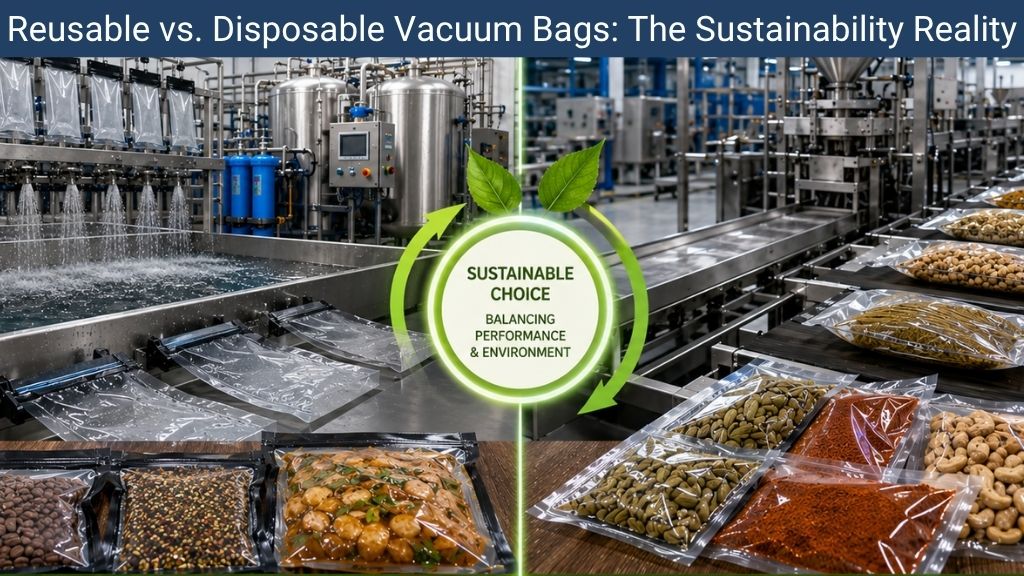
Marketing claims positioning reusable bags as environmentally responsible often omit lifecycle analysis. Reusable silicone or plastic bag production consumes significant energy and raw materials upfront. If bags are discarded or replaced within 3-5 years (common commercial lifespan), the environmental payload of manufacturing exceeds savings from avoided single-use packaging.
Washing cycles consume water, energy, and detergent, generating wastewater requiring treatment. For high-volume operations, cumulative environmental impact rivals or exceeds disposable packaging alternatives.
Conversely, single-use disposable vacuum bags often qualify for recycling—particularly nylon-polyethylene films compatible with plastic film recycling programs. Manufacturers increasingly offer compostable vacuum bags manufactured from biodegradable polymers, enabling end-of-life disposal aligned with sustainability objectives while maintaining barrier protection during product lifecycles.
For commercial food exporters, selecting packaging based on environmental claims alone contradicts decision frameworks prioritizing product protection, food safety compliance, and economic efficiency. Sustainability benefits emerge only when superior performance prevents product loss—where avoided waste provides genuine environmental value.
Our Other Product
Food producers requiring custom vacuum bags with specific dimensions, barrier properties, or printed branding must evaluate whether reusable systems can accommodate modification. Standard reusable bags have fixed dimensions and limited customization; modifying them requires changing equipment, increasing operational friction.
Disposable bags offer unlimited customization at no additional setup cost. Producers specify exact dimensions, thickness, material grade, seal type, and printing requirements; manufacturers deliver tailored solutions. A cheese exporter, for example, can order 100,000 units of custom vacuum bags sized precisely for their product, eliminating undersized or oversized alternatives requiring trimming or secondary packaging.
Nylon vacuum bags sourced from specialized manufacturers like Vishakha Polyfab accommodate modifications that reusable systems cannot achieve—from micro-adjustments in oxygen transmission rates to multi-color printing featuring PDO labels, brand imagery, or nutritional information. This customization flexibility differentiates disposable packaging for premium product categories where packaging presentation influences retail shelf performance.
Food safety certifications (BRC Grade A, SQF, GFSI) explicitly recognize vacuum sealing in certified packaging films as primary food preservation methodology. These standards provide extensive documentation of disposable film performance; reusable bag systems require custom compliance documentation establishing that washing procedures reliably restore food-safety status.
FDA regulations governing food contact surfaces presume single-use materials in commercial applications. Reusable bags must undergo third-party testing demonstrating that mechanical cleaning removes all residual food material and potential pathogens. This testing requirement adds cost and complexity; disposable films satisfy compliance immediately upon receipt from certified manufacturers.
EU packaging regulations require traceability documentation confirming that all materials contacting food originate from approved suppliers and conform to Regulation (EU) 10/2011. Reusable bags create traceability challenges when materials are used repeatedly; disposable bags maintain unambiguous traceability from manufacturer to end-user.
Exporters to regulated markets (North America, Europe, Australia, Japan) face audit requirements examining packaging documentation and food contact certifications. Disposable vacuum bags comply immediately; reusable systems require supplementary documentation that often fails to satisfy inspector expectations.
European organic and premium food producers increasingly adopt disposable vacuum bags to achieve certifications required by North American retailers and Asian importers. Organic standards mandate food contact materials from approved sources with documented food safety compliance—requirements disposable films satisfy automatically.
Asian food manufacturers exporting to North American retailers report that quality audits specifically request vacuum bag certifications and manufacturing documentation. Suppliers responding with disposable film documentation pass verification immediately; reusable bag proponents struggle to provide compliant documentation.
Meat and seafood exporters universally adopted disposable vacuum bags due to regulatory requirements and superior preservation during long-haul refrigerated transport. Industry consolidation toward single-use packaging reflects market recognition that reusable alternatives cannot meet commercial-scale requirements.
Vishakha’s heavy-duty nylon vacuum bags and custom vacuum bags deliver barrier properties and customization flexibility essential for commercial food export. Multi-layer PA/EVOH construction provides oxygen transmission rates (2-5 cc/m²/day) maintaining product freshness throughout international logistics networks. Unlike reusable systems limited to standard dimensions, Vishakha accommodates custom specifications supporting precise product fit and aesthetic brand presentation.
BRC certification ensures that every batch complies with food safety standards expected by North American and European importers. Rotogravure printing capabilities enable custom branding without requiring secondary label application, reducing production steps and supply chain complexity.
Bulk pricing reflects manufacturing scale and operational efficiency. Importers ordering 200,000+ units of custom vacuum bags achieve per-unit economics competitive with reusable alternative total-cost-of-ownership, while capturing superior barrier protection and simplification benefits.
No. USDA and EU regulations recognize only single-use, food-contact-certified packaging materials as primary preservation methods for animal protein products. Reusable bags do not qualify under regulatory definitions of "primary packaging" for meat export, making compliance impossible. Seafood exporters universally use disposable vacuum bags due to regulatory requirements and superior moisture barrier during refrigerated transport.
Approximately 300,000-500,000 kg annual volume (equivalent to 200,000-300,000 meal units). Below this threshold, reusable systems may achieve lower per-unit costs if existing infrastructure is available. Above this volume, disposable vacuum bags' superior barrier properties prevent product loss that offsets incremental packaging costs.
Theoretically yes, but practically no. Reusable bag materials can be certified individually, but the washing process introduces variables preventing consistent food safety status. Each wash potentially reintroduces contaminants or degrades materials. Regulatory bodies require continuous documentation of compliance; reusable systems cannot maintain this standard at commercial scale without prohibitive cost and operational burden.
Clear disposable vacuum bags allow visual product inspection, critical for retail applications where appearance communicates quality. Opaque bags offer marginally superior light barrier (reducing oxidative degradation) but eliminate consumer confidence from visibility. Premium food products universally adopt clear bags despite minor performance trade-off because retail impact exceeds technical barrier advantage. Reusable bags often emphasize opaque designs due to material limitations.
Custom bag dimensions (eliminating oversized or undersized alternatives), custom thickness (optimizing barrier vs. cost), and multi-color printing featuring branding or certification information. Disposable bags accommodate these modifications at no tooling cost; reusable bags require equipment changes increasing per-unit cost. For products where packaging presentation influences retail performance, disposable customization supports premium positioning.
Yes. Vishakha Polyfab and other BRC-certified Indian manufacturers operate under identical food safety standards, supply chain controls, and testing protocols as European or American competitors. BRC Grade A certification is globally recognized; importers can source from certified Indian manufacturers with confidence matching any Western alternatives. Cost advantage reflects operational efficiency, not lower standards.
Establish relationships with manufacturers offering inventory commitment and tiered pricing based on annual volume forecasts. Qualified suppliers like Vishakha provide lead times (4-6 weeks standard, 2-3 weeks expedited) enabling production planning coordination. Annual agreements specifying volume ranges allow manufacturers to reserve capacity; bulk importers gain pricing stability and delivery certainty.
Mechanical wear compromises seal integrity; zipper function degrades; material becomes brittle at temperature extremes; odor compounds become embedded in microporous surfaces. Industry experience suggests reusable bags reliably perform for 50-100 cycles before requiring replacement. This durability translates to 12-24 month useful life for commercial operations; reusable system economics depend on achieving sufficient cycle count before disposal.
The reusable versus disposable vacuum bag decision reflects broader strategic choices about food safety prioritization, supply chain complexity, and total economic efficiency. While reusable systems appeal to small-scale consumer markets and food-service operations managing modest unit counts, commercial food export requires disposable vacuum bags providing superior barrier properties, regulatory compliance simplicity, and customization flexibility.
Heavy-duty disposable vacuum bags manufactured from food-grade nylon and polyethylene achieve barrier performance, hygiene reliability, and cost parity with reusable alternatives while eliminating operational complexity. For bulk food exporters—whether shipping meat to North America, cheese to Europe, or specialty foods to Asia-Pacific—disposable vacuum bags represent the pragmatic choice supporting both product quality and regulatory compliance.
Vishakha Polyfab’s customizable disposable vacuum bags deliver the barrier protection and compliance certainty that commercial food producers require, enabling focus on product excellence rather than packaging logistics.

Vishakha Polyfab Pvt. Ltd. is a global pioneer in high-barrier flexible packaging, specializing in advanced 9-layer co-extruded PA/EVOH-based films. Headquartered in Ahmedabad, India, the company utilizes world-class Brampton Engineering (Canada) and Aqua Frost® water-quenched technology to deliver superior shelf-life extension solutions. From Modified Atmosphere Packaging (MAP) to deep-draw thermoforming applications, Vishakha Polyfab delivers compliant, high-performance materials that protect product integrity throughout complex international supply chains. Their expertise in vacuum packaging, thermoforming, and lidding films helps enterprise-level brands in the food, pharmaceutical, and industrial sectors optimize packaging performance and sustainability.

Make Vishakha Polyfab the silent guardian of your products to preserve their vigour and enhance the quality of user interaction with them.
Sign Up for Our Newsletter
Corporate Head Office
Social Media
An ISO & BRCGS Certified Company


Manufacturing Address

