
September 17, 2026
Table of Contents




Table of Contents
Different snacks need different packaging structures because each product loses quality in a different way. Chips lose crispness through moisture uptake, namkeen and nuts suffer oil migration and oxidation, which leads to rancid odours, and baked snacks can soften or turn stale. Snack packaging selection therefore depends on moisture barrier, oxygen barrier, oil resistance, aroma retention and mechanical strength. Flexible packaging for snacks uses multilayer laminated films where each layer performs a defined role, matched to product type, shelf life and distribution conditions.
A packet of potato chips, a pouch of fried namkeen and a bag of roasted almonds may share a retail shelf, but they age in very different ways. Chips go soft as water vapour enters. Namkeen turns stale as its oil oxidises. Nuts lose flavour when oxygen reaches them. A film that protects one product well can leave another exposed.
Effective snack packaging starts with the product, not with pack design or film price per kilogram. Oil content, seasoning and texture decide which risks matter most, and the structure is built to control them for the required shelf life.
Vishakha PolyFab builds its flexible packaging solutions on this principle, combining layers with separate jobs: one prints well, another blocks gas and another seals the pack. The sections below show how requirements shift from one snack category to the next.
Potato chips and similar fried snacks are thin, dry and porous. They absorb moisture quickly, and even a small gain removes their snap. Their frying oil also reacts with oxygen and light, which creates stale or rancid notes over time.
A suitable chips packaging film needs several properties working together:
Chips are fragile, so packs are usually nitrogen flushed to cushion the product and lower the oxygen level. This works only if the film and seals keep the gas inside, and the film should also retain aroma.
Manufacturers should discuss line speed, seal width and shelf life targets with the packaging supplier. The VISHLAMI range from Vishakha PolyFab includes transparent, metallised and white laminated films in standard and EVOH based high barrier grades, printable by rotogravure and flexo, so the structure can be tuned after trials on the actual filling machine.
Fried namkeen such as sev, bhujia and chivda carries surface oil and spices that release strong aroma. Packs are often heavier than chip packs and handled more roughly in distribution.
Oil can migrate into some films, weaken the seal area and cause layer separation over time. Oil that contaminates the seal during filling can also lead to leakers. Good namkeen packaging needs a sealant layer that tolerates a small amount of oil contamination.
Key requirements include:
Metallised laminates suit lighter pouches, while stronger PET based laminates are often considered for larger family packs. Multilayer PA and EVOH barrier films from Vishakha PolyFab are another option where oil resistance and aroma retention are the priority. The right choice depends on pack size, shelf life and distribution.
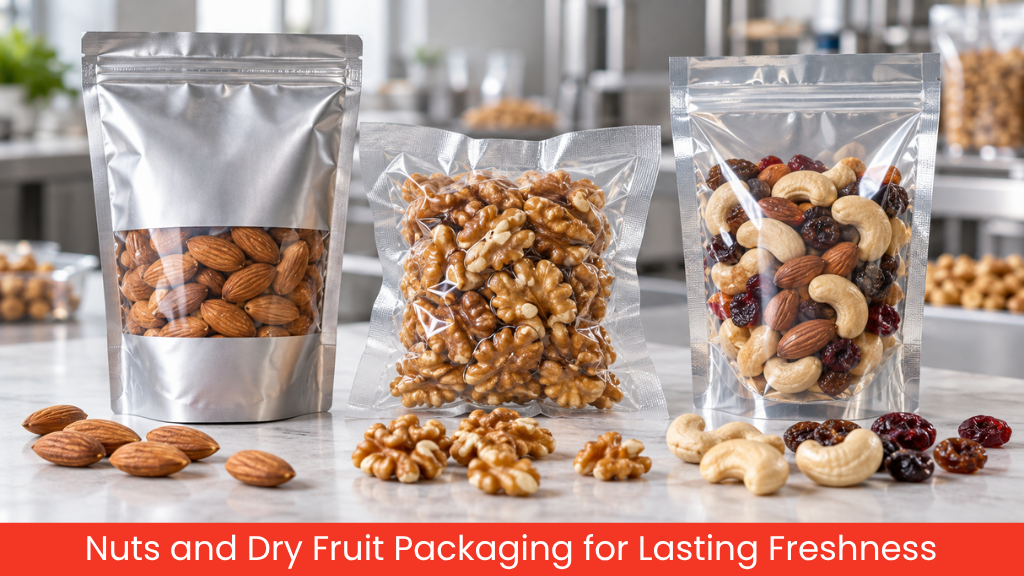
Nuts and dry fruits contain natural oils that oxidise when exposed to air. The result is a flat taste, a rancid smell and a shorter shelf life. Roasted and salted nuts are more sensitive still.
For this reason nuts packaging usually relies on a stronger oxygen barrier than chips packaging does. Structures that include PET, nylon, aluminium foil or another high barrier layer are commonly considered, combined with a polyethylene sealant layer. The pack must also hold the right moisture balance, since nuts can turn soft while dry fruits can turn hard.
Points to consider:
Our Other Product
Baked snacks such as crackers, baked chips and roasted multigrain snacks are lower in oil than fried products but are often very dry and brittle. Their texture depends on staying dry, so the pack must keep outside humidity from reaching the product for the full shelf life.
Moisture migration inside the pack is a separate concern. If seasoning or a filling has a different moisture content from the base, water can move within the pack and change the texture.
Baked snack packaging should focus on:
Low oil baked snacks often do not need the highest oxygen barrier, so an excessive barrier only adds cost. Metallisable CPP grades, such as those in Vishakha PolyFab’s CPP range, add barrier and shine in laminates for biscuits and similar products.
Seasoning changes packaging needs even when the base snack is the same. Powder seasoning can settle in the seal area and reduce seal strength. Spice aroma can transfer to or from the packaging if the barrier is weak. Oil based flavours can interact with the sealant layer in the same way as namkeen oil.
Consider these factors:
A plain and a masala version of the same snack may need slightly different structures, so test both flavours in the actual film before launch. Vishakha PolyFab can support such testing.
Flexible packaging for snacks is usually built as a laminate, where two or more films are bonded together. A common arrangement has an outer printable layer, a middle barrier layer and an inner sealant layer. Vishakha PolyFab’s laminate range covers PET, BOPP, CPP, PE, BOPA, metallised, foil and PA EVOH based structures. The table below compares typical requirements by snack category. It is a general guide, and final selection should follow trials.
| Snack Category | Main Risk | Key Film Properties | Commonly Considered Structures |
| Chips | Loss of crispness, oxidation, breakage | Moisture and light barrier, seal strength, puncture resistance | BOPP/MET/CPP or PET/MET/CPP laminates |
| Fried namkeen | Oil migration, aroma loss | Oil resistance, aroma barrier, seal integrity | Metallised laminates, PA/EVOH barrier films, PET based laminates for larger packs |
| Nuts and dry fruits | Oxidation, flavour loss | High oxygen barrier, moisture control | PET with PE, foil or PA/EVOH layers, vacuum pouches |
| Baked snacks | Softening, staling, breakage | Water vapour barrier, machine compatibility | BOPP based laminates, metallised structures |
| Seasoned snacks | Aroma transfer, seal contamination | Aroma barrier, contamination tolerant sealant | Chosen by base snack with a suitable sealant layer |
Several factors decide the final choice:
These properties interact. A high barrier film with poor seals still fails, so the structure must be balanced. Vishakha PolyFab runs real time gauge and seal testing to keep these properties consistent.
Many packaging failures come from a mismatch between film and machine, not from a poor barrier. Most snack lines use vertical form fill seal (VFFS) machines. Points to check with the supplier:
Sealant choice matters here. High hot tack sealant grades are designed for fast sealing on FFS lines, while general grade CPP offers the clarity and machinability suited to snack overwraps. Manufacturers should share the machine make, model and speed with the supplier. Vishakha PolyFab’s application team can then recommend a structure and support film trials before bulk orders.
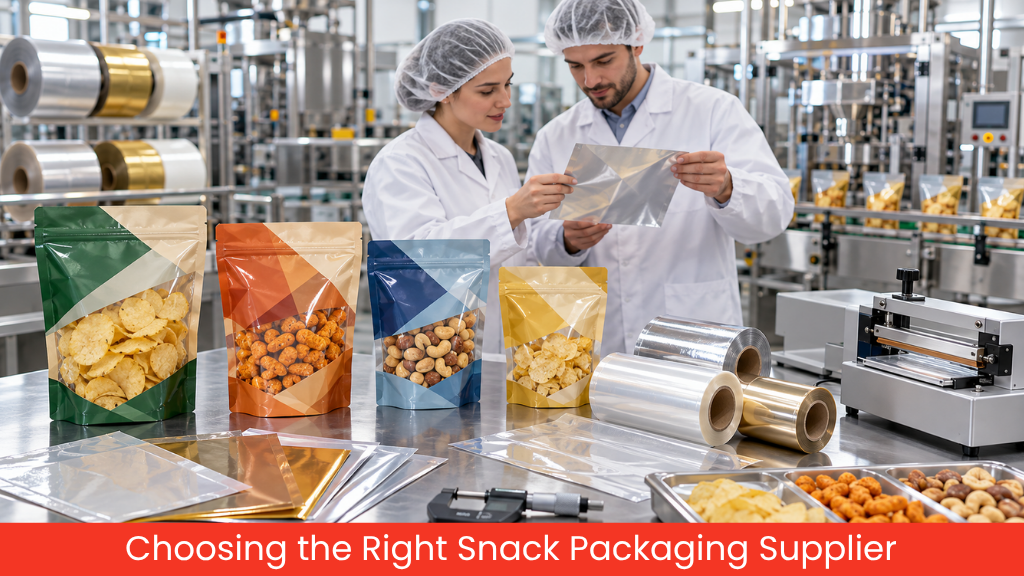
A good supplier acts as a technical partner. Working with an experienced snack packaging manufacturer helps brands evaluate film structures, sealing performance and shelf life requirements before final production. Manufacturers should evaluate:
For an accurate recommendation, share product details, shelf life expectations, filling process, storage conditions and distribution requirements. Vishakha PolyFab is ISO and BRCGS certified and offers 7 and 9 layer coextruded barrier films, laminates printed up to nine colours, pouch making and an on site testing lab, so its technical team can propose structures for the product and the line.
Our Other Product
Chips, namkeen, nuts and baked snacks lose quality for different reasons, so each needs a structure built around its own risks. Seal performance and machine compatibility decide whether the barrier works in real conditions.
Manufacturers who share clear product and process details and test on their own lines get better results than those who choose films on appearance or cost alone. Vishakha PolyFab supports this approach with application development and field trials for flexible packaging for snacks.
Each snack loses quality differently. Chips lose crispness through moisture, namkeen and nuts suffer from oil oxidation, and baked snacks lose texture. Barrier, oil resistance and aroma needs vary by product, so the structure must be matched to the snack.
A chips packaging film is usually a metallised multilayer laminate, such as BOPP/MET/CPP or PET/MET/CPP. It should provide moisture and light barrier, strong seals for nitrogen flushing and good puncture resistance. The final structure depends on shelf life and machine speed.
Namkeen packaging should resist oil, retain spice aroma and keep humidity out. Laminated films with an oil tolerant sealant layer are commonly used, with metallised structures for light packs and PET based laminates for heavier packs.
Nuts contain natural oils that oxidise on exposure to air, causing rancid flavour and shorter shelf life. High oxygen barrier layers such as PET, nylon or foil, and vacuum or gas flushed packs, slow this process.
Start with the product's oil content, moisture sensitivity and fragility. Then consider shelf life, storage and distribution conditions, and the filling machine. Share these details with the packaging supplier and confirm the structure through machine trials before bulk production. Suppliers such as Vishakha PolyFab support this with application development.

Vishakha Polyfab Pvt. Ltd. is a global pioneer in high-barrier flexible packaging, specializing in advanced 9-layer co-extruded PA/EVOH-based films. Headquartered in Ahmedabad, India, the company utilizes world-class Brampton Engineering (Canada) and Aqua Frost® water-quenched technology to deliver superior shelf-life extension solutions. From Modified Atmosphere Packaging (MAP) to deep-draw thermoforming applications, Vishakha Polyfab delivers compliant, high-performance materials that protect product integrity throughout complex international supply chains. Their expertise in vacuum packaging, thermoforming, and lidding films helps enterprise-level brands in the food, pharmaceutical, and industrial sectors optimize packaging performance and sustainability.

Make Vishakha Polyfab the silent guardian of your products to preserve their vigour and enhance the quality of user interaction with them.
Sign Up for Our Newsletter
Corporate Head Office
Social Media
An ISO & BRCGS Certified Company

Manufacturing Address

