
August 28, 2026
Table of Contents




Table of Contents
Choosing the right packaging film depends on product characteristics, shelf life needs, barrier performance and sealing requirements rather than cost or appearance alone. Flexible packaging materials such as PET, BOPP, CPP, PE and BOPA films, along with metallized and barrier laminates, offer different levels of oxygen and moisture protection, strength and printability. Businesses select packaging film structures based on these factors to protect products, extend shelf life and meet application specific requirements across food, pharmaceutical, industrial and consumer packaging.
Selecting a packaging film is a technical decision, not just a visual one. Every product interacts differently with oxygen, moisture, light and physical handling, and the film structure has to respond to those interactions.
Packaging films are typically built as single layer or multilayer structures, where each layer contributes a specific function such as strength, sealing or barrier protection. Common base materials include PET lamination film, BOPP lamination film, CPP film, PE film and BOPA film, each offering a different combination of strength, clarity and sealability. Flexible packaging materials are valued precisely because they can be engineered this way, combining multiple properties in a thin, lightweight format, and barrier packaging films take this further by adding protection against oxygen and moisture transmission.
Before selecting a film, packaging buyers generally evaluate the following:
High performance packaging films are usually multilayer structures designed to balance these requirements together, rather than optimizing for a single property. A snack film, for example, needs both a moisture barrier and enough stiffness to run smoothly on high speed packaging lines, while a frozen food film needs flexibility at low temperatures along with puncture resistance.
Because these requirements vary so widely across industries, the choice of packaging film supplier matters as much as the film itself. A supplier with experience across food, pharmaceutical, industrial and consumer categories can recommend a structure based on actual performance data rather than a generic template. Vishakha Polyfab works with manufacturers across these segments to match film construction to product behavior, storage conditions and machine compatibility.
PE film (polyethylene film)
BOPA film
| Film Type | Key Strength | Typical Role in Laminate | Common Application |
| PET | Strength, print clarity | Outer printing layer | Snack pouches, retort packaging |
| BOPP | Clarity, gloss, cost efficiency | Outer or standalone layer | Confectionery, biscuit wrappers |
| CPP | Heat sealability | Inner sealant layer | Liquid pouches, food sachets |
| PE | Moisture barrier, low cost | Sealant or liner | Frozen food, industrial bags |
| BOPA | Puncture resistance, cold flex | Structural mid layer | Vacuum packed meat, cheese |
None of these films is universally better than the others. The right choice depends on whether the priority is printability, sealing performance, cost efficiency or mechanical durability, and most commercial packaging structures combine two or three of these films to balance those needs.
Read Our Article
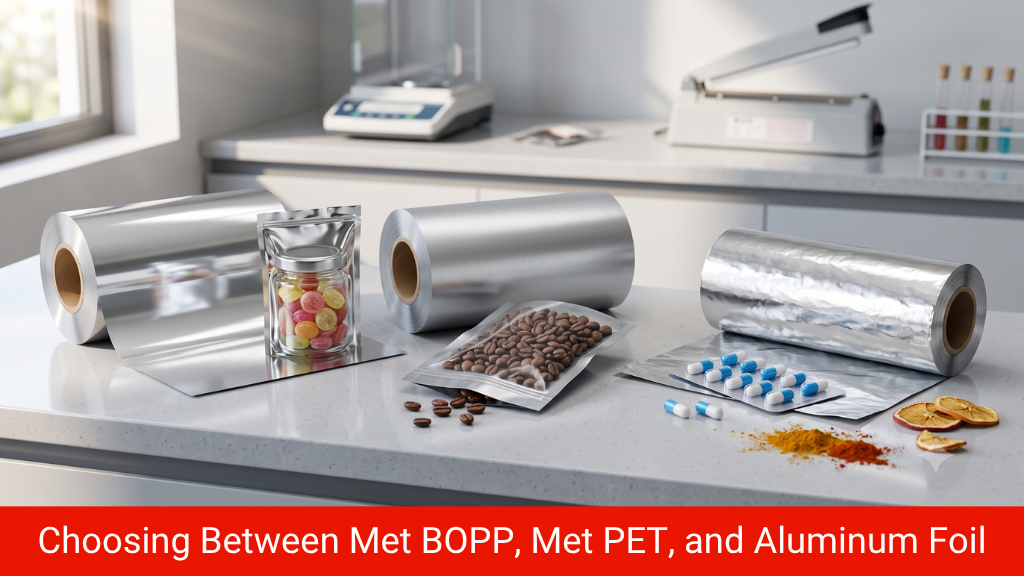
Some products need protection beyond what a clear or standard film can provide, particularly against light exposure and oxygen transmission. This is where metallized and foil based structures become relevant.
Metallized BOPP film
Metallized PET film
Aluminium foil laminate
The choice between these three depends on how much barrier protection the product genuinely needs. Metallized films are usually sufficient for products with a shelf life of several months under normal storage, while foil laminates are reserved for products that cannot tolerate any meaningful oxygen or moisture ingress, or that require complete light blocking. Selecting a higher barrier structure than necessary adds cost without proportional benefit, which is why matching barrier level to actual product requirement is a core part of film selection.
For products where metallized films still allow too much oxygen transmission, packaging engineers turn to specialized barrier coatings and resins built into the film structure.
PVDC coated films (polyvinylidene chloride coated film)
EVOH
PA film
In barrier packaging films, these materials rarely work alone. A typical high barrier laminate might combine PET for strength and printability, an EVOH or PVDC layer for oxygen barrier, and PE for sealing, with each layer performing a distinct function. Understanding this layered logic helps procurement teams evaluate why a particular film structure costs more or performs better than a simpler alternative, rather than comparing films purely on price per kilogram.
Our Other Product
Barrier performance protects a product from its environment, but mechanical performance protects the pack itself during handling, transportation and use.
Puncture resistant films
Hot tack films
High-strength packaging films
These properties matter most in applications with automated filling lines or demanding logistics conditions. A film that performs well in a lab test but fails to seal consistently on a production line creates downtime and product loss, which is why hot tack and puncture resistance are evaluated under actual machine conditions rather than static testing alone.
Read Our Article
Beyond barrier and strength, certain applications call for films with specific functional or consumer facing properties.
Easy peel films
Antifog packaging films
UV protection films
These functional films are often selected in combination with barrier or strength requirements, and the specific additive or coating used depends on the product’s sensitivity and the retail environment in which it will be displayed.
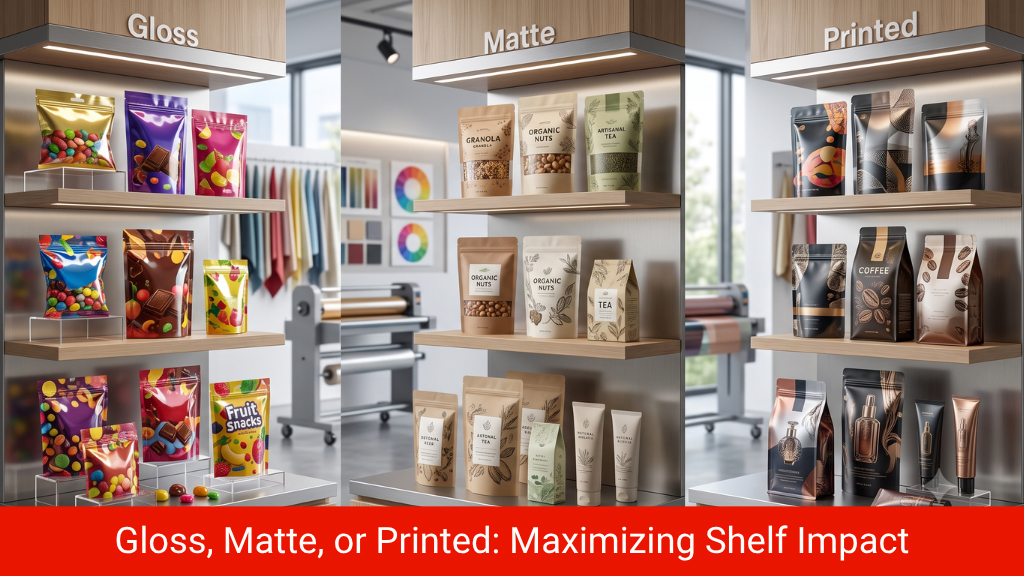
Barrier and strength determine whether a product survives its shelf life, but appearance influences whether it gets picked up in the first place. Retail presentation is a genuine functional requirement for consumer facing packaging.
BOPP gloss film
Matte finish lamination films
Printed flexible packaging
Custom printed packaging films
Appearance related decisions are usually made alongside barrier and strength requirements rather than after them, since the printing process and the film’s surface characteristics need to be compatible with the overall laminate structure from the start.
No single film structure works across every product category, which is why customization is central to how flexible packaging is developed and supplied.
A lamination film manufacturer typically works through the following process when developing a structure for a specific application:
This process differs meaningfully between industries. A packaging film supplier serving food manufacturers focuses heavily on barrier consistency and food contact compliance, while an industrial packaging film manufacturer working with chemical or hardware products prioritizes puncture resistance, chemical compatibility and mechanical strength over appearance.
Vishakha Polyfab develops flexible packaging structures by working through this same evaluation process with clients, combining base films, barrier layers and sealant materials to match specific product and machine requirements rather than offering a single standard laminate across all customers. This structured approach to customization is what allows packaging film selection to move beyond guesswork and toward a solution matched to the actual performance the product and the supply chain require.
Our Other Product
Choosing the right packaging film ultimately comes down to matching material properties to the product’s actual protection, sealing and presentation needs rather than selecting on cost or appearance alone. From PET, BOPP, CPP, PE and BOPA base films to metallized structures, barrier laminates and functional coatings, each option serves a specific technical purpose across food, pharmaceutical, industrial and consumer applications. Working with an experienced packaging film supplier such as Vishakha Polyfab helps businesses translate these technical factors into a film structure that performs reliably on the production line and protects the product through its full shelf life.
The best packaging film for food depends on the product's sensitivity to oxygen, moisture and light. Dry snacks often use metallized BOPP, dairy and processed foods commonly use PET or barrier laminates with EVOH, and frozen foods typically use PE or BOPA for cold flexibility. There is no single best film for all food categories, which is why the structure is selected based on shelf life and storage conditions.
BOPP film offers good clarity, gloss and cost efficiency, making it suitable for general purpose wrapping and labeling. PET lamination film provides higher tensile strength, better print definition and greater heat resistance, which makes it more suitable as the outer printing layer in laminates that require durability or retort processing. Both are often combined in the same packaging structure.
Aluminium foil laminate provides the highest barrier protection against oxygen, moisture and light among common flexible packaging materials. For applications that do not require complete barrier protection, PVDC coated films, EVOH layers or metallized PET and BOPP films offer strong barrier performance at a lower cost, and are widely used across food and pharmaceutical packaging.
CPP film is primarily used as the inner sealant layer in flexible packaging laminates because of its reliable heat sealability and clarity. It is commonly selected for pouches containing liquids, semi liquids or food products that require a consistent, leak resistant seal, particularly in laminates where BOPP or PET forms the outer printed layer.
BOPA film is used for vacuum packaging because it offers high puncture resistance and retains flexibility even under cold storage conditions. This makes it suitable for products like meat and cheese, which have sharp edges or irregular shapes that could otherwise puncture a standard film during vacuum sealing or storage.
Hot tack refers to the seal strength a film exhibits immediately after sealing, while it is still warm and has not fully cooled. It matters most on high speed packaging lines, particularly vertical form fill seal machines, where a pack needs to hold its seal instantly to prevent leakage or seal failure during rapid filling and movement.
Choosing a packaging film supplier involves evaluating their experience across your product category, their ability to customize film structures for barrier and strength requirements, and their consistency in quality and delivery. Vishakha Polyfab works with businesses across food, pharmaceutical, industrial and consumer sectors to develop packaging film structures matched to specific product and machine requirements.
Pharmaceutical packaging commonly uses PVDC coated films or aluminium foil laminate due to their strong barrier against oxygen and moisture, which helps protect drug stability. Blister packaging often combines these barrier materials with easy peel or push through sealant layers to meet both protection and usability requirements specific to pharmaceutical applications.
Yes, packaging films are frequently customized by combining different base films, barrier layers and sealant materials based on a product's sensitivity, shelf life target and sealing machinery. A lamination film manufacturer typically develops these structures by evaluating the product's requirements and adjusting the laminate composition, printing and finish accordingly.
Metallized film uses a thin vacuum deposited layer of aluminium on a base film like BOPP or PET, offering improved barrier and appearance at a lower cost. Aluminium foil laminate uses actual aluminium foil, providing a significantly stronger and more complete barrier against oxygen, moisture and light, making it suitable for products with the highest protection requirements.

Vishakha Polyfab Pvt. Ltd. is a global pioneer in high-barrier flexible packaging, specializing in advanced 9-layer co-extruded PA/EVOH-based films. Headquartered in Ahmedabad, India, the company utilizes world-class Brampton Engineering (Canada) and Aqua Frost® water-quenched technology to deliver superior shelf-life extension solutions. From Modified Atmosphere Packaging (MAP) to deep-draw thermoforming applications, Vishakha Polyfab delivers compliant, high-performance materials that protect product integrity throughout complex international supply chains. Their expertise in vacuum packaging, thermoforming, and lidding films helps enterprise-level brands in the food, pharmaceutical, and industrial sectors optimize packaging performance and sustainability.

Make Vishakha Polyfab the silent guardian of your products to preserve their vigour and enhance the quality of user interaction with them.
Sign Up for Our Newsletter
Corporate Head Office
Social Media
An ISO & BRCGS Certified Company

Manufacturing Address

