
October 18, 2026
Table of Contents




Table of Contents
Barrier film testing turns marketing labels like “high barrier” or “strong” into evidence a buyer can actually compare. A technical data sheet, an agreed specification, a batch test report, and a certification are different documents with different purposes. Properties such as OTR, WVTR, tensile strength, puncture resistance, seal strength, coefficient of friction, and haze and clarity only mean something when read alongside their test conditions, and two reports can only be compared fairly when units, methods, and conditions match.
Labels like “high barrier,” “strong,” or “high clarity” tell a buyer very little on their own. They describe an impression, not a measured result.
Reliable barrier film testing is what turns a description into evidence. It lets a procurement manager, quality team, or packaging engineer compare suppliers on facts rather than phrases.
This matters because a high barrier film packaging claim usually summarises several properties working together, not one number. A buyer who can read a technical data sheet and a barrier film test report correctly is in a far stronger position than one comparing headline claims alone.
This guide explains how to identify the document in front of you, what each property indicates, what information should travel with that result, and what to ask a supplier such as Vishakha PolyFab when the paperwork leaves a gap.
Not every supplier document means the same thing. Treating them interchangeably is one of the most common buying mistakes.
Document | Purpose | What to verify | What it does not establish |
Technical data sheet (TDS) | Describes typical properties of a film grade or structure | Whether values are typical, ranges, or guaranteed limits | A guarantee for your specific purchase order |
Agreed material specification | Records the limits both parties accepted for an order | That it reflects your actual product code, structure, and thickness | Performance of the finished pack once filled and sealed |
Batch specific quality test report or Certificate of Analysis (where supplied) | Shows results measured on the batch you are receiving | Batch or lot identification matches your shipment | Results for properties not listed on that report |
Certificate of Conformity (where supplied) | States that a batch meets an agreed specification | Which specification it refers to | The individual measured values behind that statement |
Quality system or packaging material certification | Confirms the manufacturer operates under a recognised quality or food safety system | Scope of the certification and what it covers | Performance of any one film property or batch |
A packaging quality certificate is not one universally standardised document. It can mean a quality system certification, a Certificate of Conformity, or a batch report, depending on who is asking.
Before relying on it, confirm exactly which document is being referenced. Request it by name.
Before reading any numbers, confirm the document actually applies to what you are buying.
Look for these details in the header and sample information:
If any of this is missing, ask the supplier to provide it. Build your purchasing decision only once this traceability is confirmed.
Property | What it indicates | Details needed to interpret it | Common reading mistake |
Thickness | The film’s nominal gauge | Measured value vs nominal, any agreed tolerance | Treating a brochure’s thickness range as a batch tolerance |
OTR (Oxygen Transmission Rate) | How much oxygen passes through the film under stated conditions | Units, method, temperature, humidity, structure tested | Assuming OTR alone predicts shelf life |
WVTR (Water Vapour Transmission Rate) | How much moisture passes through the film under stated conditions | Same as OTR, plus humidity gradient | Treating WVTR and OTR as interchangeable |
Tensile strength and elongation | Resistance to stretching and breaking under load | Test direction, specimen details, method, units | Using tensile data to infer puncture performance |
Puncture resistance | Resistance to a localised sharp force | Method, probe type, specimen preparation | Assuming one strength value predicts all handling damage |
Seal strength | Force needed to separate a formed seal | Seal conditions, specimen preparation, test method | Assuming a strong lab seal guarantees a leak free pack |
Coefficient of friction of film | How the film surface behaves against another surface or itself | Film side tested, static vs dynamic, test surfaces | Assuming the lowest coefficient is always best |
Haze and clarity | Optical appearance of the film | Whether a numerical measurement was taken, or only a qualitative description | Treating “clear” or “glossy” as a measured specification |
The sections below expand on the distinctions that matter most. The table is a summary, not a substitute for them.
A technical data sheet usually states a nominal thickness or a thickness range for the film grade.
This is not the same as a measured result on your batch. It is also not automatically a tolerance your supplier has agreed to hold.
Vishakha PolyFab lists a 40 to 250 micron range specifically for its VISHBARR NG film line, and a 30 to 300 micron range for VISHLAMI laminated films. These figures describe what the film line can produce. They are not an acceptance window for a specific order.
If a tolerance matters to your application, it needs to be written into your agreed specification separately. Thickness alone also cannot establish barrier, puncture, or sealing performance.
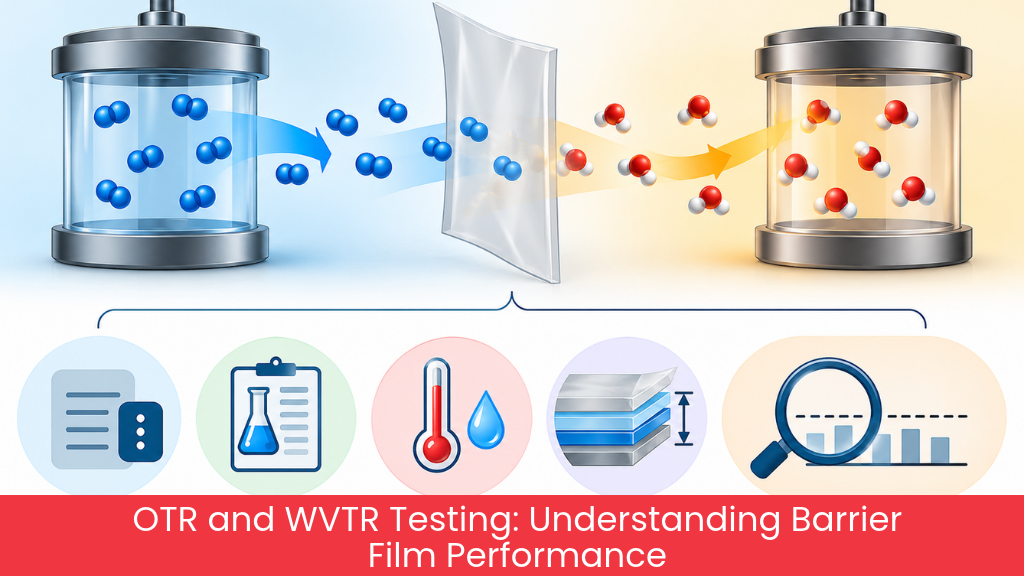
Oxygen Transmission Rate (OTR) and Water Vapour Transmission Rate (WVTR) are two distinct properties. Each describes how readily a different substance passes through the film.
An OTR test and a WVTR test measure different transmission properties and must be interpreted using their stated methods and conditions. They should never be assumed to move together or substitute for one another.
Before comparing any reported OTR or WVTR value between suppliers, check:
Two films cannot be fairly ranked on OTR or WVTR alone unless their test conditions and reporting basis are comparable. A lower number under one set of conditions is not meaningfully better than a higher number under different conditions.
Neither OTR nor WVTR, by itself, is a basis for predicting a finished product’s shelf life. Shelf life depends on the product, the pack format, and storage conditions as well as the film. Where test conditions are not spelled out, treat that as a question for the supplier.
Tensile strength, elongation, and puncture resistance each measure a different kind of physical performance. One cannot substitute for another.
Tensile strength and elongation describe how a film behaves under a stretching load. Puncture resistance describes resistance to a concentrated, localised force, which matters for sharp or irregular products.
When comparing reported values, check the test direction where reported, specimen preparation, method, and units.
A high tensile strength of packaging film does not, by itself, predict how that film performs against a bone, a sharp edge, or a corner during handling. That situation is closer to what puncture resistance testing represents.
A seal strength test result only means something once you know how the seal and the test specimen were prepared and assessed. Sealing temperature, dwell time, pressure, and how the result was measured all shape the number.
Where this context is not supplied, request it from the supplier before relying on the figure.
It is also worth keeping these related ideas apart:
A strong laboratory seal result does not, on its own, guarantee that every commercial pack leaving a filling line will be leak free. That depends on the sealing equipment, settings, and in line checks used during production.
The coefficient of friction of film describes how the film surface behaves when it slides against another surface, or against itself. This affects how smoothly a film runs through packaging machinery.
Where this is reported, check which film side was tested, whether it is a static or dynamic measurement, and what surfaces and conditions were used.
A lower coefficient of friction is not automatically preferable. Machine compatibility depends on matching the film’s friction behaviour to the specific equipment it will run on, not on minimising the number.
Where friction test conditions are not detailed, this is a reasonable point to raise directly with the supplier.
Descriptions such as “clear,” “glossy,” “transparent,” or “low haze” communicate a visual impression, not a numerical specification.
Vishakha PolyFab’s VISHFORM range, for example, is described as offering high clarity and less haze compared with conventional air cooled blown film. That is a qualitative product description rather than a stated test figure.
Where a numerical optical measurement is required for your application, a qualitative description is not a substitute for it. Request it separately.
It is also worth separating aesthetic preference from functional need. High clarity says nothing about a film’s barrier performance or how fresh the packaged product will stay.
Before concluding one film outperforms another, work through a short checklist:

Once you have worked through a document, a short list of questions closes most remaining gaps:
Not every answer will be available from a single document. Not every property is necessarily tested on every production batch either.
Vishakha PolyFab is a flexible packaging film manufacturer based in Ahmedabad, Gujarat, operating under ISO and BRCGS certifications. Its product ranges include VISHBARR barrier films for vertical form fill seal applications, VISHVACU vacuum pouches and bags for vacuum, MAP, gas flush, and boilable processes, VISHFORM thermoforming films for deep draw packaging, VISHTOP top lidding films, VISHLAMI lamination films, and REGAIN recyclable barrier film solutions.
Confirm available thicknesses and customisation options for the selected range with Vishakha PolyFab. Where quality control capability is documented, Vishakha PolyFab notes in house testing for properties such as seal integrity, tensile strength, and barrier performance; this is not confirmation that every property is tested on every order, which is worth confirming for your specific requirement.
A barrier film comparison is only as good as the documents behind it. Read each document for what it actually is, a typical value, a specification limit, or a measured batch result, and check that the conditions behind a figure are stated and comparable before drawing conclusions.
Where information is missing, the right response is a supplier question, not an assumption. If you are working through a film specification or document set for your own packaging requirement, Vishakha PolyFab is available to discuss the documentation and testing details relevant to your application.
No. A technical data sheet typically shows typical values for a film grade, while a batch test report shows results measured on a specific batch. When evaluating documentation from Vishakha PolyFab or any supplier, check which type of document you have before comparing figures.
Not reliably. OTR depends on structure, material, and test conditions as well as thickness. For a meaningful comparison across suppliers such as Vishakha PolyFab, confirm the structure and conditions behind each figure first.
Ask the supplier directly for the method, units, temperature, and any other conditions behind the result. When working with Vishakha PolyFab, ask which documentation is available for the specific film and batch in question.
No. A quality system or packaging material certification confirms a manufacturer's processes, not the measured performance of a specific film or batch. Buyers working with Vishakha PolyFab should request performance documentation separately from certification evidence.
A typical value reflects expected performance for a film grade, not a guaranteed limit for every batch. If a guarantee is required, it needs to be written into an agreed specification with Vishakha PolyFab rather than inferred from a typical value sheet.

Vishakha Polyfab Pvt. Ltd. is a global pioneer in high-barrier flexible packaging, specializing in advanced 9-layer co-extruded PA/EVOH-based films. Headquartered in Ahmedabad, India, the company utilizes world-class Brampton Engineering (Canada) and Aqua Frost® water-quenched technology to deliver superior shelf-life extension solutions. From Modified Atmosphere Packaging (MAP) to deep-draw thermoforming applications, Vishakha Polyfab delivers compliant, high-performance materials that protect product integrity throughout complex international supply chains. Their expertise in vacuum packaging, thermoforming, and lidding films helps enterprise-level brands in the food, pharmaceutical, and industrial sectors optimize packaging performance and sustainability.

Make Vishakha Polyfab the silent guardian of your products to preserve their vigour and enhance the quality of user interaction with them.
Sign Up for Our Newsletter
Corporate Head Office
Social Media
An ISO & BRCGS Certified Company


Manufacturing Address

