
October 15, 2026
Table of Contents




Table of Contents
Cheese packaging testing assesses how filled packs perform during filling, sealing, storage and transport. Evaluation should reflect the cheese format and intended distribution conditions, with agreed acceptance criteria and documented results. Packaging integrity checks alone do not establish product shelf life or food safety.
Cheese Packaging Testing evaluates a filled cheese pack under its real packing, storage and distribution conditions. A pouch material can look ideal on a data sheet, but it can still underperform once it is filled, sealed, chilled and transported through the cold chain to its export destination.
Choosing a barrier film is only the starting point. Cheese is a variable product: block, soft, shredded, grated, crumbled or chunk, and each format interacts differently with a pouch during a cheese packaging trial.
A validation plan should start by identifying what is being packed and how, including the fill quantity, equipment, storage conditions and distribution route. An approval for one cheese format does not automatically apply to another.
Cheese Format | Key Evaluation Questions |
Hard cheese blocks and chunks | Does the pouch fit the block without excess air pockets? Do sharp edges raise puncture risk? |
Soft cheese | Does the pack hold shape during filling or vacuum evacuation? |
Shredded or grated cheese | Does the pouch seal cleanly around loose particles? |
Crumbled cheese | Does the fill pattern leave product debris near the seal area? |
Bulk versus retail packs | Does pack size change handling stress, fill speed or stacking behaviour? |
These are evaluation questions for representative trial packs, not claims about how any given cheese will behave.
Before running a trial, the buyer and packaging supplier should agree on what will be assessed, so the trial stays focused and the results stay traceable. Points to confirm in advance:
Numerical limits and specific test methods should be set by the buyer’s QA team, packaging supplier or a qualified testing provider.
Filling trials should use the equipment that will run in production, for manual and automatic filling alike. The goal is to confirm pouch fit, loading practicality, product placement and consistent pack formation.
For vacuum applications, the evacuation conditions used in the trial should be recorded rather than treated as a universal setting for every cheese type or pouch size.
Filling trial results should stay separate from seal and leakage inspection, since a filling issue and a sealing issue usually need different corrective actions.
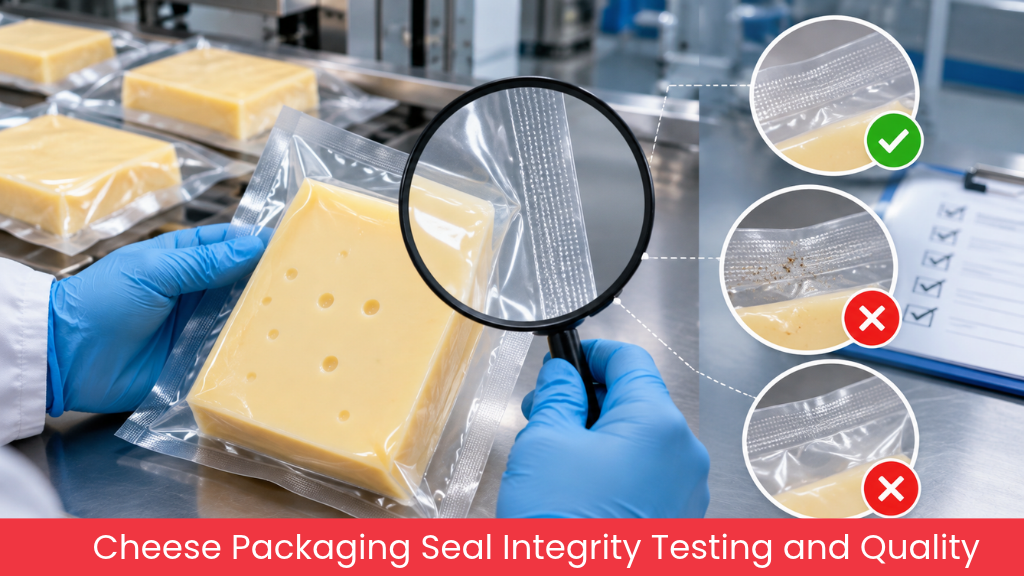
Seal inspection focuses on the seal area and the evidence needed before approval. It typically includes:
A visible irregularity is an investigation point, not automatic proof of one cause. It could come from the filling process, the product itself or the sealing parameters.
An acceptable looking seal does not by itself confirm complete pack integrity. That needs the leakage and vacuum retention checks covered next.
Leakage assessment looks at the complete pack, not just the seal area, since a seal can appear sound while a leak starts elsewhere in the pouch. Checks should suit the specific pack and application rather than follow one universal test.
For vacuum packed cheese, part of the evaluation should assess whether the intended pack condition is retained over the agreed evaluation period. A change in pack appearance should prompt investigation of the product, process and packaging together, not an assumption of one single cause.
Puncture assessment should focus on risks relevant to the actual cheese pack, including product shape, pack fit and the handling contact points a pack will meet during loading, stacking and transit. Hard cheese with firm edges or corners carries particular weight in this check, since product geometry affects contact pressure on the film.
High puncture resistance pouches with the right gauge and construction can help address these risks. Thicker film is not automatically the right solution for every situation, and no puncture resistant material is immune to failure under the wrong handling conditions.
Storage evaluation assesses the pack under the intended storage conditions and duration, as set by the responsible technical team. Moisture management should stay distinct from gross leakage checks, since a change in product moisture is not automatic evidence of a hole or a failed seal.
Any product mass or moisture related evaluation should use a method that can separate product changes from packaging effects. Barrier data for a film is useful supporting evidence for material selection, but no single barrier target applies to every cheese type.
Temperature transitions can be assessed as part of one coordinated storage and distribution validation plan. A separate test programme is not always necessary, but the transitions that are actually part of the intended packing, storage, loading or distribution process should be identified and recorded on their own terms, such as a move from a chill room to a loading dock or a transition point on a cold-chain route.
Select temperature-transition and excursion conditions through a documented assessment of the intended route and reasonably foreseeable handling risks. Packaging should never be treated as a substitute for adequate temperature control along the route.
Individual cheese packs should be assessed together with their intended cartons, pack arrangement and handling configuration. Cold-chain packaging performance depends on loading, stacking and bracing as much as on the film itself.
Handling evaluation or transport simulation should represent the planned distribution conditions for the specific route in question, with test selection, severity and acceptance limits set by the responsible technical team.
After transport evaluation, repeat the relevant integrity checks to identify damage caused by handling. One successful simulation does not guarantee every future export shipment; it confirms performance under the specific conditions tested.
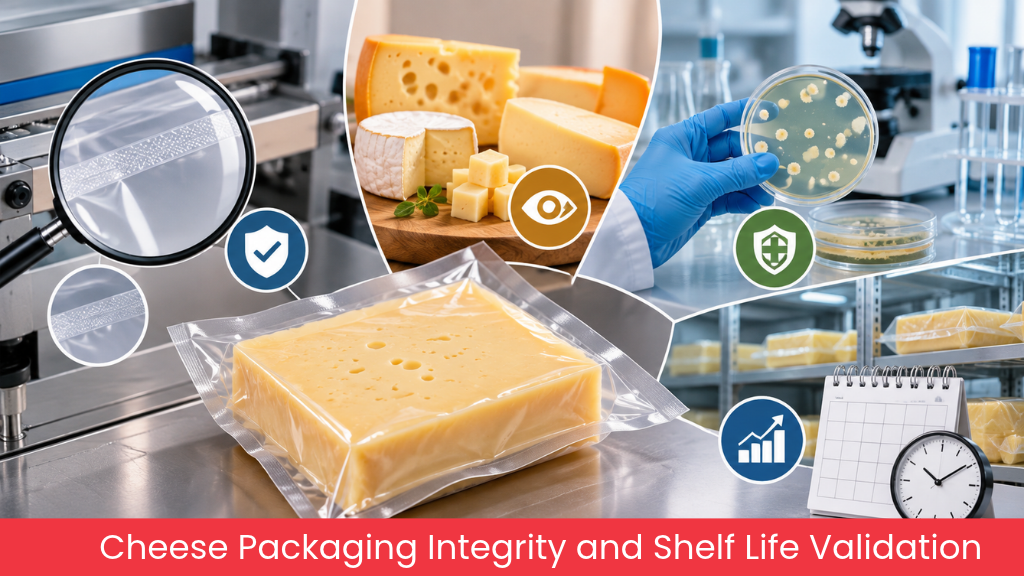
Packaging approval and shelf life claims are not the same thing, and this distinction matters for export packaging for cheese in particular. Shelf life claims require product specific testing under the intended storage and distribution conditions. They are not inferred from pouch clarity, retained vacuum, barrier data or the absence of visible leakage during a packaging trial.
Keep these elements clearly separate:
A packaging validation does not establish a safe storage duration on its own, and a packaging certificate does not validate the finished cheese product.
The final stage brings the evaluation together into a documented decision. An approved specification should record:
Destination market requirements should be confirmed separately with the responsible compliance team and the importer; this process does not establish or imply universal export approval for any country.
Certain changes should trigger a review of whether revalidation is needed, such as a different cheese format, a change in pack size, a new material, different equipment or a new distribution route.
Vishakha PolyFab is a flexible packaging film manufacturer whose ranges support cheese packaging testing and dairy packaging validation across dairy, food and non food sectors. Its product range covers vacuum pouches under VISHVACU, thermoforming films under VISHFORM, top lidding films under VISHTOP, barrier VFFS films under VISHBARR, lamination films under VISHLAMI and recyclable barrier films under REGAIN.
For cheese applications, buyers can discuss pouch format, dimensions, barrier requirements and filling conditions with Vishakha PolyFab to identify suitable packaging options.
Approving cheese packaging means building evidence from the actual product, the packing process and the intended distribution conditions, rather than relying on the pouch material alone.
For cheese manufacturers and QA teams working through this process, Vishakha PolyFab is available to discuss cheese packaging formats and specification requirements for your product and route.
Not automatically. The validation scope should account for differences in filling, seal contamination and handling between block and shredded cheese. Discuss both formats with Vishakha PolyFab when reviewing the proposed material.
Vacuum retention assessment applies where vacuum packaging is used. Other formats require checks appropriate to their packaging system. Discuss the selected format and material requirements with Vishakha PolyFab.
Yes. A different pack size changes fill behaviour, seal geometry and handling stress, so it is a reasonable trigger for revalidation. Vishakha PolyFab offers customisable gauge and width that can support this kind of adjustment.
Material and dimensional specifications, trial records, evaluation results and relevant supplier documentation, including certification status. Discuss ISO and BRCGS certification documentation with Vishakha PolyFab for this file.
Not without review. A new distribution route may bring different handling, temperature and duration conditions that were not part of the original evaluation. Raise a route change with Vishakha PolyFab to identify which variables may need rechecking.

Vishakha Polyfab Pvt. Ltd. is a global pioneer in high-barrier flexible packaging, specializing in advanced 9-layer co-extruded PA/EVOH-based films. Headquartered in Ahmedabad, India, the company utilizes world-class Brampton Engineering (Canada) and Aqua Frost® water-quenched technology to deliver superior shelf-life extension solutions. From Modified Atmosphere Packaging (MAP) to deep-draw thermoforming applications, Vishakha Polyfab delivers compliant, high-performance materials that protect product integrity throughout complex international supply chains. Their expertise in vacuum packaging, thermoforming, and lidding films helps enterprise-level brands in the food, pharmaceutical, and industrial sectors optimize packaging performance and sustainability.

Make Vishakha Polyfab the silent guardian of your products to preserve their vigour and enhance the quality of user interaction with them.
Sign Up for Our Newsletter
Corporate Head Office
Social Media
An ISO & BRCGS Certified Company


Manufacturing Address

