
July 15, 2026
Table of Contents




Table of Contents
Vacuum sealing bags used for food in the United States must meet the requirements of the Food and Drug Administration under Title 21 of the Code of Federal Regulations, primarily Parts 174 through 178, which govern indirect food additives and substances that come into contact with food. This means every resin, adhesive, and additive used in a multilayer vacuum bag, including common structures built from polyamide, polyethylene, and EVOH, must either be listed as an approved food contact substance, recognized as Generally Recognized as Safe, covered by a Food Contact Notification, or fall under a Threshold of Regulation exemption. Manufacturers must also follow current Good Manufacturing Practice and, for products intended for retort or boilable applications, demonstrate that the film performs safely under sustained heat and pressure. This article explains what these requirements mean in practice for buyers of vacuum sealing bags, referencing the actual FDA regulation parts, and describes how Vishakha Polyfab aligns its VISHVACU vacuum pouches and bags with these standards.
In the United States, packaging materials that touch food are regulated as indirect food additives rather than as separate consumer products. The FDA’s Code of Federal Regulations Title 21 sets out the framework for this. According to the FDA’s own inventory of food contact substances, materials used to manufacture food packaging fall under Part 174, which lays out general provisions, with more specific rules in Parts 175 through 178 and additional listings in Part 179.45 and Part 180.22.
For a vacuum sealing bag to be considered compliant, every substance in its construction, including the base resins, any adhesive used in lamination, colorants, and processing aids, must satisfy one of the following conditions.
| Regulation | What It Covers | Relevance to Vacuum Bags |
| 21 CFR Part 174 | General provisions for indirect food additives | Establishes the overall compliance framework |
| 21 CFR Part 175 | Adhesives and components of coatings | Applies to laminating adhesives used to bond film layers |
| 21 CFR Part 176 | Paper and paperboard components | Relevant for paper based or paper hybrid vacuum bags |
| 21 CFR Part 177 | Polymers, resins, and plastic materials | Applies directly to PE, PA nylon, and EVOH resins used in vacuum bags |
| 21 CFR 177.1520 | Olefin polymers such as polyethylene and polypropylene | Governs PE layers commonly used as the sealant layer |
| 21 CFR 177.1360 | Ethylene vinyl alcohol copolymers | Governs EVOH barrier layers used for oxygen protection |
| 21 CFR Part 178 | Adjuvants, production aids, and sanitizers | Covers slip agents, antistatic agents, and similar processing additives |
Read Our Article
FDA compliance for a finished vacuum bag structure is not a single certificate but a chain of documentation covering every material in the pack.
Our Other Product
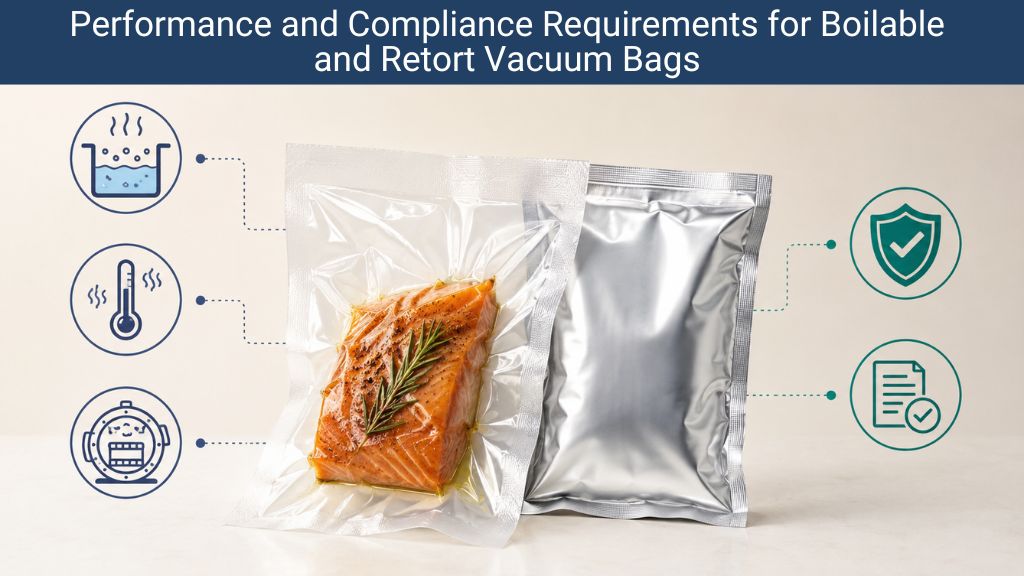
Vacuum bags intended for sous vide cooking or retort sterilization face an additional layer of scrutiny because they are exposed to sustained heat, sometimes reaching sterilizing conditions well above boiling temperature for extended periods. Beyond confirming that the resins themselves are approved for food contact, manufacturers must demonstrate that the finished film maintains its seal integrity and does not release its components in excess of established migration limits when exposed to these conditions. Research on EVOH barrier films indicates that EVOH maintains its barrier function and chemical stability at retort conditions up to around 135 degrees Celsius, which is one reason EVOH based structures are widely specified for boilable and retortable vacuum pouches rather than materials that may soften or degrade at high temperature.
While this article focuses on the United States FDA framework, vacuum bag manufacturers that export internationally also need to align with regional equivalents.
| Region | Governing Framework | Key Requirement |
| United States | FDA, Title 21 CFR Parts 174 to 178 | Approved substances, GRAS status, or FCN authorization |
| European Union | Regulation EC No 1935/2004 and Regulation EU No 10/2011 | Specific migration limits and declaration of compliance |
| India | Food Safety and Standards Authority of India packaging regulations | Food grade material standards under the Food Safety and Standards Act |
Manufacturers supplying multiple markets typically design films to meet the strictest applicable migration limits across these frameworks so a single structure can serve both domestic and export customers without redesign.
Vishakha Polyfab manufactures its VISHVACU vacuum pouches and vacuum bags using PA and EVOH based co extruded films under ISO and BRCGS certification, and states that its PA EVOH based films comply with applicable safety regulations, making them suitable for direct food contact globally. Because the company controls its own extrusion, printing, and lamination process, it can provide the documentation buyers need to confirm that resins, adhesives, and processing aids used in a specific vacuum bag structure meet the applicable food contact requirements, along with boilable vacuum pouches engineered for high temperature stability for sous vide and retort style applications.
FDA compliance for vacuum sealing bags is built on a layered framework rather than a single blanket approval, covering the base resins, adhesives, and processing aids that make up the finished film. Understanding the relevant CFR parts, particularly Part 177 for plastics and resins and Part 175 for adhesives, helps food processors and packaging buyers ask the right questions and request the right documentation from their vacuum bag supplier. This is especially important for boilable and retort vacuum bags, where the film must remain stable and compliant under sustained heat rather than only at room temperature.
Vacuum sealing bags themselves are not individually approved as products. Instead, the food contact substances used to make them, such as the PE, PA nylon, or EVOH resins and any adhesives, must comply with the applicable regulations under 21 CFR Parts 174 to 178.
GRAS status means a substance is Generally Recognized as Safe for its intended use based on established scientific consensus, while a Food Contact Notification is a specific premarket authorization the FDA grants to a manufacturer for a defined use of a particular substance.
Yes, ethylene vinyl alcohol copolymers used as an oxygen barrier layer in vacuum bags are addressed under 21 CFR 177.1360, and EVOH is widely recognized as compliant with United States, European Union, and Japanese food contact regulations.
Buyers should request a Letter of Guarantee or Certificate of Compliance from the manufacturer confirming that the specific resins, adhesives, and additives used in the vacuum bag structure meet the applicable FDA food contact regulations for the intended use.
Boilable and retort vacuum bags face additional scrutiny because they are exposed to sustained high temperature, so manufacturers must confirm the film maintains seal integrity and stays within migration limits under those specific heat conditions rather than only at ambient temperature.
FDA compliance confirms the packaging material itself is safe for food contact, but overall food safety also depends on proper handling, storage temperature, and processing by the food producer, since packaging is one part of a larger food safety system.

Vishakha Polyfab Pvt. Ltd. is a global pioneer in high-barrier flexible packaging, specializing in advanced 9-layer co-extruded PA/EVOH-based films. Headquartered in Ahmedabad, India, the company utilizes world-class Brampton Engineering (Canada) and Aqua Frost® water-quenched technology to deliver superior shelf-life extension solutions. From Modified Atmosphere Packaging (MAP) to deep-draw thermoforming applications, Vishakha Polyfab delivers compliant, high-performance materials that protect product integrity throughout complex international supply chains. Their expertise in vacuum packaging, thermoforming, and lidding films helps enterprise-level brands in the food, pharmaceutical, and industrial sectors optimize packaging performance and sustainability.

Make Vishakha Polyfab the silent guardian of your products to preserve their vigour and enhance the quality of user interaction with them.
Sign Up for Our Newsletter
Corporate Head Office
Social Media
An ISO & BRCGS Certified Company


Manufacturing Address

