
August 24, 2026
Table of Contents




Table of Contents
Flexible packaging materials include films, laminated packaging films, multilayer packaging structures, packaging pouches and roll stock packaging used to protect food, pharmaceutical, industrial and consumer products. The right choice depends on barrier properties, shelf life needs, seal strength, printing requirements and storage or transport conditions. Businesses also weigh sustainability, using recyclable or reduced material structures without compromising protection. Selecting an experienced manufacturer, such as Vishakha Polyfab, helps buyers match material type, lamination structure and film specification to their specific product and application needs.
Packaging films are the foundational material in most flexible packaging structures. A film is a thin, flexible plastic or bio based substrate that can be used on its own or combined with other layers to build a complete packaging solution. The right flexible packaging film depends heavily on what is being packed and how it will be stored, shipped and used.
For food packaging films, the priority is usually moisture resistance, oxygen barrier and grease resistance. Snacks, bakery products and dry goods need films that keep out humidity and preserve crispness. Dairy and frozen food products need films that perform well at low temperatures without becoming brittle or losing seal strength. In most cases this means a multilayer film combining a barrier layer, such as metallized film or EVOH, with a sealant layer, rather than a single layer film trying to do every job at once.
Industrial packaging films serve a different purpose. Products such as chemicals, hardware components, textiles and construction materials often need films with higher puncture resistance, tear strength and UV stability rather than food grade barrier properties. Many of these applications also draw on laminated packaging films and multilayer packaging structures to combine strength with barrier protection.
Key considerations when selecting a packaging film include:
Vishakha Polyfab manufactures multilayer barrier films at scale, including 7 and 9 layer airblown, waterquench and 11 layer cast Nylon and EVOH structures. This depth of film making capability allows food processors and industrial manufacturers to move beyond standard stock film and specify a barrier structure built around their product’s actual shelf life and protection needs.
A single layer film rarely delivers every property a product needs. This is where laminating films come in. Lamination is the process of bonding two or more film layers together to combine their individual strengths into one composite structure.
Laminated packaging films typically combine:
This layered approach is what allows flexible packaging laminating films to achieve properties that no single material can provide alone. PET brings toughness and print quality, while polyethylene provides a reliable heat seal at the pack’s opening.
Multilayer packaging films are widely used across:
These structures matter most wherever a product needs more than one layer of protection at once, such as extended shelf life food products, moisture sensitive pharmaceuticals or products exposed to rough handling during transport, since no single film can be printable, barrier protective and heat sealable at the same time.
Vishakha Polyfab’s laminated film range, marketed as VISHLAMI, is built for lamination grade use across solvent based, solventfree and standard lamination processes, and is available in transparent, metallized and white film formats to support different barrier and branding needs.
Read Our Article
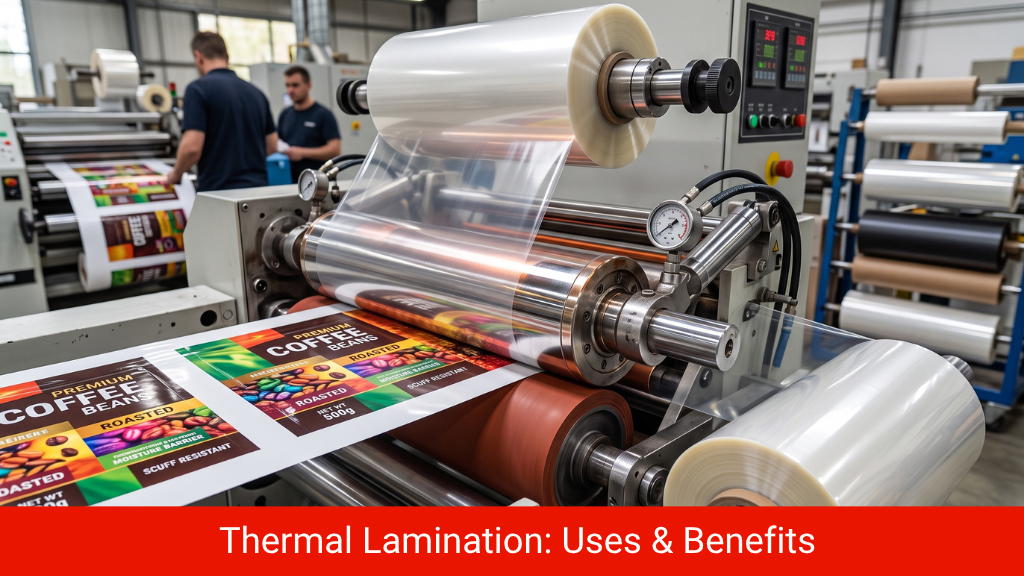
Thermal lamination is a process where a film layer is bonded to a substrate using heat and pressure rather than a liquid adhesive. Thermal lamination film typically consists of a polyester or polypropylene base coated with a heat activated adhesive layer.
In flexible packaging, thermal laminating film is commonly used for:
Thermal lamination differs from solvent based or solventfree lamination because it does not require a curing period, which can shorten production timelines. It is frequently chosen for retail facing packaging where visual presentation matters alongside functional protection, or where shorter runs and last minute print changes make waiting on a cure cycle impractical.
Flexible packaging is a broad category covering any packaging made from materials that can be easily shaped or sealed, as opposed to rigid packaging like glass jars or metal cans. Flexible packaging solutions include pouches, bags, wraps, sachets, roll stock and lidding films.
Common formats within flexible packaging materials include:
Food flexible packaging has grown steadily because it typically uses less material by weight compared to rigid alternatives, while still meeting barrier and shelf life requirements. This makes it relevant to both cost conscious FMCG brands and companies working toward material reduction goals.
Demand for these formats spans several industries at once. Edible oil brands need leak proof, high durability pouches. Dairy processors need packaging that secures freshness for milk, cheese and UHT products. Bakery, cereal, snack, tea, coffee and pet nutrition companies need shelf stable structures, while non food sectors such as home care, personal care and agriculture rely on sterile or oxygen barrier films suited to their own product ranges.
Packaging pouches for food are one of the most widely used flexible packaging formats because they offer a practical combination of protection, shelf presence and convenience. The right pouch structure depends on the food category, fill process and expected shelf life.
Common types of food packaging pouches include:
| Pouch Type | Typical Use Case | Key Requirement |
| Stand up pouch | Snacks, cereals, pet food | Barrier protection, shelf stability |
| Flat pouch | Powders, spices, sauces | Cost efficiency, sealing reliability |
| Spouted pouch | Liquids, sauces, baby food | Leak resistance, dispensing convenience |
| Vacuum pouch | Meat, cheese, frozen food | High barrier, puncture resistance |
| Retort pouch | Ready to eat meals | Heat resistance, long shelf life |
Across these formats, the protection itself comes down to two things working together: barrier layers that block oxygen, moisture and light, and seals strong enough to keep contamination and leakage out through storage, transport and handling. A pouch can carry the right barrier film and still underperform if the seal is inconsistent, which is why seal integrity gets as much attention as film selection in food pouch development.
For chilled, frozen and processed foods such as cheese, Vishakha Polyfab’s VISHVACU range uses PA and EVOH based films designed for vacuum sealing, offering high puncture resistance and a low leak rate alongside barrier protection against moisture, gas, oxygen and aroma loss. When evaluating packaging pouches manufacturers more broadly, businesses should look at barrier performance, seal consistency and the ability to support custom gauge, print and width specifications.
Our Other Product
Businesses often need to decide between pre made pouches and packaging roll film that is formed, filled and sealed on automated machinery. Both use similar materials, but the right choice depends on production volume, packaging line setup and product type. The underlying distinction is simple: packaging film is the raw flat material, supplied as sheets or packaging film rolls, while a pouch is that same material already formed into a finished unit ready to be filled directly.
Packaging roll film, also referred to as roll stock packaging, is supplied as a continuous roll and is typically used on form fill seal machines, which form, fill and seal the pouch in one continuous line rather than filling a pre made shape. Flexible packaging roll film is common in high volume food and industrial production where speed and consistency matter.
| Factor | Roll Stock Packaging | Pre Made Pouches |
| Production speed | High, suited to automated lines | Slower, often manual or semi automatic |
| Initial equipment need | Requires form fill seal machinery | Minimal equipment needed |
| Format flexibility | Fixed to machine specification | Wide range of shapes available |
| Best suited for | High volume manufacturers | Small to mid volume producers, sample runs |
| Cost efficiency at scale | Generally more cost efficient | Better for lower volumes |
Vishakha Polyfab also offers a CPP film line, positioned as an 11 layer Nylon and EVOH based next generation film structure, available in general, metalizable and high hot tack grades, with the high hot tack grade marketed for fast sealing on form fill seal lines and pharmaceutical sachet applications.
BOPP stands for Biaxially Oriented Polypropylene. Packaging BOPP film is created by stretching polypropylene film in two directions, which increases its clarity, tensile strength and dimensional stability compared to standard polypropylene.
BOPP packaging film is widely used in flexible packaging because it offers:
BOPP flexible packaging is often used as the outer ply in a laminated structure, paired with a barrier or sealant layer to complete the packaging performance. A typical BOPP laminated film structure combines BOPP for print and strength with polyethylene for heat sealing.
In short, BOPP packaging film is the outer web that gives a laminated pack its shine, stiffness and shelf appeal, while the inner layers handle barrier and sealing duties. Businesses choose it over plain polypropylene mainly for print clarity and dimensional stability on high speed printing presses, not for oxygen or moisture protection, which is why it almost always appears paired with a barrier or sealant layer rather than alone. BOPP film applications extend well beyond snack and confectionery pouches into label stock, tape backing and carton lamination, which is part of why it remains one of the most specified films in flexible packaging structures across food and non food categories alike.
Read Our Article
Selecting among packaging material suppliers involves more than comparing price per kilogram of film. Since flexible packaging directly affects product shelf life, brand presentation and regulatory compliance, the manufacturing partner matters as much as the material specification.
When evaluating a flexible packaging company, businesses should assess:
Choosing the right packaging material starts with defining the product’s protection requirements, including moisture sensitivity, oxygen sensitivity, expected shelf life and storage conditions. From there, businesses can shortlist film types and structures, request samples for compatibility testing on their filling equipment, and confirm the packaging manufacturers can support their required volumes and specifications.
Packaging manufacturing is a technical process. Vishakha Polyfab’s facilities combine extrusion, rotogravure and flexo printing, lamination and pouching under one roof, supported by an in house research and development center with real time gauge and seal testing and SAP based traceability, along with ISO, BRCGS and Kosher certifications that food and pharmaceutical buyers commonly require.
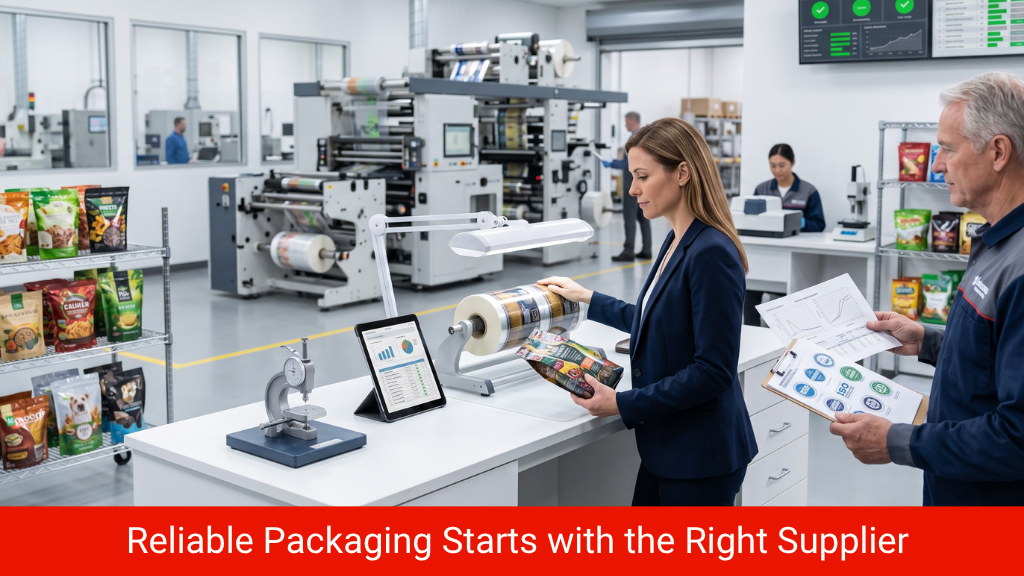
India’s flexible packaging sector has grown substantially, supported by demand from food processing, pharmaceutical and export oriented industries. The supply base ranges from large multinational producers to specialized regional manufacturers, so the right fit depends on the buyer’s own scale: a large export focused FMCG brand may prioritize a supplier with multiple manufacturing units and international certifications, while a smaller regional brand may prioritize faster turnaround on shorter production runs.
Gujarat, and Ahmedabad specifically, sit along India’s petrochemical and polymer supply chain, which is why a concentration of film and lamination producers are based there. This typically means shorter raw material lead times than sourcing from other regions, though buyers evaluating suppliers in the state should ask directly about in house testing capability and certification records rather than relying on capacity claims alone. Ahmedabad based manufacturers in particular often run the full production chain, extrusion, printing, lamination and pouching, under one roof, which reduces the handoffs between vendors that can otherwise slow down custom development and sampling for a new packaging structure.
A flex packaging company in India serving both domestic and export markets typically needs to demonstrate:
Vishakha Polyfab is headquartered in Ahmedabad, Gujarat, with additional manufacturing facilities in West Bengal and Indonesia. Its flexible packaging operations run across multiple manufacturing units with a combined flexible film capacity built to serve customers across 30+ countries, giving Gujarat and Ahmedabad based buyers access to export grade production without sourcing internationally.
Our Other Product
Product packaging serves a functional purpose well beyond branding. Packaging for product protection is what prevents damage, contamination and spoilage between the point of manufacturing and the point of use.
Key roles that packaging for food products and other goods plays include:
Packaging importance becomes especially clear when products fail prematurely due to inadequate barrier properties or weak seals, resulting in returns, waste and reputational impact. Films built for oil, gas and moisture resistance, such as Vishakha Polyfab’s VISHBARR range, are designed to retain taste, aroma, colour and texture even under retort or pasteurization conditions, illustrating how barrier film choice directly determines whether a product reaches the consumer in its intended condition.
These three terms are often used loosely, but they describe different things, and understanding the distinction matters for businesses setting sustainability goals.
| Term | What It Means | Depends On |
| Recyclable packaging | Material that can be processed and converted into new material after use | Local collection and recycling infrastructure actually being in place |
| Recycled packaging | Material made partly or fully from post consumer or post industrial recycled content | Availability and quality of recycled feedstock for the application |
| Reusable packaging | Packaging designed to be used multiple times, for the same or a different purpose, before disposal | Durability of the pack and a product or return model built around reuse |
Not all recyclable packaging is actually recycled in practice, since a recyclable claim depends on what happens after the consumer is done with the pack, and is only meaningful where collection and processing infrastructure actually exists in that market. A reusable claim, by contrast, depends on the packaging itself being durable enough to survive multiple use cycles before it needs to be recycled or discarded at all.
For flexible packaging specifically, mono material structures, using a single polymer family such as all polyethylene or all polypropylene, are increasingly used to improve recyclability, since multi material laminates can be more difficult to process through standard recycling streams. Vishakha Polyfab’s REGAIN range is built around this principle, offering recyclable certified structures for chilled, frozen and pharmaceutical products where brands want a circular economy story without giving up barrier performance.
Sustainable packaging decisions require balancing environmental goals with the practical need to protect the product. A package that reduces material use but fails to protect the product adequately can create more waste overall, through spoilage or returns, than a slightly heavier but more protective structure. This is where recyclability and protection can pull in different directions: a mono material film is easier to recycle, but it may need to be run thicker or paired with a coating to match the barrier a multilayer laminate would otherwise provide.
Practical approaches businesses can consider for sustainable flexible packaging include:
Eco friendly packaging materials are not a one size fits all solution. A pharmaceutical product with strict barrier requirements will have different sustainable packaging options compared to a dry snack food with more flexibility in material choice. Vishakha Polyfab supports this evaluation through thin gauge optimization, barrier recyclable film development and energy efficient manufacturing, including solar power capacity installed across its facilities to reduce reliance on non renewable energy during production.
Choosing the right flexible packaging material comes down to matching film type, lamination structure, format and barrier performance to the specific product and its journey through storage and transport. Films, laminates, pouches, roll stock and BOPP structures each serve distinct purposes, and sustainability goals can be met through mono material and down gauged options without compromising protection. Working with an experienced manufacturing partner such as Vishakha Polyfab helps businesses translate these technical factors into a packaging structure that performs reliably in real world conditions.
Flexible packaging is typically made from polymer films such as polyethylene, polypropylene, BOPP and PET, either used alone or combined through lamination into multilayer structures. The material combination depends on the required barrier, strength and sealing properties. Vishakha Polyfab develops flexible packaging films and laminated structures using material combinations suited to food, pharmaceutical and industrial applications.
A laminated film combining BOPP or metallized film for barrier protection with a polyethylene sealant layer generally works well for snacks and dry food, since it blocks moisture and oxygen while maintaining strong seal integrity. The exact structure depends on the product's fat content, expected shelf life and storage conditions.
BOPP film is a single stretched polypropylene material valued for clarity and strength, while laminated film combines BOPP or another base with additional layers, such as barrier or sealant films, to achieve properties no single material provides alone. BOPP is often used as one component within a broader laminated packaging structure.
Film thickness depends on the product's weight, fragility and required shelf life, and typically ranges from around 12 microns for lightweight sachets to over 100 microns for heavier or high barrier applications. Thicker films are not always better, since over specifying thickness adds unnecessary material cost without functional benefit.
Flexible packaging generally uses less raw material by weight than rigid alternatives like jars or cans, which often makes it more cost efficient for production, storage and transport. Actual savings depend on the product category, required barrier level and packaging format selected.
Yes, flexible packaging films can be customized for pouch size, film thickness, barrier level, finish and high resolution printing to support brand presentation. Vishakha Polyfab's rotogravure and flexo printing capability supports customized flexible packaging solutions that align material specifications with branding and shelf visibility goals.
Pharmaceutical packaging typically requires high barrier laminated films with strong moisture and oxygen protection, tamper evident sealing and compliance with relevant regulatory standards. Structures such as laminated strips, sachets and pouches are common, chosen based on the specific formulation's sensitivity and dosage format.
Mono material BOPP film is generally recyclable within polypropylene recycling streams, though this depends on local recycling infrastructure. When BOPP is laminated with other polymer types, recyclability can become more limited, which is why mono material structures are increasingly considered for recyclable flexible packaging.
Getting custom flexible packaging typically starts by sharing product details, expected shelf life and storage conditions with a manufacturer, who can then recommend a suitable film or laminate structure and provide samples for testing. Vishakha Polyfab supports businesses through this process, with pouch making, lamination and printing capabilities suited to custom formats and tight tolerances.
Flexible packaging is widely used across food processing, dairy, snacks, frozen food, FMCG, pharmaceutical and industrial product sectors, since it offers a practical combination of protection, cost efficiency and shelf presence. Each industry typically requires different barrier levels and structures based on its specific product protection needs.

Vishakha Polyfab Pvt. Ltd. is a global pioneer in high-barrier flexible packaging, specializing in advanced 9-layer co-extruded PA/EVOH-based films. Headquartered in Ahmedabad, India, the company utilizes world-class Brampton Engineering (Canada) and Aqua Frost® water-quenched technology to deliver superior shelf-life extension solutions. From Modified Atmosphere Packaging (MAP) to deep-draw thermoforming applications, Vishakha Polyfab delivers compliant, high-performance materials that protect product integrity throughout complex international supply chains. Their expertise in vacuum packaging, thermoforming, and lidding films helps enterprise-level brands in the food, pharmaceutical, and industrial sectors optimize packaging performance and sustainability.

Make Vishakha Polyfab the silent guardian of your products to preserve their vigour and enhance the quality of user interaction with them.
Sign Up for Our Newsletter
Corporate Head Office
Social Media
An ISO & BRCGS Certified Company

Manufacturing Address

