
September 24, 2026
Table of Contents




Table of Contents
Shredded and grated cheese consists of many small particles with a large exposed surface, so packaging must manage surface moisture, loose particles and product entering the sealing zone. These factors can affect seal integrity, clumping and pack appearance. Reliable results depend on moisture management, clean seal areas, suitable barrier and sealant layers, controlled filling, appropriate portion size, resealable formats where useful and validated refrigerated storage. Requirements vary by cheese, pouch format and equipment.
A block of cheese presents one compact surface to the packaging film. Shredded cheese presents thousands of small surfaces, each carrying a thin layer of moisture and fat. This difference changes filling, sealing and storage decisions, which is why shredded cheese packaging cannot be treated as a smaller version of block cheese packaging.
The features that matter most are:
The film is only one variable. A clean, strong seal depends equally on how the product enters the pouch and how the seal is formed. The packaging material, filling equipment, sealing process and cold storage conditions therefore need to be planned together rather than selected one at a time. Vishakha PolyFab serves dairy applications, including cheese, within its flexible packaging range.
Coarse shreds and finely grated cheese do not behave alike. Shreds are longer strands that tend to bridge inside hoppers and tangle in weigher buckets. Fine grated cheese behaves closer to a powder. It flows through small gaps, creates dust when dropped and can drift toward the pouch mouth as air is displaced during filling.
Particle size can influence four areas:
A trial that works for shredded mozzarella should not be assumed to work for finely grated hard cheese, even when the same pouch is used. Trials are best run separately for each format, and packaging suppliers such as Vishakha PolyFab can support field trials before a structure is finalised.
Surface moisture usually comes from whey on the cheese surface, from shredding and mixing operations, and from condensation when warm product meets a cold pouch or cold room. Product temperature at filling matters. Cheese packed warm releases moisture as it cools inside the sealed pouch, which dampens particles, wets the inner film and encourages clumping.
A moisture barrier limits moisture exchange between the pouch and its surroundings. It does not remove moisture already present on the product. A strong barrier can even keep that moisture inside the pack, so clumping created at filling may not be solved by a higher barrier.
The barrier needed depends on the cheese, pouch format, storage conditions and distribution route. Vishakha PolyFab offers multilayer PA and EVOH-based structures described with low oxygen and water vapour transmission, but suitability for a given cheese must be confirmed through trials. Any shelf-life expectation should be supported by product-specific testing.
Teams should monitor product temperature at filling and the moisture condition of shreds before dosing.
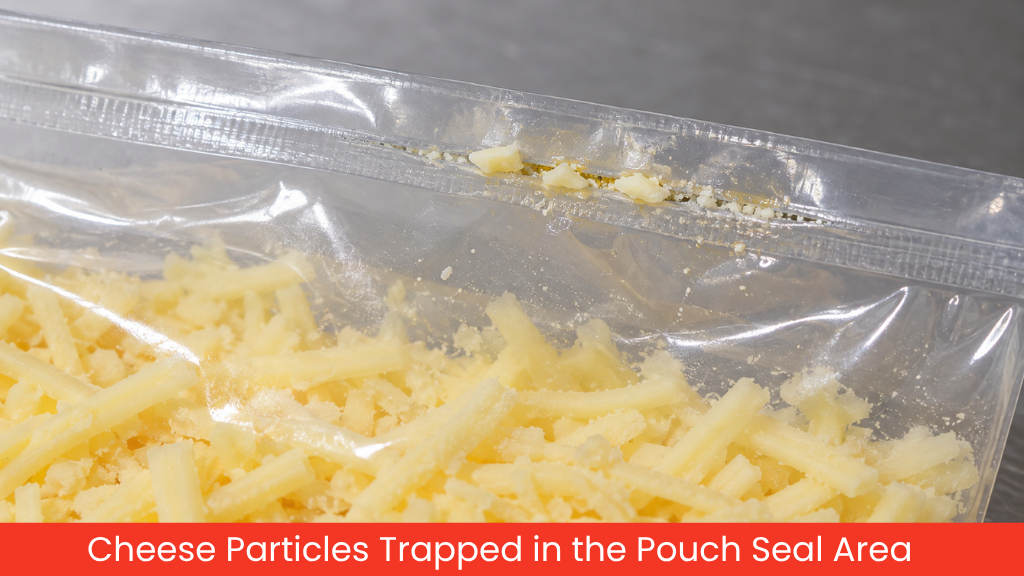
A heat seal forms when the sealant layers on both sides of the pouch melt and fuse under heat, pressure and time. Anything trapped between those layers, whether a particle, a droplet or a film of fat, prevents full contact.
Contaminants can reach the seal zone during:
Typical contaminants include cheese fragments, fine grated particles, moisture, oil or fat residues and anti-caking powder.
Seal failure often appears as weak patches, narrow leak channels or seals that peel open under light load. It should not automatically be blamed on the film, because contamination, filling conditions and machine settings can all contribute. Some sealant layers tolerate light contamination better than others, and good hot tack can help, but no sealant replaces a clean sealing area. Vishakha PolyFab describes seal layers as customizable in its laminated films, which allows the sealant to be reviewed against the product and the machine.
Filling conditions decide how much product reaches the seal zone. These variables are worth reviewing:
Line managers can check whether filling is contributing by asking:
Our Other Product
Many processors first notice seal problems at the machine, so it helps to separate machine behaviour from film behaviour. On vertical form fill seal (VFFS) lines, these points deserve routine checks:
Recording machine settings next to seal test results helps trace whether a problem comes from the machine or the material. Any setting change should be confirmed with the equipment and film suppliers rather than adjusted by trial alone. Vishakha PolyFab’s CPP film range includes a high hot tack grade described for fast sealing on FFS lines, and whether it suits a particular cheese and machine requires trials.
Buyers should evaluate these properties against the actual application:
The right combination depends on cheese type, product format, portion size, packaging equipment, storage requirements and distribution conditions. No single structure suits every product.
Vishakha PolyFab produces multilayer Nylon/EVOH barrier films and laminated structures, including its VISHBARR and VISHLAMI ranges. These offer options in barrier level, thickness, seal layers and print, so buyers can match a structure to the application, subject to trials.
Portion size changes the load on the pouch as well as its appearance. The examples below are illustrative, not recommendations.
As portion size increases, pouch dimensions, film strength, headspace, closure needs and usage after opening should be reviewed again rather than scaled from a smaller pack. Vishakha PolyFab describes customizable gauge, width and print across its film ranges, which supports adapting pouch dimensions to different portion sizes.
Two functions are often confused. The primary hermetic seal is created during packing and protects the product through distribution. The reclosure feature, usually a zipper, works only after the pack is opened. A zipper alone does not provide the original package seal and does not guarantee preservation after opening.
Resealable cheese pouches add value in several situations:
Design points to review:
Vishakha PolyFab offers customized pouch formats, and reclosure requirements are best raised at the design stage.
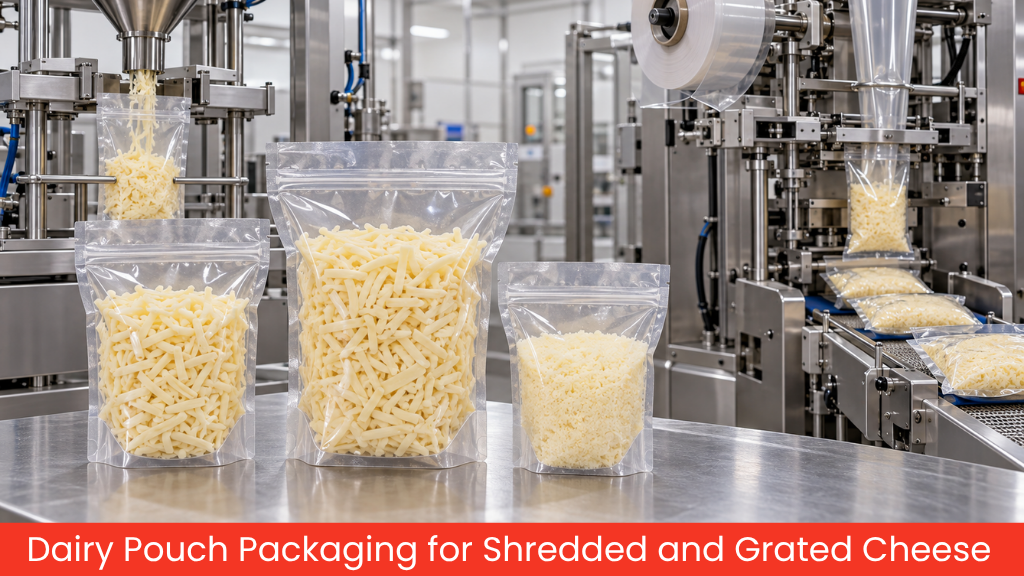
Dairy pouch packaging for shredded and grated cheese generally follows one of two routes:
Other factors include line compatibility, production volume, portion requirements, printing and branding, and storage and distribution conditions. The format should be chosen for the whole packing operation rather than appearance alone. Vishakha PolyFab describes pouch making with customized formats and tight tolerances, along with rotogravure and flexo printing.
Our Other Product
Cold-chain conditions test the package after it leaves the line:
Packaging should be evaluated under realistic storage and distribution conditions, including temperature cycling, stacking loads and transit tests where applicable. QA teams can inspect seals and condensation on samples after storage, not only at the packing line. A fixed quality period should not be claimed for any package without relevant validation data. Vishakha PolyFab describes its barrier films for chilled, frozen and refrigerated products, so storage conditions should be shared early enough for structures to be assessed against them.
| Observed Problem | Possible Cause | Inspection Point | Corrective Action |
| Weak or incomplete seal | Contamination, sealing settings outside the verified range, worn jaws, sealant mismatch | Seal strength test, jaw condition, seal appearance | Clean seal area, verify settings and jaws, review sealant with supplier |
| Cheese particles trapped in seal | Product scatter during filling, overfill, dust, poor pouch alignment | Position of particles, fill weight, drop height | Reduce scatter, adjust fill point, check headspace |
| Moisture visible inside package | Warm product at filling, condensation after temperature change, moist shreds | Product temperature, storage records | Cool product before filling, review temperature changes in handling |
| Product clumping | Surface moisture, fines, compression during stacking, anti-caking level | Moisture and fines in product, pack compression | Confirm moisture and fines at source, review stacking |
| Pouch leakage | Channel leaks from contamination, pinholes, damaged corners | Leak test, seal channels, film damage | Locate leak position, separate seal issues from film damage |
| Seal opening during handling | Weak seal, overfilled pack, stacking stress, cold brittleness | Seal strength after cold storage, carton load | Check fill weight, carton packing and seal after storage |
| Poor zipper operation | Cheese particles in track, misaligned zipper, sealing over zipper | Track cleanliness, zipper position | Keep track clean during filling, review zipper position |
| Package deformation | Overfill, headspace changes, stacking pressure, soft cartons | Fill weight, carton fit, stack height | Adjust fill, review carton and stacking |
Most symptoms have more than one possible cause, so change one variable at a time and record the result.
A supplier can evaluate materials and pouch requirements more accurately when it receives application-specific information. Useful details include:
Without this information, recommendations rest on assumptions. With it, the supplier can compare structures, sealant layers and pouch formats against the actual product. Vishakha PolyFab lists package design and development, customized packaging solutions, field trials and an on-site testing lab with real-time gauge and seal testing among its support services, which suits this kind of application review. Sharing failed packs early can shorten the diagnosis.
Clumping usually reflects moisture and fat on particle surfaces, fine particles, warm product at filling or compression during stacking. It is a product condition first and a film issue second. Reviewing product temperature, moisture at filling and carton compression is a sensible starting point.
The most common cause is material trapped between the sealant layers, such as cheese particles, fat residue or moisture. Filling conditions and machine settings such as jaw condition, alignment and dwell time also contribute. A film mismatch is possible but should be confirmed after these checks.
There is no single suitable structure. The choice depends on cheese type, shred or grate size, portion size, packaging machine, storage temperature and distribution route. A supplier such as Vishakha PolyFab can shortlist options from application-specific information, and trials on the actual line confirm the choice.
Moisture on fine grated particles makes them stick to the film and the seal area, which can weaken seals and lead to visible condensation inside the pack. Controlling product temperature and moisture before filling comes first. Barrier selection then addresses moisture entering from outside.
They can be, particularly for family-size packs used over several meals. Small packs consumed at once may not need a reclosure. The zipper does not replace the primary seal, and cheese in the zipper track can prevent closing, so suitability depends on pack size, usage and filling method.

Vishakha Polyfab Pvt. Ltd. is a global pioneer in high-barrier flexible packaging, specializing in advanced 9-layer co-extruded PA/EVOH-based films. Headquartered in Ahmedabad, India, the company utilizes world-class Brampton Engineering (Canada) and Aqua Frost® water-quenched technology to deliver superior shelf-life extension solutions. From Modified Atmosphere Packaging (MAP) to deep-draw thermoforming applications, Vishakha Polyfab delivers compliant, high-performance materials that protect product integrity throughout complex international supply chains. Their expertise in vacuum packaging, thermoforming, and lidding films helps enterprise-level brands in the food, pharmaceutical, and industrial sectors optimize packaging performance and sustainability.

Make Vishakha Polyfab the silent guardian of your products to preserve their vigour and enhance the quality of user interaction with them.
Sign Up for Our Newsletter
Corporate Head Office
Social Media
An ISO & BRCGS Certified Company


Manufacturing Address

