
October 4, 2026
Table of Contents




Table of Contents
A useful vacuum bag RFQ gives the supplier four kinds of information: what is being packed, the physical bag specification, the performance the pack must deliver and the commercial terms of purchase. It also records which commercial details need written confirmation before an order. This guide sets out what to include so that quotations can be compared on a like-for-like technical basis.
Clear vacuum bag specifications help procurement teams request comparable quotations and give suppliers the information needed to assess an application. A useful vacuum bag RFQ (request for quotation) describes the product, packing process and order requirements, while identifying which details are fixed and which need a technical recommendation.
For custom vacuum bags, buyers should provide vacuum pouch dimensions and any approved vacuum bag thickness, supported by a drawing or current sample where available.
Performance and presentation requirements also affect the quotation. Buyers considering barrier vacuum bags should explain the intended protection and storage conditions, while enquiries for printed vacuum bags should include artwork, colour and design quantities.
A bulk vacuum bag supplier also needs the initial order volume, annual forecast and delivery requirements to prepare a commercially relevant proposal.
Start with a plain description of the product. Give its commercial name and category, and state whether it is a food or non-food item. This affects both material review and documentation.
Then describe the product itself:
Describe the application rather than nominating a structure you have not tested. If an existing material is already approved, mention it separately as a reference point.
State vacuum pouch dimensions as width by length, with the unit of measurement clearly written. Confirm whether the figures are overall outside dimensions or the usable internal space after seals. A quotation built on the wrong basis may produce a bag that does not fit.
Indicate which edge is open for filling, and therefore whether the width runs across the opening. Name the preferred bag construction where you know it.
Vishakha PolyFab lists two-side and three-side seal pouches, tubular bottom-seal pouches and other customised formats within its VISHVACU range, so state which format your line uses.
Mark dimensions on the drawing or sample you send. If dimensional tolerances matter to your filling equipment, ask the supplier to propose them and agree the values in writing.
If you have a defined vacuum bag thickness, quote it with its unit, usually microns, and say whether the figure is total film thickness. Attach any approved specification sheet.
Then make one point explicit: is the thickness fixed by your quality team, or open to review if the supplier proposes something better suited to the product?
Where the right gauge is unknown, say so and ask for a recommendation based on the product details you have supplied. The VISHVACU product page publishes a film thickness range of 40 to 200 microns.
Treat that as range information for the product family, not a guide to what your application needs. The brochure describes VISHVACU gauge as customisable, so ask Vishakha PolyFab to confirm the proposed gauge and its tolerance. A heavier bag is not automatically a better one.
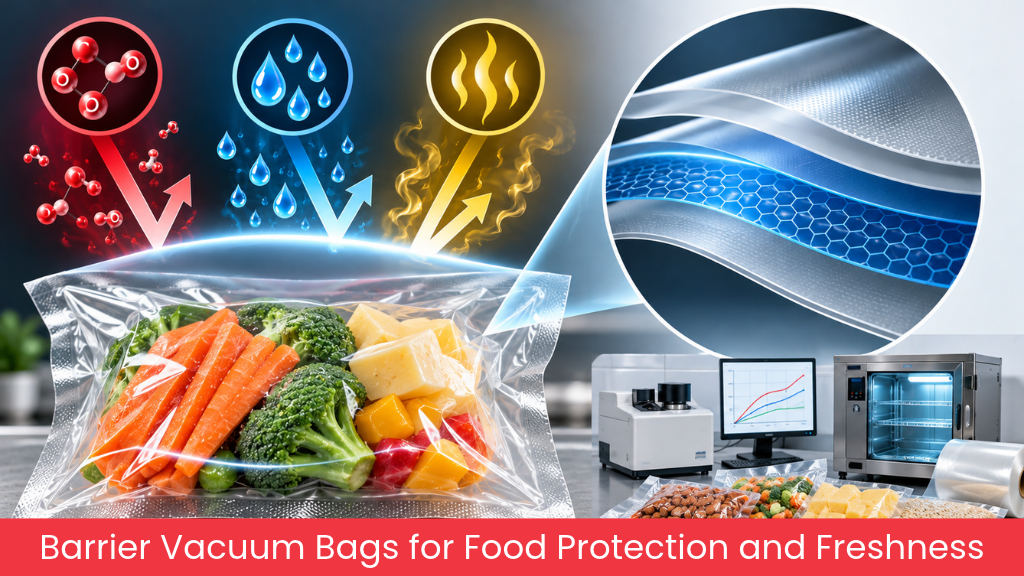
Barrier vacuum bags restrict the passage of gases and vapours through the film. Your RFQ should describe what the product needs protecting from.
Oxygen, moisture and aroma are the usual concerns, and VISHVACU material is described as PA/EVOH based, with the product page listing medium barrier and high barrier structures.
If your quality team works to numerical barrier values, include them together with the test conditions behind each figure, such as temperature and relative humidity. Ask Vishakha PolyFab which data it can provide for the proposed structure and on what basis it was measured.
State your target shelf life as a commercial objective for discussion, not as a property of the bag. The supplier can advise on the packaging contribution, and a material family alone does not confirm suitability.
List the processing steps the filled pack will go through after sealing. Give the temperatures and durations you know.
Where relevant, state clearly whether the pack will be:
Vishakha PolyFab lists boilable and sous vide use among VISHVACU applications. That listing describes the range, not every pouch in it.
Ask the supplier to confirm in writing that the specific quoted structure suits your declared process, and do not assume a boilable pouch is suitable for sterilisation or other more demanding treatments.
Custom vacuum bags need to run on your line, so give the make and model of your packing machine where known. State whether bags are loaded manually or automatically, and whether the process is vacuum only or uses gas flushing, sometimes called modified atmosphere packaging.
Describe the final closure your own equipment makes after filling, as distinct from the bag construction specified earlier.
Note the sealing method, how bags are presented and held during closure, and any existing approved operating settings. This lets the supplier review whether the proposed seal layer is likely to suit your machine.
If compatibility with your line has not been proven, request samples for a machine trial before committing to a production quantity. Vishakha PolyFab describes field trials as part of its development support, so discuss trial arrangements at the RFQ stage.
State first whether the bags are plain or printed. For printed vacuum bags, say whether you need a single logo or a full design, and how many colours the artwork uses.
The VISHVACU specification lists printing from single colour logos up to nine colours, using CI flexographic and rotogravure processes.
Supply artwork with a clear revision reference so that both parties quote and approve the same file. Indicate print position and which faces are printed. If there are several designs or SKUs on the same bag size, list each one separately.
Ask Vishakha PolyFab to explain its artwork file requirements and its proof approval stage. Request confirmation of whether cylinder, plate or other origination costs apply and whether they are quoted separately.
Describe how the finished pack should look. Many buyers want clear vacuum pouches so the product can be seen in full. The VISHVACU range lists natural, pigmented and tinted options, and the RFQ should name which one you intend.
If an approved appearance standard already exists, send a reference sample. Where the design includes an unprinted window for product visibility, mark its position and size on the artwork or drawing.
Ask the supplier to confirm that the chosen appearance option is available in the proposed structure and format.
Explain the conditions the filled packs will meet after they leave your line. State the storage environment, such as ambient, chilled or frozen warehousing, and the expected storage period before consumption or use.
Describe the distribution route as well:
Include foreseeable handling and exposure conditions so the supplier can assess the proposed material against the intended distribution route.
A bulk vacuum bag supplier plans material and production capacity from the volumes in an RFQ, so separate forecast figures from firm commitments.
Give an estimated annual quantity, the size of the initial order and how that order divides across bag sizes or SKUs. Label the forecast clearly as an estimate.
Add the expected frequency of repeat orders, the delivery schedule you need and the delivery address. Specify the unit you want prices quoted in, such as per thousand bags or per kilogram, and the currency.
Ask Vishakha PolyFab to confirm minimum order quantity, production lead time and its starting point, quotation validity, delivery terms and additional charges in the written offer before ordering.
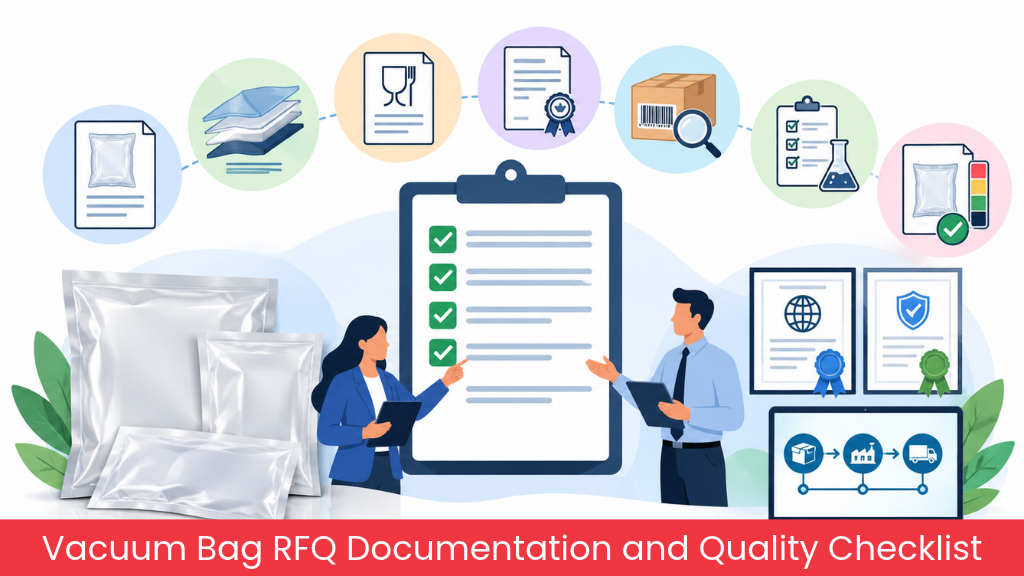
Identify every document your quality or regulatory team will need, then ask the supplier to confirm which it can provide for the quoted product. Typical requests include:
Vishakha PolyFab displays ISO and BRCGS Packaging Materials certification and describes SAP based product traceability.
Certification covers a management system within its stated scope and does not by itself confirm that a particular bag suits your product or your export market, so request product specific documentation where it is needed.
Before sending your enquiry, check that it covers:
Vishakha PolyFab manufactures flexible packaging for food, non-food and institutional use. Its VISHVACU range covers vacuum bags and pouches in various formats, barriers, thicknesses and print options.
Other products include VISHFORM, VISHTOP, VISHBARR, VISHLAMI, CPP and REGAIN films. The company also supports package design, customised solutions and field trials.
Complete vacuum bag specifications help buyers obtain comparable quotations and reduce clarification before ordering. An RFQ should identify the product, dimensions, thickness, barrier needs, processing conditions, printing, quantities and required documentation.
Clearly distinguish approved requirements from details needing a supplier recommendation. Share your brief with Vishakha PolyFab to discuss suitable options, and confirm the proposed specification, trial requirements and commercial terms before placing an order.
Yes. Send what you know about the product, process and volumes, and list the open items as requests for recommendation. Vishakha PolyFab can then review the application before quoting. Expect the first response to include clarifying questions or a proposed specification, and treat the price as provisional until the specification is agreed.
Send a physical sample of the current bag, its specification sheet and a note of what you want to change, whether cost, performance or supply security. Telling Vishakha PolyFab why you are switching helps the team decide whether a like-for-like match or an improved proposal is appropriate. Plan a line trial before full changeover.
List each size and design as a separate line with its own quantity and artwork reference. Ask Vishakha PolyFab whether common material across lines can be combined for production planning, and whether origination costs apply per design. Separate lines make it easier to compare unit prices and identify which SKUs carry the highest set-up cost.
You can ask for options, for example two gauges or two barrier levels, provided each is clearly labelled. Request that Vishakha PolyFab price each option separately and state its basis, so you are comparing defined specifications rather than a single figure with a range attached. Limit options to those you would genuinely trial.
Ask what changed, why, and what evidence supports the change for your product and process. If Vishakha PolyFab proposes an alternative structure, gauge or format, request the revised specification sheet and confirm whether samples or trials are needed. Record the agreed version so that future orders reference the approved specification, not the original enquiry.

Vishakha Polyfab Pvt. Ltd. is a global pioneer in high-barrier flexible packaging, specializing in advanced 9-layer co-extruded PA/EVOH-based films. Headquartered in Ahmedabad, India, the company utilizes world-class Brampton Engineering (Canada) and Aqua Frost® water-quenched technology to deliver superior shelf-life extension solutions. From Modified Atmosphere Packaging (MAP) to deep-draw thermoforming applications, Vishakha Polyfab delivers compliant, high-performance materials that protect product integrity throughout complex international supply chains. Their expertise in vacuum packaging, thermoforming, and lidding films helps enterprise-level brands in the food, pharmaceutical, and industrial sectors optimize packaging performance and sustainability.

Make Vishakha Polyfab the silent guardian of your products to preserve their vigour and enhance the quality of user interaction with them.
Sign Up for Our Newsletter
Corporate Head Office
Social Media
An ISO & BRCGS Certified Company

Manufacturing Address

