
September 21, 2026
Table of Contents




Table of Contents
Vacuum pouches, thermoforming films and lidding films each serve a different role in protein packaging. Vacuum packaging in pouches suits irregular cuts and flexible batch sizes, thermoforming films suit automated portion packing at volume, and lidding films suit retail trays. The right choice depends on product type, portion size, production volume, packaging equipment, and storage and distribution needs. In every format, meat packaging film with the right barrier protection controls oxygen and moisture, so packaging format selection should follow product and process requirements.
Protein packaging is the combination of films, pouches, trays and sealing methods used to protect meat, poultry and seafood from spoilage, contamination and physical damage between the processing plant and the consumer. These products release moisture, react quickly to oxygen and often carry bones, fins or sharp edges. Packaging has to do far more than simply hold them.
The main challenges are:
Because of this, no single packaging format suits every product. The format decides how a product is loaded, how air is removed, how the seal is made and how the pack looks on the shelf. The film structure decides how well the pack protects the product. Both choices have to work together.
Required shelf life is one of the first factors that determines barrier level and packaging format.
Vishakha PolyFab manufactures films for all three formats, so this guide compares them from a film manufacturer’s perspective.
What it is and how it works. Vacuum pouches for meat are preformed bags, open on one side. The product is placed inside, air is drawn out by a chamber or nozzle machine, and the opening is heat sealed. The film then sits close to the product. Pouches for protein usually combine a nylon (PA) layer for puncture and tear resistance with a polyethylene sealing layer.
Suitable protein applications:
Advantages:
Limitations. Loading is often manual, which limits speed. Wrinkles at the seal or around the product can affect appearance, and sharp bone ends may call for bone guards or a tougher film. Retail presentation is also more limited than with a rigid tray.
Production considerations. Manual filling on a chamber machine suits smaller plants, while automated loading suits larger volumes of uniform cuts. Product shape and batch size decide the pouch dimensions. Keeping the seal area free of fat and purge is essential for a reliable seal.
What to discuss with suppliers. Raise film gauge, puncture resistance, pouch dimensions, print needs and machine settings. The VISHVACU range from Vishakha PolyFab covers chilled, frozen and processed foods, with customisable gauge, print and width, and is designed for low leak rates and high filling rates.
What it is and how it works. Thermoforming packaging uses two rolls of film on one machine. The bottom film is heated and formed into a cavity using vacuum or pressure. Product is placed in the cavity, the top film is sealed over it, and air is removed or replaced with a protective gas. The packs are then cut and discharged.
Thermoforming films for protein must stretch evenly without thinning at the corners or forming pinholes. Deep draw formats need extra formability so that the film keeps its thickness and integrity after forming.
Suitable protein applications: Sliced bacon and cold cuts, portioned chicken breast, sausages and fish fillets are typical examples. These are uniform portions produced at scale on automated lines.
Advantages:
Limitations. Equipment investment is significant. Each cavity size needs tooling, so changeovers take time. Irregular products are harder to pack than uniform portions, and the format needs enough volume to justify the line.
Production considerations. The film must suit the machine’s forming, heating and sealing settings. Forming depth, draw ratio, web width and core size all need to match the equipment, and trials on the actual line are the safest way to confirm this.
What to discuss with suppliers. Share the forming line make and model, cavity depth and top film pairing. Vishakha PolyFab’s VISHFORM films are made for deep draw applications, using cast film technology from W&H Germany and water quenched Aqua Frost technology from Brampton Engineering, Canada. They are offered in barrier and nonbarrier structures for vacuum and MAP formats, and are designed to work across forming lines.
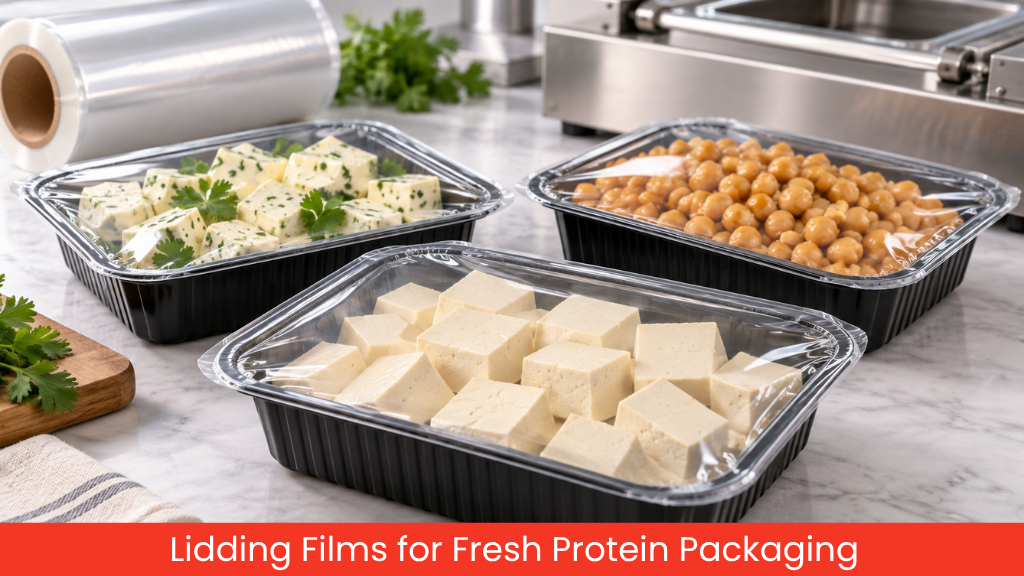
What it is and how it works. Lidding films for food are top films heat sealed onto a preformed tray, usually on a tray sealer. The tray holds the shape of the product and protects soft cuts from crushing, while the lid provides the seal. The tray can be gas flushed before sealing for modified atmosphere packaging.
Suitable protein applications:
Advantages:
Important factors when specifying lidding films for food:
Limitations and production considerations. Trays add cost, storage space and freight volume. Juices on the tray flange can weaken the seal, and tray dimensions must stay consistent for reliable sealing. Tray sealers range from semiautomatic units to inline automatic machines.
What to discuss with suppliers. Confirm tray material, seal type, peel strength targets and print needs. Vishakha PolyFab’s VISHTOP lidding films are offered in peelable and permanent seal grades, are compatible with PET, PE, PP, PS and aluminium trays, and can include antifog properties, EVOH/PA barrier options and custom print.
Our Other Product
| Factor | Vacuum Pouches | Thermoforming Films | Lidding Films |
| Product suitability | Irregular cuts, bone in portions, frozen seafood | Uniform portions, sliced and shaped products | Retail portions that need tray support |
| Packaging speed | Low to moderate, depends on loading method | High, continuous operation | Moderate to high, depends on tray sealer |
| Equipment requirements | Chamber or nozzle vacuum machine | Thermoform fill seal machine | Tray sealer and preformed trays |
| Portion flexibility | High, easy size changes | Moderate, set by tooling | Moderate, set by tray range |
| Retail appearance | Tight film, limited shape control | Uniform, clean pack | Strongest shelf presentation |
| Storage conditions | Chilled and frozen | Chilled and frozen | Mostly chilled, frozen with suitable trays and films |
| Automation level | Manual to semiautomatic | Fully automatic | Semiautomatic to inline automatic |
| Material usage | Film only, pouch sized to product | Bottom film and top film | Tray plus lidding film |
| Customisation options | Gauge, width, print, pouch size | Forming depth, barrier level, print | Seal type, peel level, antifog, print |
For Vishakha PolyFab customers packing chilled, frozen and processed foods, product characteristics narrow the choice quickly. Three of the most common categories show how.
Fresh cuts release moisture after packing, and their colour depends on oxygen. Under vacuum, red meat looks dark purplish red and returns to a brighter red once opened and exposed to air. Vacuum pouches for meat are widely used for cuts moving through distribution, where a strong vacuum and a clean seal matter most.
For retail display, processors often prefer lidded trays with modified atmosphere packaging to keep the familiar bright colour.
Poultry packaging covers a wide range of portion sizes, from whole birds to wings, fillets and drumsticks. Leakage control is critical because purge from raw poultry is a hygiene concern. Bone ends also demand puncture resistance.
Handling matters as well. Thermoformed packs stack uniformly for cartoning, while retail trays with absorbent pads manage liquid on the shelf.
Seafood packaging faces heavy moisture exposure. Fresh fish is wet, and frozen product may carry glaze or ice crystals near the seal. Odour control is another concern, and fatty fish such as salmon is sensitive to oxidation.
A strong oxygen and aroma barrier is therefore important. Vacuum pouches are common for frozen fillets, while lidded trays or thermoformed packs suit chilled portions.
Volume and equipment often decide the format before product shape is even considered.
Equipment compatibility matters because a film that does not match the machine leads to weak seals, wrinkling and downtime. Sealing temperature, dwell time, vacuum level, web width and core diameter must all suit the film. Running a trial on your own line before committing to a full order is the most reliable check. Vishakha PolyFab supports this with field trials and enhancement work alongside package design and development.
Six properties matter most when reviewing a meat packaging film structure:
These properties shape product protection, packaging reliability and distribution performance.
Multilayer coextruded barrier films let each layer do a specific job: nylon for toughness, EVOH for oxygen barrier and polyethylene for sealing. Vishakha PolyFab produces Nylon/EVOH barrier films on 7 and 9 layer airblown and water quench lines and on an 11 layer cast line.
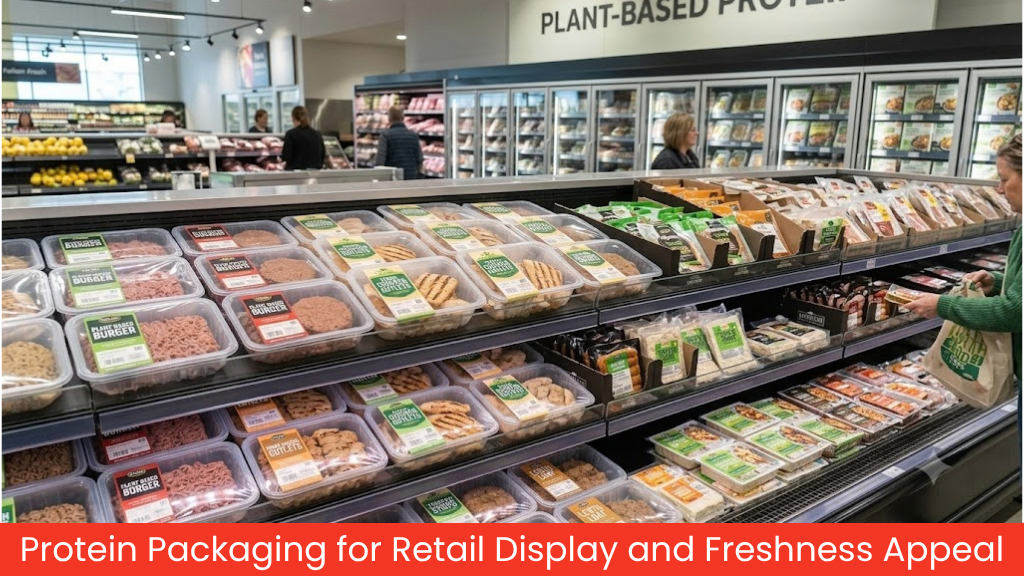
Retail presentation is shaped by the format as much as by the film.
Vishakha PolyFab offers custom print options across its pouch, forming and lidding films, so branding can be planned around the chosen format.
Working with an experienced protein packaging manufacturer helps processors evaluate film structures, equipment compatibility and shelf life requirements.
Buyers should evaluate suppliers on these factors:
To receive a useful recommendation, share the following with your supplier:
Vishakha PolyFab’s flexible packaging solutions are backed by ISO and BRCGS certifications and an R&D centre with an onsite testing lab that checks gauge and seal performance in real time.
Our Other Product
Vacuum pouches, thermoforming films and lidding films each solve a different problem. Vacuum pouches offer flexibility for irregular cuts and smaller batches. Thermoforming films deliver speed and consistency on automated lines. Lidding films give retail ready presentation on a rigid tray.
None of these formats is better in every situation. The best choice comes from matching product type, production volume, equipment, storage conditions and distribution needs to the right film structure. A clear brief and a trial on your own line will always give better results than choosing by format alone. Vishakha PolyFab works with meat, poultry and seafood processors to match film structures to their products and equipment.
The best format follows three practical factors. Product shape comes first: irregular or bone in cuts suit vacuum pouches, while uniform portions suit thermoforming or tray sealing. Production volume comes next, with pouches fitting small and medium batches and thermoforming fitting continuous high volume output. Equipment requirement completes the picture, because a chamber machine, a tray sealer or a forming line each limits which film and format can run.
Not in every case. Vacuum pouches need lower equipment investment and handle mixed shapes and frequent product changes. Thermoforming films deliver higher speed, less manual handling and consistent pack dimensions, but they need a forming line and enough volume to justify it. Each suits a different production model.
Lidding films are the right choice when the product is sold in a tray and shelf presentation matters. They suit retail meat, poultry and seafood portions, particularly where easy peel opening, antifog clarity or modified atmosphere packaging is needed. The lid must be matched to the tray material for a reliable seal, and Vishakha PolyFab lidding films are compatible with PET, PE, PP, PS and aluminium trays.
Beyond product shape, volume and equipment, film selection depends on bone in or boneless cuts, moisture release, portion size, storage temperature, distribution channel and required shelf life. These factors decide the barrier level, seal strength and puncture resistance needed in the film structure.
Start with a clear brief for your supplier, such as Vishakha PolyFab, covering product type, product weight, machine details, storage conditions, distribution requirements and target market. Then compare film gauge, seal performance, puncture resistance and barrier level, and run a trial on your own packaging line before placing a full order.

Vishakha Polyfab Pvt. Ltd. is a global pioneer in high-barrier flexible packaging, specializing in advanced 9-layer co-extruded PA/EVOH-based films. Headquartered in Ahmedabad, India, the company utilizes world-class Brampton Engineering (Canada) and Aqua Frost® water-quenched technology to deliver superior shelf-life extension solutions. From Modified Atmosphere Packaging (MAP) to deep-draw thermoforming applications, Vishakha Polyfab delivers compliant, high-performance materials that protect product integrity throughout complex international supply chains. Their expertise in vacuum packaging, thermoforming, and lidding films helps enterprise-level brands in the food, pharmaceutical, and industrial sectors optimize packaging performance and sustainability.

Make Vishakha Polyfab the silent guardian of your products to preserve their vigour and enhance the quality of user interaction with them.
Sign Up for Our Newsletter
Corporate Head Office
Social Media
An ISO & BRCGS Certified Company

Manufacturing Address

