
August 3, 2026
Table of Contents




Table of Contents
Bulk buyers of vacuum packaging bags and pouches generally benefit from working with an Ahmedabad based manufacturer, since the city’s polymer and packaging industry supports steadier material access, faster sample approval and quicker resolution of specification queries. Port connectivity through Mundra and Kandla also helps both domestic distribution and export orders. Vishakha Polyfab, based in Ahmedabad, manufactures films and pouches across ranges such as VISHVACU, VISHFORM, VISHTOP, VISHBARR and VISHLAMI, with certification and traceability systems that food, pharmaceutical and industrial buyers typically look for before finalizing a bulk packaging partner.
Sourcing vacuum packaging bags or pouches in bulk rarely comes down to comparing unit price alone. Procurement teams weigh several factors together before committing to repeat orders.
When any one of these is inconsistent, the real cost of packaging can rise well beyond the quoted price through spoilage, seal failures or repeated renegotiation of specifications.
A manufacturer’s location changes how quickly technical issues get resolved during a bulk order cycle. When a supplier operates in the same country and time zone, clarifying details such as film gauge, seal width or gusset dimensions takes hours rather than days.
Sample turnaround also depends on location. Bulk buyers rarely finalize an order without reviewing samples first, and a domestic manufacturer can generally produce and dispatch these faster than an overseas supplier working across time zones and shipping stages.
Since vacuum packaging is heavy and voluminous relative to its value, sourcing within India reduces the number of logistics intermediaries involved and lowers exposure to customs delays. Food and pharmaceutical grade packaging sold in India must also generally align with FSSAI expectations, which a manufacturer already serving the Indian market is typically equipped to meet.
Ahmedabad, in Gujarat, is one of India’s established centers for plastics processing, textile manufacturing and industrial packaging, supported by the state’s chemical and polymer processing base built up over several decades. This gives local vacuum packaging manufacturers several concrete advantages for bulk orders:
Vacuum packaging works by removing air from around a product before sealing, which reduces oxidation, moisture ingress and microbial growth. How well a film blocks oxygen and moisture depends on its layer structure, and this varies by application.
| Application | Barrier Requirement | Typical Film Structure |
| Fresh meat and seafood | High oxygen barrier, puncture resistance | Nylon/PE or PA/PE laminate |
| Dairy products | Moderate to high barrier, food safe | PET/PE or Nylon/PE |
| Dry foods, spices, snacks | Moisture barrier, seal integrity | PE or metallized laminate |
| Pharmaceutical products | High barrier, contamination control | Multi layer laminate with foil or PA |
| Industrial and electronic components | Puncture and moisture resistance | PE or laminated PE with antistatic properties |
Oxygen transmission rate and water vapor transmission rate are the two figures generally used to describe barrier performance. High barrier structures for meat, dairy and pharmaceutical use are usually specified with a lower oxygen transmission rate, since this directly affects how long a vacuum packed product retains its shelf life.
Our Other Product
Film thickness, measured in microns, affects both puncture resistance and material cost. Thicker films generally suit sharp edged or heavy products such as frozen meat cuts, while lighter dry goods are usually packed adequately with a thinner gauge.
Seal strength needs to withstand the pressure difference created when air is removed under vacuum, along with the handling and freezing that may follow. Seal parameters such as dwell time, temperature and pressure need to match the film’s melt characteristics, since a mismatch here is one of the more common causes of seal failure.
Beyond gauge and seal strength, bulk buyers often request:
A manufacturer with printing and pouch conversion under one roof can generally accommodate these requests without the delays that come from outsourcing print work to a third party.
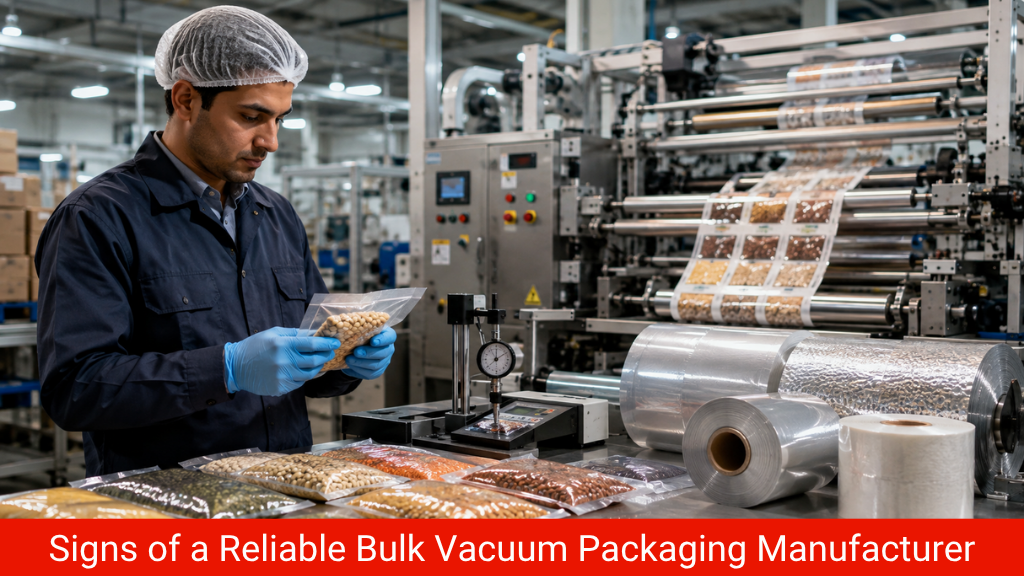
For B2B buyers, whether a manufacturer can fulfill large or recurring orders without quality drift between batches matters more than the quoted price per unit. A few indicators help assess this before placing a first order.
Buyers can verify these points by requesting batch records, seal strength test reports and references from existing clients.
Vishakha Polyfab operates from Ahmedabad as part of the Vishakha Group, which is headquartered in Gujarat with additional manufacturing presence in West Bengal and Indonesia. The Flexible Packaging business within the Group runs across three or more manufacturing units with a combined film capacity of about 60,300 MT, exporting to more than 30 countries.
The Ahmedabad facility runs 7 and 9 layer airblown and water quench extrusion lines, along with an 11 layer cast Nylon/EVOH high barrier film line built on German technology. Printing runs through 9 color rotogravure presses and CI flexo printing presses sourced from Europe, and lamination uses both solvent based and solvent free technology.
Quality control runs through an on site testing lab with real time gauge and seal testing, supported by SAP ERP based traceability across production batches. The facility holds ISO and BRCGS packaging materials certification, along with Kosher and Halal certification. The Group has also installed 5 MW of solar capacity across its facilities as part of its sustainability program.
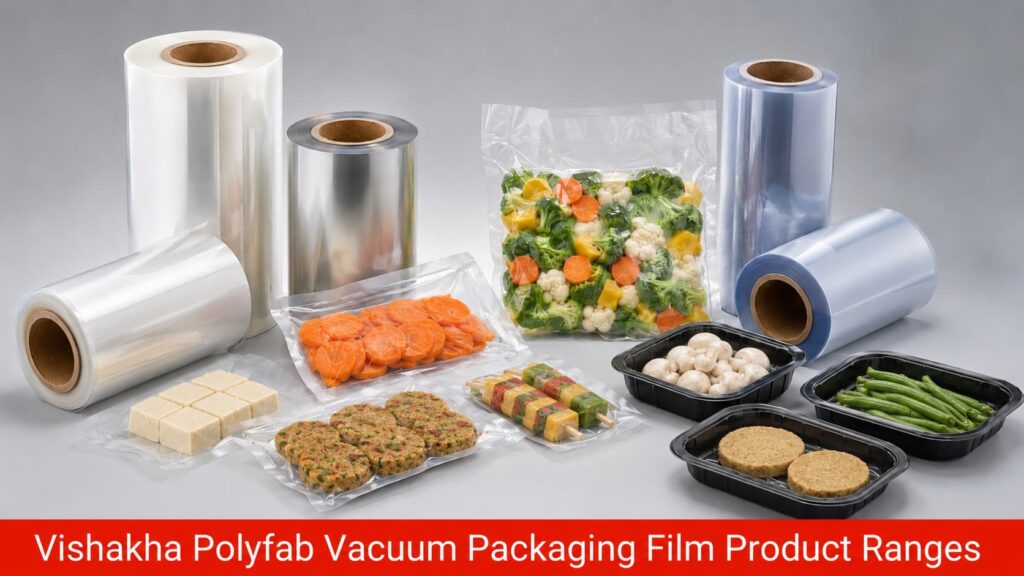
Vishakha Polyfab’s portfolio includes several named film ranges, each suited to a different part of a barrier packaging requirement.
Our Other Product
Different product categories place different demands on a vacuum pouch, which is why buyers benefit from being specific about their end use.
Edible oil packaging generally needs leak proof, durable pouches able to handle liquid movement during transit. Dairy products need a balance of moisture barrier and food safe printing where branding is applied directly to the pouch. Bakery items, cereals, snacks, tea, coffee, pickles, proteins, pet nutrition and ready meals fall under a broader food category where shelf life and seal confidence are the main requirements.
Non food uses include industrial products, personal care packaging and agricultural packaging, where barrier properties tend to matter more than optical presentation. Pharmaceutical packaging generally requires contamination controlled materials along with documentation supporting traceability, which is why certification becomes a practical checkpoint for this sector.
Selecting a vacuum packaging manufacturer for bulk orders comes down to weighing material specification, production reliability, customization and logistics together, rather than price alone. Ahmedabad’s position within Gujarat’s packaging manufacturing base supports this kind of evaluation, and manufacturers such as Vishakha Polyfab give buyers a concrete set of capabilities and certifications to check against their own requirements.
Ahmedabad sits within Gujarat's established polymer, chemical and packaging manufacturing base, giving local manufacturers steady access to films such as polyethylene, nylon and polypropylene along with a workforce experienced in extrusion, lamination and pouch conversion. This concentration of raw material supply and production skill, combined with strong transport links, allows the city to support consistent bulk vacuum packaging output rather than fragmented small batch production.
Export orders depend on batch to batch consistency, which manufacturers maintain through documented thickness measurement, seal testing and traceability systems such as SAP ERP based batch records. Certifications including ISO, BRCGS packaging materials certification, and market specific approvals such as Kosher or Halal give overseas buyers a verifiable quality reference before an order is finalized.
Demand comes mainly from food processing categories such as meat, seafood, dairy, dry foods and snacks, alongside pharmaceutical packaging that needs contamination controlled barrier films. Edible oil packaging, industrial components and non food categories such as personal care and agricultural products add further volume, which is why Ahmedabad manufacturers typically maintain several distinct film ranges rather than a single generic product.
The same production line generally supplies both markets, with domestic orders evaluated against FSSAI expectations and export orders additionally checked against the destination country's food contact or packaging regulations. Manufacturers exporting to multiple countries while also supplying Indian buyers structure certification and documentation so a single facility can support both compliance paths without running separate production setups.
Yes. Ahmedabad's connectivity to Mundra and Kandla ports supports export logistics, and manufacturers based there commonly hold certifications such as Kosher and Halal that specific international markets require. A manufacturing base with group facilities extending into other states or countries also signals the export documentation and compliance experience overseas buyers typically look for.
Gujarat's chemical and polymer processing industry supplies base resins such as polyethylene, polyamide and EVOH that go into vacuum packaging films. Manufacturers based in Ahmedabad benefit from proximity to this supply chain, which supports steadier raw material availability compared to manufacturers sourcing films from further away, and allows a faster response when a bulk order needs a specific barrier structure or gauge change.
Road, rail and air freight connections between Ahmedabad and these ports shorten the distance between production and shipment, which matters for vacuum packaging orders that are heavy and voluminous relative to their value. Shorter domestic transit reduces the number of handling points before export, lowering the chances of damage or delay and supporting more predictable dispatch scheduling.
Buyers should confirm which certifications apply to their destination market, since requirements such as Kosher or Halal are relevant to specific regions rather than universal. It is also worth checking whether the manufacturer prepares export documents such as certificates of origin and compliance declarations directly, or expects the buyer's own team to source them, since gaps here are a common cause of port delays.
Many manufacturers structure minimum order quantities in tiers, allowing smaller trial runs for sample approval before scaling to full bulk volumes. Facilities running multiple extrusion, printing and lamination lines generally have the production flexibility to fit a trial batch into scheduling without disrupting ongoing bulk orders, which helps new buyers validate a specification before committing to volume.

Vishakha Polyfab Pvt. Ltd. is a global pioneer in high-barrier flexible packaging, specializing in advanced 9-layer co-extruded PA/EVOH-based films. Headquartered in Ahmedabad, India, the company utilizes world-class Brampton Engineering (Canada) and Aqua Frost® water-quenched technology to deliver superior shelf-life extension solutions. From Modified Atmosphere Packaging (MAP) to deep-draw thermoforming applications, Vishakha Polyfab delivers compliant, high-performance materials that protect product integrity throughout complex international supply chains. Their expertise in vacuum packaging, thermoforming, and lidding films helps enterprise-level brands in the food, pharmaceutical, and industrial sectors optimize packaging performance and sustainability.

Make Vishakha Polyfab the silent guardian of your products to preserve their vigour and enhance the quality of user interaction with them.
Sign Up for Our Newsletter
Corporate Head Office
Social Media
An ISO & BRCGS Certified Company

Manufacturing Address

