
September 10, 2026
Table of Contents




Table of Contents
Laminated pouch defects include delamination, wrinkles, seal failure, leakage and printing faults. They rarely come from one cause. Film selection, adhesive performance, curing, printing conditions, sealing parameters, machine settings and handling practices all influence lamination quality, seal integrity and film performance. Identifying the visible defect, inspecting bond strength, seal strength and web condition, and tracing the fault to its stage of production allows quality and production teams to apply the correct corrective action and prevent repeat failures.
Laminated pouch defects are visible or measurable faults that reduce a pouch’s appearance, strength, barrier performance or machine runnability. Common examples are layer separation, wrinkles, weak seals, leaks, colour variation and film distortion.
A laminated pouch is a system, not a single film. A typical structure combines an outer print layer such as PET or nylon, a barrier layer such as EVOH or metallised film, and an inner sealant layer such as polyethylene or CPP. Adhesive and ink hold these layers together, so a weakness in one layer often appears as a defect in another.
That is why treating only the symptom rarely works. A leaking seal may reflect a low sealing temperature, but it may equally come from a wrinkle created during lamination or from product contamination. Root cause analysis means tracing the defect back through film selection, printing, lamination, pouch making, filling and transport.
Vishakha PolyFab produces films through extrusion, rotogravure and flexo printing, solvent based and solventless lamination, and pouching. Because defects often begin where these stages meet, the sections below start with the visible defect and work back to its likely cause.
Laminated pouch delamination is the separation of bonded layers in the film structure. It appears as blisters, tunnels, silvery air patches or layers that peel apart by hand, often near the seal or at the edges. Once the bond weakens, the pouch loses strength and barrier performance, and printed ink may lift with the outer layer.
Inspection points: Measure T peel or ply adhesion in N per 15 mm at several positions across the web, before and after curing and after product contact. Check visually for tunnels and bubbles, and test residual solvent where relevant.
Corrective actions and prevention: Verify mix ratio, coat weight and surface treatment level, follow the full curing schedule and hold rolls until bond strength meets the specification. Vishakha PolyFab runs both solvent based and solventless lamination, and its VISHLAMI films are designed for bond strength and ink adhesion across these processes.
Example: An edible oil pouch may separate near the seal when oil migrates into the adhesive line, while a dry snack pouch more often fails because lamination was released before curing was complete.
Laminated film wrinkles are ridges, creases or waves in the film. They may run along the web, appear only at the edges or form diagonal creases. Wrinkles spoil pouch appearance, disturb print registration and can cause feeding and sealing problems on filling machines.
Inspection and prevention: Check gauge profile, roll hardness and edge condition on receipt. Record tension settings for each structure, keep roller alignment on the maintenance schedule and store rolls on cores or in cradles in controlled conditions. Vishakha PolyFab applies real time gauge testing in its quality systems to help control thickness variation.
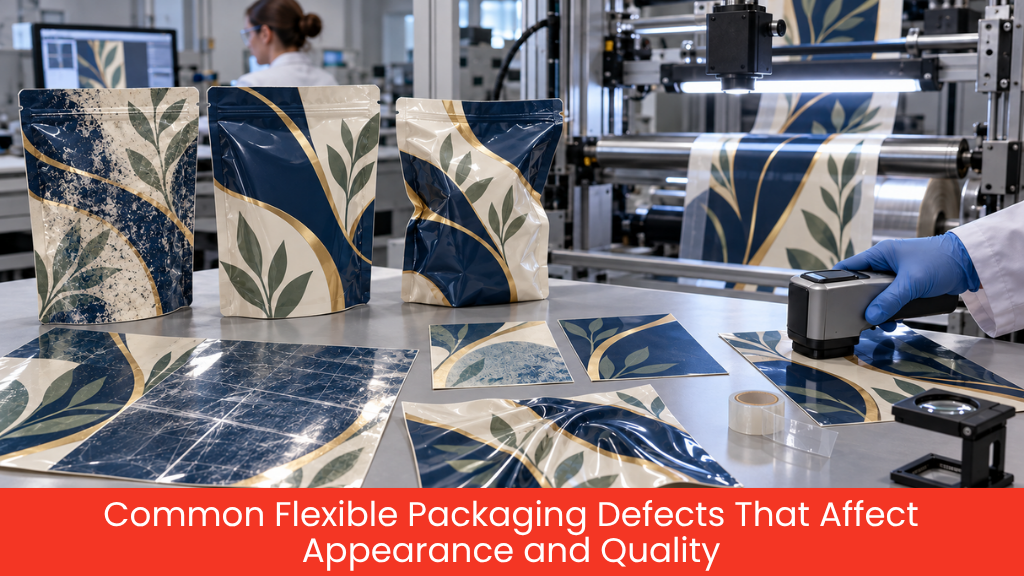
Pouch seal failure covers weak seals, open seals, incomplete sealing and contaminated seals. A weak seal may pass a visual check but open under a drop or internal pressure. Open or channel seals leak immediately, while powder, oil or product streaks in the seal area reduce seal strength.
Inspection points: Test seal strength (for example, ASTM F88), use burst or bubble emission tests for integrity and inspect seal width and appearance under light.
Corrective actions: Establish the sealing temperature window first, then adjust pressure and dwell time in small steps. Clean and service the jaws, control product falling into the seal and choose a sealant that tolerates contamination where needed. For pharmaceutical sachets on form fill seal lines, high hot tack CPP grades, such as those in the Vishakha PolyFab CPP range, support fast, reliable sealing.
Our Other Product
Pouch leakage causes fall into four groups: seal area leaks, pinholes, punctures and handling damage.
Inspection and prevention: Locate the leak first, since a seal leak, a fold leak and a film puncture need different fixes. Use vacuum, dye or bubble leak tests, together with drop and compression tests on retained samples. Polyamide based structures such as the PA/EVOH films in Vishakha PolyFab’s VISHVACU vacuum pouches offer higher puncture resistance than thin polyolefin films, and bone guards or rounded corners reduce piercing.
Many defects that look like film problems start at the pouch making or filling machine. The same laminate can run well on one line and fail on another.
Sealing temperature and line speed must be balanced. Raising temperature to keep up with speed can overheat the outer layer and cause curl, shrinkage or print damage, while a cooler jaw at high speed leaves a weak seal.
Jaw pressure must be even across the full seal width. Excess pressure squeezes molten sealant out of the joint and thins it, while low pressure leaves unfused channels around wrinkles.
Filling speed decides how much product reaches the seal area. Fast drops of powder, liquid or granules can splash into the jaws, and seals may open before they cool if hot tack is too low for the speed.
Web alignment controls pouch length, print registration and wrinkle formation. A web that tracks off centre can carry a crease into the seal or cut through printed areas.
Pouch handling after sealing also matters. Rough transfers, tight stacking of warm pouches and static build up can scuff film, distort seals or cause leaks. Recording machine settings for each film structure gives quality teams a baseline for comparing good and defective runs. Vishakha PolyFab converts customised pouch formats on a wide range of pouch making machines, and the same principle applies: settings must be matched to each format and film structure.
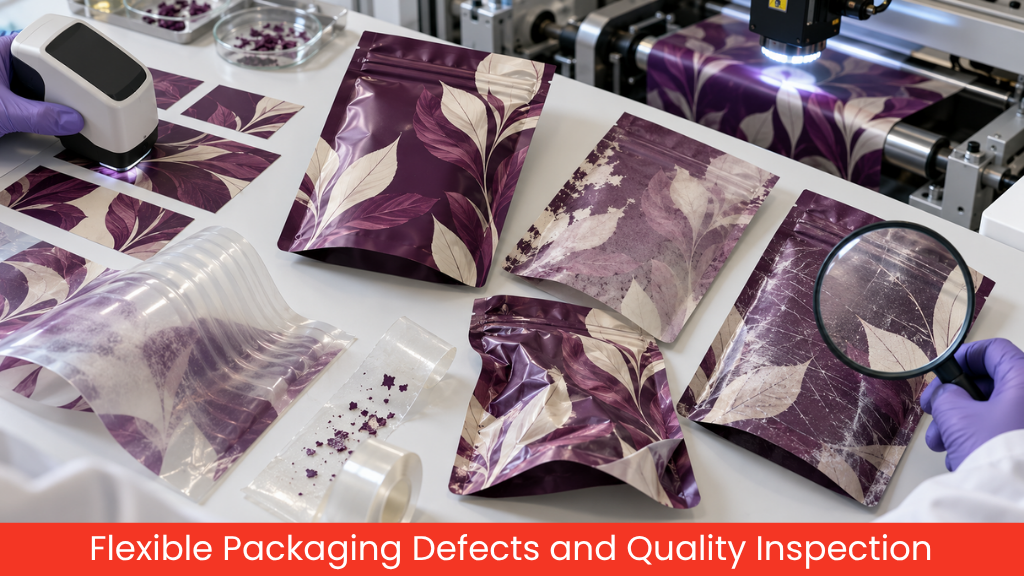
Flexible packaging defects also include faults that affect appearance and shelf presence.
Camera based print inspection, gauge scanning and laboratory checks of bond and seal strength help detect drift before defective rolls reach the filling line. Vishakha PolyFab prints on nine colour rotogravure and CI flexo presses and supports these checks with an in house testing laboratory.
Use this table for laminated pouch troubleshooting on the production floor.
Defect | Likely Cause | Inspection Point | Corrective Action |
Delamination | Wrong adhesive ratio, undercuring, poor surface treatment | T peel strength across the web, tunnels and blisters | Verify mix ratio and coat weight, complete curing, check treatment level |
Wrinkles | Web tension imbalance, gauge variation, misaligned rollers | Roll profile, tension records, roller alignment | Rebalance tension, realign rollers, review roll storage |
Weak seals | Low temperature, low pressure, short dwell time, wrong sealant | Seal strength, seal width, jaw condition | Set the sealing window, service jaws, confirm sealant layer |
Leakage | Contaminated seals, pinholes, punctures, transport stress | Bubble or dye test, drop test, leak location | Keep seals clean, improve puncture resistance, validate transit |
Printing defects | Poor ink adhesion, wrong ink viscosity, loss of surface treatment | Tape test, rub test, colour measurement, registration | Check treatment, ink system and drying, recalibrate the press |
Film deformation | Heat exposure, shrinkage difference between layers, uneven tension | Pouch curl and flatness after sealing | Adjust temperature, match layer shrinkage, control tension |
Adhesive failure | Chemical attack from product, residual solvent, low coat weight | Bond strength after product contact, residual solvent | Change adhesive system, improve drying, adjust coat weight |
Prevention starts with film selection. The structure should match the product, fill temperature, shelf life and sealing process. Vishakha PolyFab’s VISHLAMI films, for example, offer customisable thickness, surface treatment and seal layers, which gives packaging teams room to match the structure to the application.
Lamination and adhesive control come next. Record coat weight, mix ratio and curing conditions for every batch, confirm bond strength before dispatch and retest after product contact. Sealing parameters need the same discipline: document the sealing window for each structure and verify it at every changeover.
People and checks complete the system. Operators who recognise early signs such as seal discolouration, edge wrinkles and print shift can stop a run before defects multiply. Regular inspection of incoming rolls, in process pouches and finished packs catches small drifts early.
A complete technical brief helps identify whether a defect lies in the film, the process or the application. Working with an experienced laminated pouch manufacturer is most effective when the following information is available.
Product and structure: Share the contents, fat or acid level, fill temperature, shelf life target, pouch structure, layer details, gauge and sealant type. Include the lamination date, adhesive system and curing period if known.
Printing and machines: Provide colour count, ink type and coverage, plus the pouch or filling machine model, speed and sealing settings. Add production conditions such as temperature, humidity and recent changeovers.
Evidence and logistics: Send defect images and samples of both defective and good pouches from the same batch. Describe warehouse conditions, pallet stacking and the shipping route, since many failures develop after the pack leaves the plant.
With clear evidence and process records, an experienced flexible packaging manufacturer can evaluate whether the issue originates from film structure, lamination, pouch conversion or filling conditions, and recommend the right change instead of guessing. Vishakha PolyFab’s R&D centre supports custom development, and a complete brief shortens the path to a suitable structure.
Our Other Product
Delamination usually results from an incorrect adhesive mix ratio, insufficient curing, poor surface treatment, low coat weight, residual solvent or product contents that attack the adhesive. Measuring T peel strength at several positions helps locate the cause.
Seals fail when sealing temperature, pressure or dwell time falls outside the working window, when the sealant layer does not suit the product, or when powder, oil or wrinkles interfere with the seal area. Worn jaws and misaligned pouches add to the problem.
Wrinkles spoil pouch appearance, disturb print registration and cause feeding problems on filling machines. When a wrinkle runs into the seal, it can leave an unfused channel that leaks.
Common flexible packaging defects include delamination, wrinkles, weak or open seals, leakage, pinholes, printing faults, colour variation, surface scratches and film curl.
They identify the visible defect and where it occurs, then test bond strength, seal strength and gauge on defective and good samples. Results are compared with adhesive, printing, sealing and machine records to find the stage at fault.
Laminated pouch defects such as delamination, wrinkles, seal failure and leakage seldom have a single cause. Reliable results come from a suitable film structure, controlled lamination and printing, correct machine settings and clear communication between buyer and supplier. Regular bond testing, seal validation and production monitoring help identify issues before they affect large production batches.
Vishakha PolyFab supports this approach through in house testing, package design and field trials, helping packaging teams select suitable film structures and improve consistency across production applications.

Vishakha Polyfab Pvt. Ltd. is a global pioneer in high-barrier flexible packaging, specializing in advanced 9-layer co-extruded PA/EVOH-based films. Headquartered in Ahmedabad, India, the company utilizes world-class Brampton Engineering (Canada) and Aqua Frost® water-quenched technology to deliver superior shelf-life extension solutions. From Modified Atmosphere Packaging (MAP) to deep-draw thermoforming applications, Vishakha Polyfab delivers compliant, high-performance materials that protect product integrity throughout complex international supply chains. Their expertise in vacuum packaging, thermoforming, and lidding films helps enterprise-level brands in the food, pharmaceutical, and industrial sectors optimize packaging performance and sustainability.

Make Vishakha Polyfab the silent guardian of your products to preserve their vigour and enhance the quality of user interaction with them.
Sign Up for Our Newsletter
Corporate Head Office
Social Media
An ISO & BRCGS Certified Company


Manufacturing Address

